
Donald Trump’s latest health evaluation has raised eyebrows among medical professionals, who suggest the report appears overly optimistic and lacks crucial details.
The former President underwent this assessment last Tuesday at Walter Reed National Military Medical Center. Trump referred to this as a routine ‘six-month physical,’ later boasting on social media that the results were ‘PERFECT.’
The White House delayed releasing the exam’s findings more than usual, intensifying speculation about the 79-year-old Trump. Observers have scrutinized him for visible hand bruises, ankle swelling, and rumors of cognitive decline.
Jonathan Reiner, a cardiologist who once treated former Vice President Dick Cheney, voiced skepticism on social media, suggesting the delay in releasing the medical results might indicate there’s something the public is not being told.
Three days post-examination, the White House shared a statement from Trump’s physician, US Navy Captain Sean Barbarella. It asserted that Trump is in ‘excellent health,’ with robust cardiac, pulmonary, neurological, and general physical performance.
The health report outlined Trump’s vital signs, detailed various scans, and offered minor recommendations for preventive measures.
The President was listed at 75 inches, 238 pounds – 14 pounds heavier than last year – but with a healthy resting heart rate and normal blood pressure. He takes two cholesterol medications and aspirin for his heart, per the report.
‘That report is almost too good to be true for somebody of his age,’ Texas vascular surgeon David Shutze told the Wall Street Journal. ‘This seems to be a filtered narrative.’
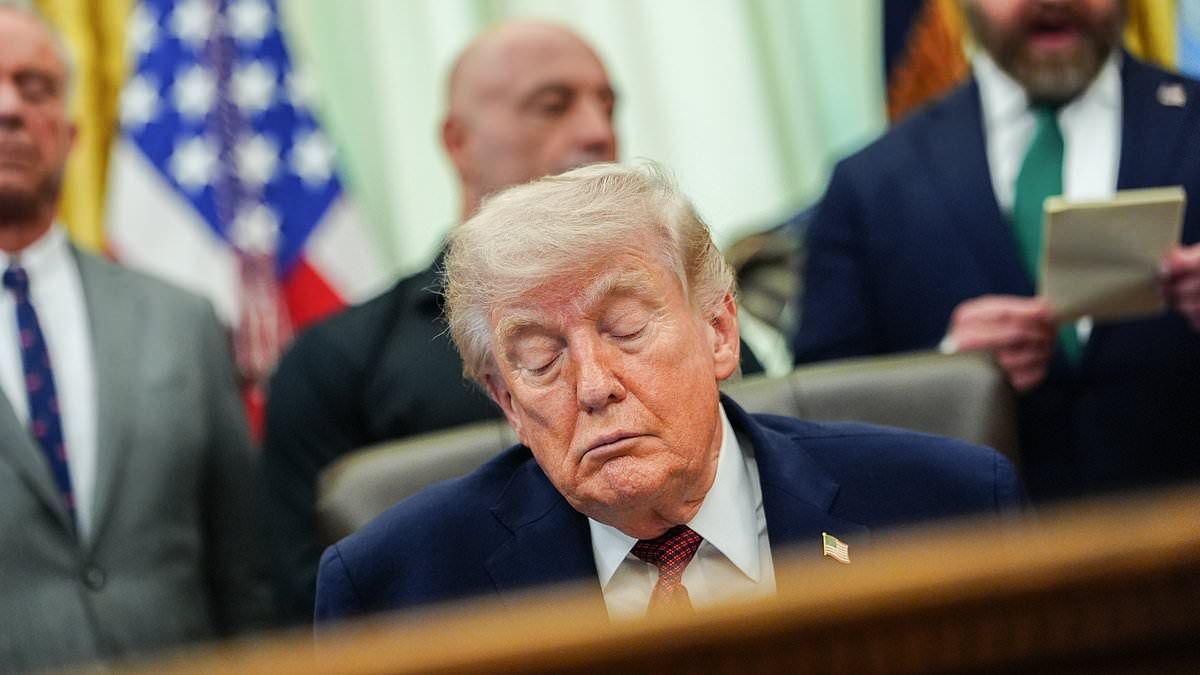
President Trump closes his eyes in the Oval Office on April 18
The White House has attributed the bruising to frequent handshakes and regular aspirin usage (pictured in Davos, Switzerland, on January 22)
Trump, 79, is the oldest person ever elected to the presidency, beating his predecessor Joe Biden by some five months.
Presidents are not obligated to release their medical information to the public.
However, Trump has faced increased political pressure to publish his records after making Biden’s health a cornerstone of his presidential campaign, lashing his rival as ‘Sleepy Joe’ for failing to take a cognitive test.
Shutze disparaged the report’s tendency to affirm Trump’s health without providing specific data which would support Barbarella’s claims.
Reiner pointed out that multiple of the tests mentioned in the White House report had been performed on Trump recently enough that repeating them is unusual.
Barbarella’s report also referenced an AI analysis of an echocardiogram that found Trump’s ‘cardiac age’ to be fifteen years younger than his actual age.
This AI evaluation ‘is not a clinically utilized tool,’ Reiner said.
Several previous issues have raised eyebrows around the President’s health, even as he prides himself on being unusually fit for his age.

Trump has at times used makeup and bandages to conceal the bruising on his hand (pictured at the White House on May 6)
Join the discussion
Are doctors right to question the White House summary?
Trump’s hands frequently appear bruised, and at times he has used makeup or bandages in an attempt to hide this.
The President and those in his orbit have attributed the bruising to frequent handshaking and the effects of regular doses of aspirin, a blood thinner.
Last year, after photos showed swelling in the President’s lower legs, it was revealed that he suffers from chronic venous insufficiency, a common circulatory problem in older patients.
Barbarella’s report noted that the swelling has improved without going into detail about why or how much.
The White House said the omission of detailed scan results is typical in an ‘executive summary’ like this report.
White House director of communications Steven Cheung blasted ‘outside doctors wildly speculating about an individual’s health.’
‘President Trump has publicly released more detailed information about his health than any other president in history,’ Cheung added.


