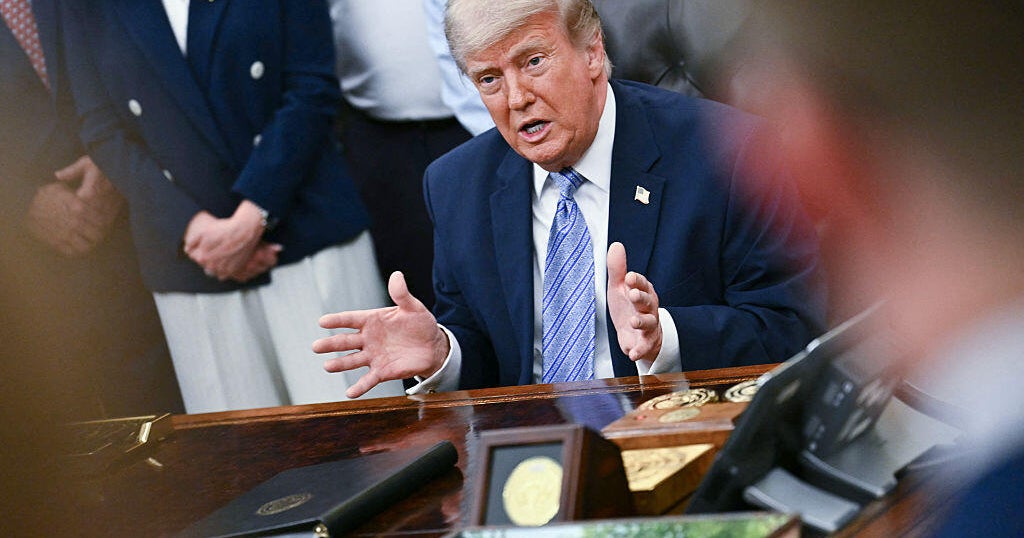

Washington — In a move aimed at bolstering both the security and innovation of artificial intelligence, President Trump has signed an executive order encouraging AI companies to voluntarily share their cutting-edge models with the government prior to their public release.
Initially, the president hesitated to sign the order almost two weeks ago, expressing concerns that it might hinder the United States’ competitive edge over China and other nations in the AI sector. However, the finalized executive order, signed on Tuesday, underscores the administration’s commitment to maintaining America’s leadership in AI by ensuring that regulation does not become a barrier to innovation. As the order states, “The United States continues to lead the world in Artificial Intelligence (AI) because of the enormous talent and innovation of our AI industry, and because we refuse to stifle this innovation with overly burdensome regulation.”
The directive focuses on enhancing federal cybersecurity systems through AI and developing a classified benchmarking process to pinpoint “frontier” models—those at the cutting edge of AI technology. It also invites AI companies to voluntarily collaborate by allowing the government access to these advanced models for up to 30 days before they are widely released.
The potential of these frontier models to uncover long-ignored software vulnerabilities has sparked worries about their misuse in cyberattacks. In response to such concerns, Anthropic, a prominent AI lab, disclosed in April that it would grant select partners early access to its new model, Mythos, to strengthen their cybersecurity measures before the model’s broader availability.
Emphasizing the cooperative nature of this initiative, the executive order clarifies that any collaboration with the federal government remains voluntary and reassures that it will not impede AI companies from pursuing technological advancements.
The president’s executive order emphasizes the voluntary nature of any AI company collaboration with the federal government, and that it doesn’t prohibit AI innovators from advancing their technology.
“Nothing in this section shall be construed to authorize the creation of a mandatory governmental licensing, preclearance, or permitting requirement for the development, publication, release, or distribution of new AI models, including frontier models,” the order says.
On cybersecurity concerns, the executive order calls on the homeland security secretary to establish and expand federal cybersecurity programs that enhance AI defensive tools. It also calls on the treasury secretary, defense secretary, director of the National Security Agency and homeland security secretary, working with AI operators, to set up an AI cybersecurity clearance house to look for software vulnerabilities.
The White House never released the original draft the president was previously expected to sign. But Mr. Trump offered an explanation for why he didn’t sign it.
“Because I didn’t like certain aspects of it, I postponed it,” Mr. Trump said at the time. “I think it gets in the way of, you know, we’re leading China, we’re leading everybody, and I don’t want to do anything that’s going to get in the way of that lead.”