

Millions of Americans who depend on Social Security may face a significant reduction in their monthly benefits, potentially averaging a $500 cut, if the retirement trust fund becomes insolvent. This scenario is projected to occur by the end of 2032.
According to a recent analysis from the Committee for a Responsible Federal Budget, a fiscal policy think tank, this reduction would translate to a 24% decrease in the average benefit payment.
The Social Security trust fund plays a critical role in bridging the gap between the program’s income and its financial obligations. However, as the baby boomer generation continues to retire, the number of beneficiaries has surged, outpacing the revenue generated. If this fund runs dry, benefit payments would automatically decrease unless Congress intervenes to secure the program’s financial future.
The analysis reveals that between 10% and 23% of each state’s population would be affected by these cuts.
“No state would escape the potentially devastating effects of insolvency,” the report warns.
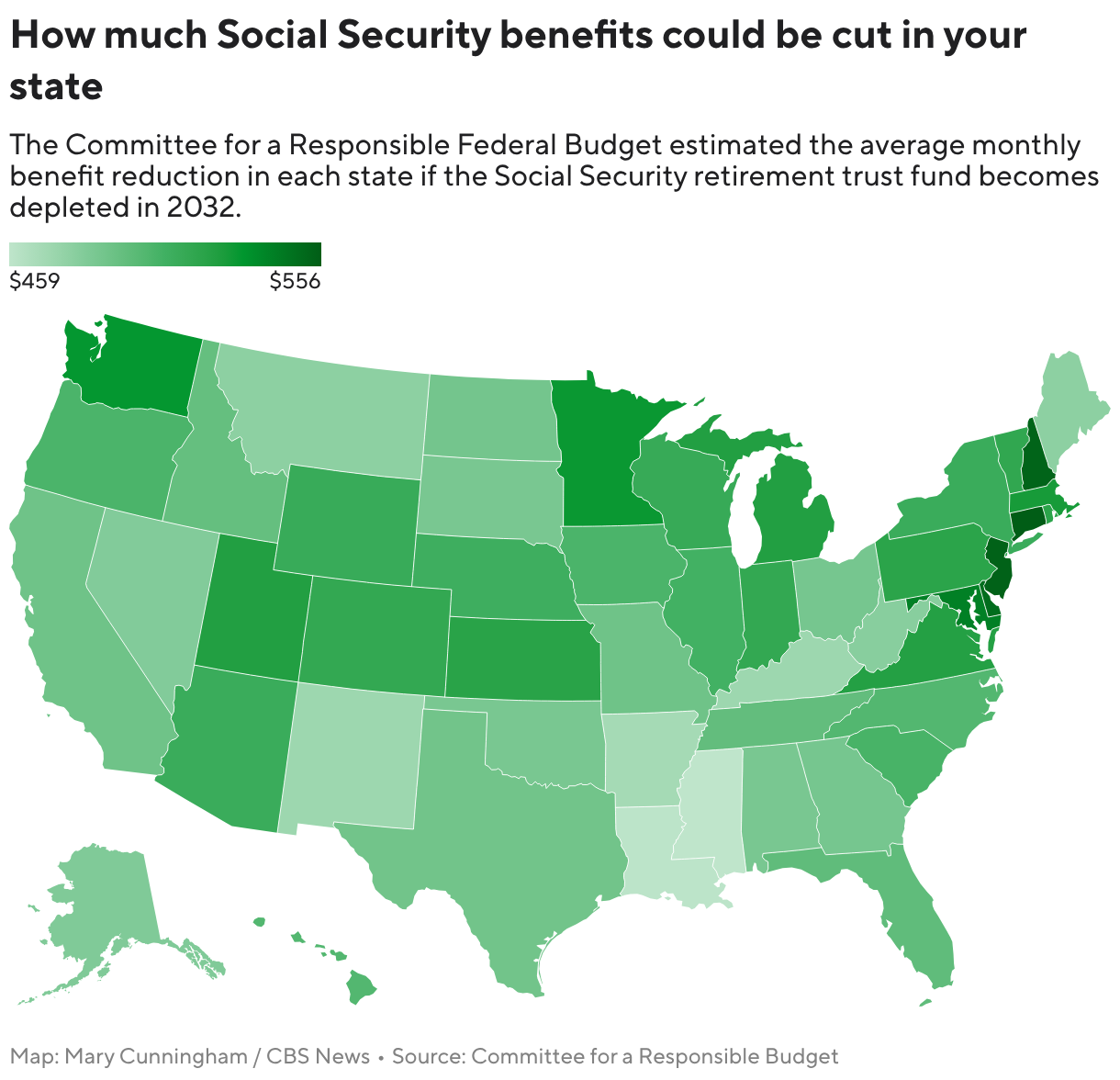
States anticipated to experience the most substantial monthly benefit reductions include:
- Connecticut, with an average $556 cut
- Delaware, $549
- Maryland, $541
- Massachusetts, $527
- Michigan, $523
- Minnesota, $530
- New Hampshire, $553
- New Jersey, $554
- Utah, $523
- Washington, $531
Insolvency does not mean Social Security beneficiaries would stop receiving payments altogether. Even after trust fund reserves are depleted, the program would continue collecting payroll tax revenue, allowing it to pay benefits at a reduced level.
Key report coming soon
The new analysis comes ahead of this year’s release of the Social Security Administration’s annual Trustees Report, which will provide an updated estimate of when the agency’s trust fund is projected to become insolvent. The report is expected to be released in the coming weeks.
Last year’s report projected an insolvency date of 2033 for one of the agency’s two key trust funds, known as the Old-Age & Survivors Insurance Trust Fund (OASI). At that point, the program would only be able to pay 77% of the current benefit amount, according to the Social Security Administration.
The agency has since moved the insolvency date for OASI to the end of 2032, citing the One Big Beautiful Bill Act’s effect on taxation of benefits.
Social Security cuts would prove devastating for the nation’s retirees, as many rely heavily on the monthly payments, experts say. According to a survey released last year by the Senior Citizens League, a nonprofit advocacy group, 73% of retirees depend on Social Security for more than half their income, while 39% depend on it for the entirety of their income.
Solving Social Security’s funding issues would require action from policymakers. One such proposal would be to eliminate the income cap on the payroll tax, which exempts people who earn more than $184,500 from paying Social Security taxes on any amount above that.