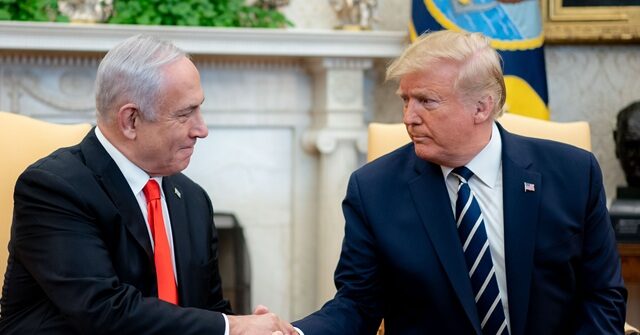

In a forward-looking move, Republican Representatives Marlin Stutzman of Indiana and Abe Hamadeh of Arizona have proposed a resolution aimed at transforming the nature of the United States’ relationship with Israel. The plan involves a gradual cessation of the $3.8 billion annual U.S. military aid to Israel, pivoting instead toward a partnership grounded in trade, technology, and strategic collaboration. This innovative proposal has garnered the endorsement of Israeli Prime Minister Benjamin Netanyahu.
The resolution, which was introduced to Congress on Wednesday, is nonbinding but carries significant implications for future U.S.-Israel relations. It advocates for the two nations to draft a new memorandum of understanding before the current decade-long military aid agreement concludes in 2028. The plan suggests a transition from direct military assistance to a collaborative framework emphasizing joint defense initiatives, co-development, co-production, and reciprocal investment.
Netanyahu’s support for this initiative is noteworthy. After a meeting with Stutzman and Hamadeh in Jerusalem on May 27, the Israeli Prime Minister expressed his approval in a letter dated June 1. In his communication, Netanyahu articulated his backing for the resolution’s vision, which seeks to redefine the bilateral relationship from one reliant on aid to one built on partnership.
“Israel deeply appreciates the financial component of the military aid the United States has generously provided us over the years,” Netanyahu wrote, underscoring the gratitude for past support while signaling a readiness for change. “The time has now arrived for us to move from aid recipient to partner,” he concluded, marking a pivotal moment in the evolution of U.S.-Israel ties.
“Israel deeply appreciates the financial component of the military aid the United States has generously provided us over the years,” Netanyahu wrote.
“The time has now arrived for us to move from aid recipient to partner.”
Netanyahu added that he was encouraged by the proposal’s call for a new framework of “joint defense cooperation, codevelopment, coproduction and mutual investment in areas including advanced missile defense, artificial intelligence, unmanned systems, cybersecurity and next generation military platforms.”
Stutzman said the proposal reflects both Israel’s growing economic strength and the evolving nature of the alliance between Jerusalem and Washington.
“The idea is to take the relationship between two great allies, the United States and Israel, to a more mature relationship with a trade agreement, a defense agreement, rather than supplemental aid from the United States to Israel,” Stutzman told the Jerusalem Post.
Recalling his recent meeting with Netanyahu, Stutzman said the prime minister emphasized that Israel’s economy is approaching $1 trillion in gross domestic product and that the country is increasingly capable of standing on its own.
“Israel is a superpower in the Middle East,” Stutzman said. “I can’t think of a greater ally to the United States than Israel.”
Netanyahu has publicly advocated reducing Israel’s reliance on American military aid for more than a year, arguing that Israel’s growing economic and technological strength makes a transition toward a more equal partnership both possible and desirable.
In a CBS News interview last month, Netanyahu said he wanted to “draw down to zero” the financial component of U.S. military assistance.
“It’s time that we wean ourselves from the remaining military support,” he said, adding that he wanted the process to begin immediately and unfold over the next decade.
Promoting the resolution on Wednesday, Hamadeh described the proposal as the next phase of the U.S.-Israel relationship.
“Thanks to President Trump and the Abraham Accords, America and Israel are shifting from aid to a true strategic partnership in economic cooperation and defense innovation,” Hamadeh wrote on X.
“The next chapter is here: Aid to Trade.”
The proposal aligns with broader discussions already underway regarding the next U.S.-Israel memorandum of understanding.
U.S. Ambassador to Israel Mike Huckabee indicated this week that a future agreement could move in that direction, writing on X that a new MOU with Israel “ends aid & will be based on trade.”
The current U.S.-Israel memorandum of understanding, signed in 2016, provides Israel with $38 billion in military assistance over a ten-year period and expires in 2028.
While Stutzman’s resolution would not alter that agreement, supporters argue it lays the groundwork for a future relationship built less on direct assistance and more on shared strategic interests, defense cooperation, technological innovation, and trade.