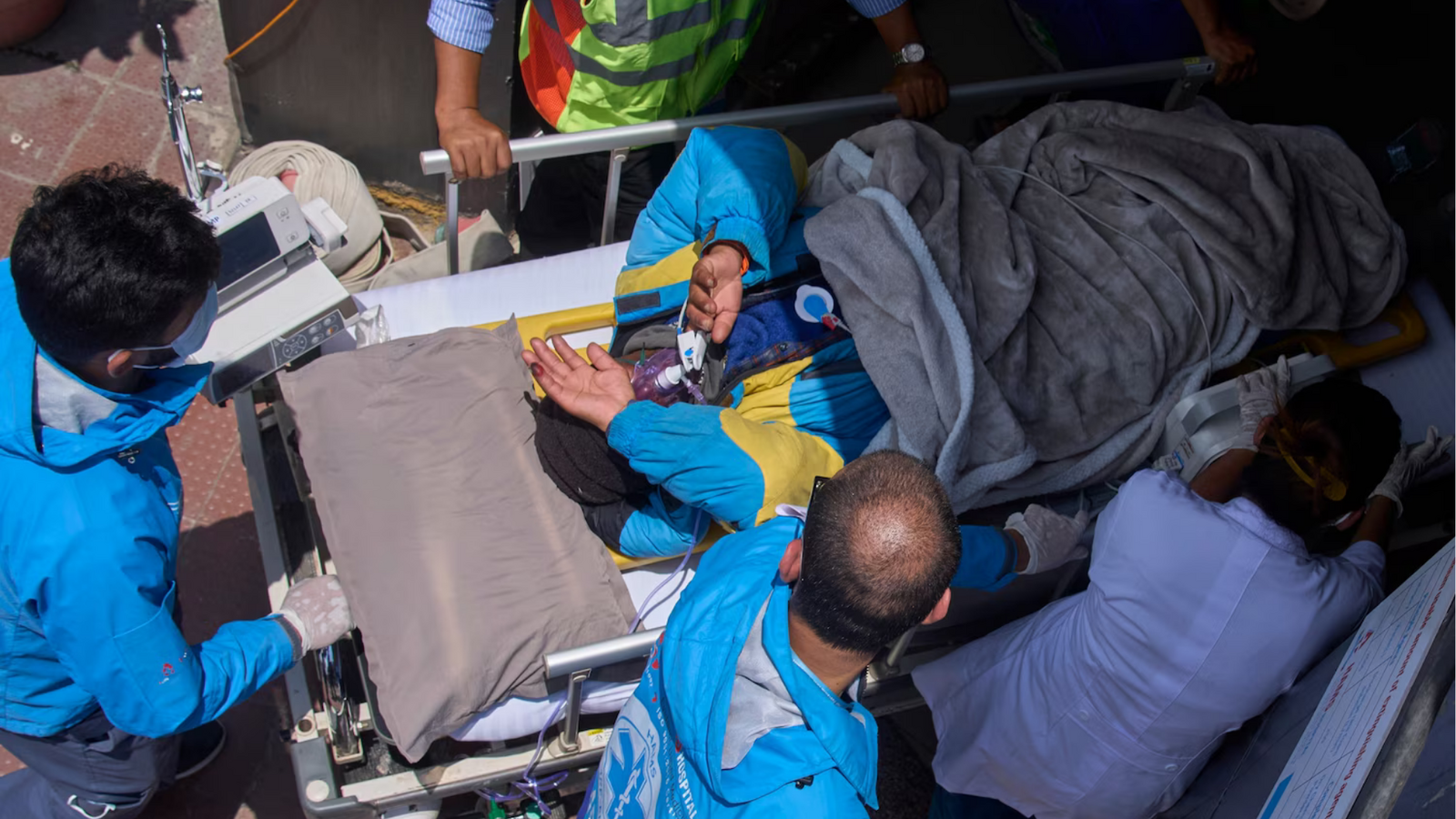

A Sherpa guide, who remarkably endured a week on Mount Everest’s perilous slopes, is on the mend at a Kathmandu hospital, as his family pursues legal action over what they allege was a delayed rescue response.
On Thursday, Dawa Sherpa was discovered crawling through the snow near the Khumbu Icefall, just above Everest’s base camp, a surprising find a week after he was reported missing. The 57-year-old was airlifted to Nepal’s capital, where he reunited with his family. According to a statement from HAMS Hospital, Dawa is being treated for frostbite, dehydration, and thigh issues, but he is stable and on the road to recovery.
His family has expressed frustration over the perceived delay in rescue efforts, filing a police complaint against Dawa’s employer, Himalayan Traverse, a company based in Kathmandu, as well as lodging a grievance with the Department of Tourism, which oversees mountaineering activities in Nepal.
“The mountaineering department needs to take action,” said Karma Gelje Sherpa, Dawa’s nephew. He criticized the company’s apparent negligence, which he believes led to the slow initiation of rescue operations. “Had Dawa been a foreign climber, the rescue would have been organized more swiftly. Unfortunately, as an older Nepali, he was not given the same urgency.”
Attempts to contact Himalayan Traverse for comment on Friday were unsuccessful.
Dawa was last seen around May 29 while descending Everest. He failed to reach base camp, unlike the two foreign climbers accompanying him, who successfully made it back. They were among the final climbers of the season, as the climbing routes were being closed down.
Dawa’s last location was a spot called Yellow Band above the Camp 3, which is located at 7,200 meters (23,622 feet). The base camp is at 5,300 meters (17,388 feet).
Dawa was last seen with British climber Chris Thrall and a Polish climber identified by local media as Mariusz Chmielewski. Thrall said in his Instagram post that he had to help the Polish climber down the mountain because he was in bad shape and had frostbites.
“He (Dawa) had been in death zone for 19 hours and at that point, a decision was made that we needed to descent through the Icefall,” he said earlier this week, explaining why he did not go up the mountain to look for Dawa.
When helicopters were finally sent to look for him, they could not find him.
It was not clear why the men were on the mountain when authorities had removed the ladders on the path on May 29.
Dawa’s family had already given up hope and they were on the second day of a funeral ritual, which lasts for several days.
The team that spotted him was part of the Sagarmatha Pollution Control Committee, which lays the ladders and ropes on the route at the start of each climbing season and then removes the equipment and cleans up the site after climbers have left.
The video in the player above is from a previous report.
Copyright © 2026 by The Associated Press. All Rights Reserved.