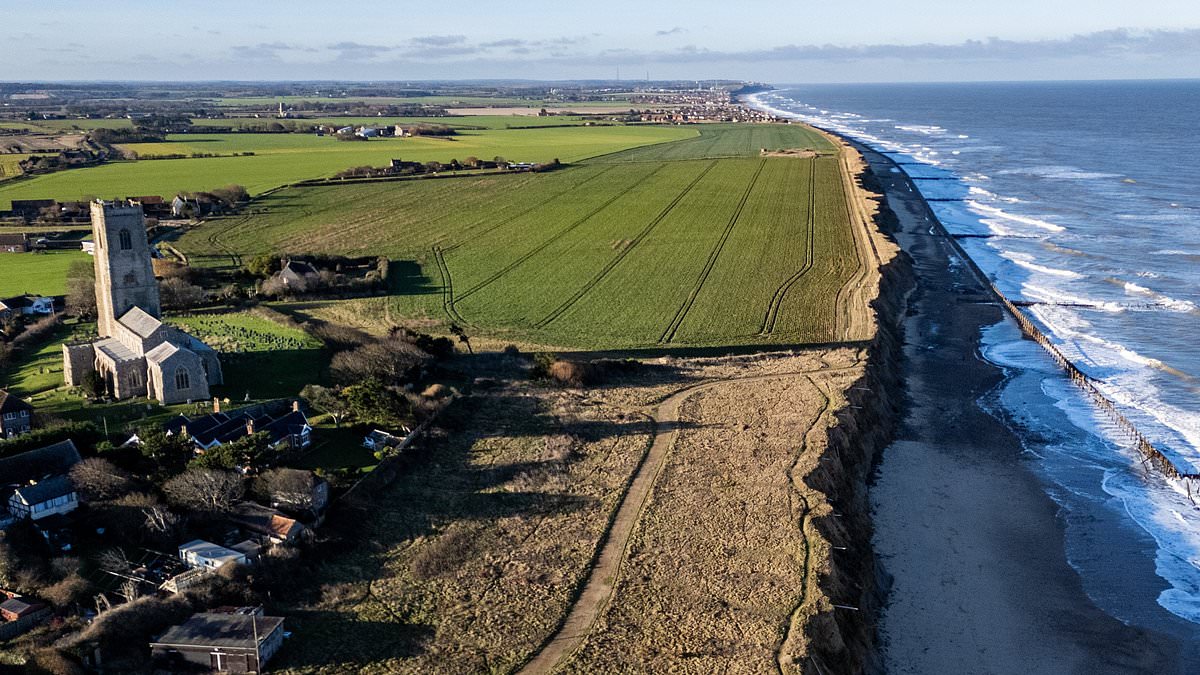

The resting places of 119 sailors who perished off the Norfolk coast two centuries ago may soon be exhumed as coastal erosion threatens to swallow clifftop cemeteries.
These sailors, victims of the ill-fated HMS Invincible, found their final resting place in St Mary’s churchyard in Happisburgh after a tragic shipwreck in 1801, while en route to join Nelson’s fleet at the Battle of Copenhagen.
Their graves are among hundreds at risk in the churchyard, as the village of Happisburgh, along with many others on the Norfolk coast, continues to grapple with severe land erosion that has led to the loss of homes and land.
Concerned relatives have expressed alarm at the potential for their ancestors’ remains to be lost to the sea, criticizing the insufficient action taken despite numerous churchyards being affected.
Among those at risk are graves belonging to soldiers who lost their lives in the First and Second World Wars.
Three graveyards, along with their associated churches in Happisburgh, Trimingham, and Mundesley, all face the threat of being overtaken by the sea in the coming decades.
Now charity The 1805 Club, which is dedicated to preserving naval heritage from the Georgian era, has formally requested that the 119 sailors’ remains are exhumed and reburied at sea.
In response, North Norfolk District Council (NNDC) has reportedly agreed to conduct a ground-penetrating radar survey of the graveyard later this summer to pinpoint the exact location of the mass grave.
Locals in Happisburgh have criticised recent claims that suggest erosion may not directly threaten St Mary the Virgin’s churchyard until 2105
The church itself is also at risk from coast erosion, and risks being lost to the sea in the coming decades
HMS Invincible in battle in 1794, as depicted in a painting by Nicholas Pocock
The naval disaster is said to have happened after the ship’s pilot ignored warnings of shallow sand ridges along the coast. Of the 590 crew on board, just 190 survived.
Many of the sailors’ remains were never found, but those that were recovered were buried in Happisburgh as it was the nearest village to the tragedy.
Previously family members of those buried more recently in the cemetery hit out at indecision from local authorities over the erosion threat. It came after the council and Church of England said it was the decision of local residents for how to proceed.
Locals in Happisburgh criticised claims that suggest erosion may not directly threaten St Mary the Virgin’s churchyard until 2105, arguing events of recent years suggest the issue will become paramount within the next few decades.
The roughly 1,100 people living in the village have seen dozens of homes crumble into the sea in the last two decades with local amenities including a car park also impacted in the last few years.
NNDC has commissioned coastal consultants to work with the local communities affected to come up with plans to tackle the issue – which could include exhuming current graves and reburying remains elsewhere.
But other options on the table are a ‘do-minimum’ approach, which would involve taking no action until the threat is immediate, and ‘long term management’, defined as accepting the ‘loss of burials’, adding ‘it will not be possible to exhume all burials’. Consultations with residents and other affected stakeholders are ongoing.
One local resident, whose grandparents are buried in St Mary’s churchyard with her parents’ ashes also interred there, told the Daily Mail earlier this year: ‘People are frightened, it’s such a sensitive issue.
Frank Mason, 69, whose parents Ethel and Fred are buried in the churchyard of St Mary the Virgin Church in Happisburgh, believes the graves should be relocated and suggested the site of a nearby water tower
The church is currently about 80 metres from the cliff edge, with government estimates showing a significant portion of its land will be under threat by 2055
‘It’s a very personal thing when you have a loved one in that situation and I think people were really concerned about it.
‘It’s so sad, I think we have to accept it. I was there this morning, there are graves there which are clearly tended.
‘It is the people who are tending those graves who are the most important in any decision that is taken. It has to be a collective decision, everyone who has a connection to the place needs to have a say.’
She added: ‘There has been some sensationalism and scaremongering and we need to stop that. The work [on what to do with the churchyard] is happening very slowly but it is happening.’
Frank Mason, 69, whose parents Ethel and Fred are buried in the churchyard of St Mary the Virgin Church in Happisburgh, agreed the graves should be relocated and suggested the site of a nearby water tower.
He told The Guardian he fears the churchyard could have ‘less than 20 years’ before it begins collapsing into the sea – although this is at odds with the latest estimates from the government.
‘At the moment we’re in limbo. It upsets me. My parents wanted this to their final resting place, but it isn’t going to be because of the sea,’ he said.
The local farmer added: ‘I would like to see my parents moved before I pass away. It’s unsettling but no one listens.’
North Norfolk District Council has commissioned coastal consultants to work with the local communities affected to come up with plans to tackle the issue – which could include exhuming current graves and reburying remains elsewhere
The churchyard is still in use for burials and also contains the remains of several local soldiers killed during the First and Second World Wars
A mass grave in the churchyard contains the remains of 119 sailors who were killed when HMS Invincible sank off the coast of Norfolk in 1801
Tended graves at St Mary the Virgin Church in Happisburgh, Norfolk
The most recent maps published by the government on coastal erosion in Happisburgh show no immediate threat to the churchyard, but they do predict that a large area of the land would be affected by 2055, with almost all the churchyard gone by 2105.
St Mary the Virgin’s churchyard is currently estimated to be around 80m from the cliff edge.
As well as the remains of local villagers, it also contains the bodies of Private William J Millar, a 23-year-old soldier who died in the First World War in 1917, and William Marsh, a Royal Navy seaman who served with HMS Badger and died in 1941 during World War Two.
The Commonwealth War Graves Commission (CWGC), which maintains graves of those who fell in the two world wars, said the decision to exhume and relocate soldiers’ remains is ‘an absolute last resort’.
Paul Betts, who is part of a coastal research group in Happisburgh and helps to lock up Grade I listed St Mary’s church, told the Daily Mail: ‘There have been a lot of options out on the table for the future of the coastline including the churchyard.’
He is part of Coastwise, a government-funded group surveying the coastline in the area that has been tasked with working with affected communities to prepare for the impacts of coastal erosion.
Mr Betts, who has lived in his cottage with wife Juliet for five years, explained: ‘We know it [coastal erosion] is going to happen but we have to think about what mitigation we can put in place.
‘It is a particularly emotive issue and those with relatives in the churchyard have genuine concerns.
Other areas of the village have already seen drastic action due to the rate of coastal erosion, with 35 homes lost in the last 20 years
Bryony Nierop-Reading, 80, last year faced losing her second home in Happisburgh to coastal erosion after the property was left just metres from the cliff edge
Now history is about to repeat itself once more as her current three-bedroom home – the Old Coastguard House – looks as if it might also soon crumble into the sea

Dozens of homes have been lost to the sea at Happisburgh in the last two decades
‘This is a seismic challenge and the village needs to be given a roadmap to work with.
‘Juliet and I will be in this house for the rest of our lifetimes.
‘There is a lot of red tape and evangelical laws that need to be considered. But options such as relocation onto other consecrated ground have been optioned.’
Financial estimates of exhuming the churchyards for NNDC show it would cost around £103,000 to clear 100 bodies over a four-week period.
Despite the ongoing risk, burials continue to take place at St Mary’s.
Any decision to relocate those buried there is expected to take years of assessments, consultations and complex efforts to locate relatives of those who were laid to rest decades ago.
Addressing reports of erosion in Happisburgh, the CWGC said: ‘We have a global monitoring system in place and detailed plans for all our sites around the world, where risks such as coastal erosion are factored in. Exhuming the remains of a Commonwealth casualty under threat from coastal erosion would be an absolute last resort and dealt with on a case-by-case basis.
‘With any imminent risk to a Commonwealth war grave, we would work closely with the appropriate military authority and government, depending on the nationality of the casualty, as well as the local authority and landowner of a cemetery.
‘We would also work hard to inform Next of Kin wherever possible.
‘All decisions to exhume and relocate war casualties are signed off at the highest level within the CWGC and only after every option has been considered.’
Other areas of the village have already seen drastic action due to the rate of coastal erosion, with 35 homes lost in the last 20 years.
A new car park was recently opened after the previous offering began collapsing into the sea.
Residents say the problem is being made worse by the presence of a Site of Special Scientific Interest (SSSI) which runs along the coast behind much of the village and part of the churchyard, and severely limits authorities introducing any defence measures.
Many would like to see more ‘soft defences’ such as rock bunds put in place to protect the village, but the presence of the SSSI poses a challenge.
Bryony Nierop-Reading, 80, this year lost her second home in Happisburgh to coastal erosion after the property was left just metres from the cliff edge.
She said last year she planned to move into a static caravan in the home’s back garden and hopes to live there for seven more years.
Mrs Nierop-Reading said at the time: ‘I won’t leave the edge because I want to go on campaigning to save the village and the lighthouse and the pub, but if you live further from the cliff edge you stop caring.
‘It keeps my mind focussed when you can see it disappearing. There are terrible repercussions of losing Happisburgh.’
The other churches and graveyards at risk are Trimingham Church and All Saints Church, in Mundesley.
A NNDC spokesman said previously: ‘Graveyards and churches that are at risk from coastal erosion are a very sensitive issue for the communities affected.
‘The council, through the Coastwise scheme, are working with the Diocese of Norwich to help support them and the local communities.’