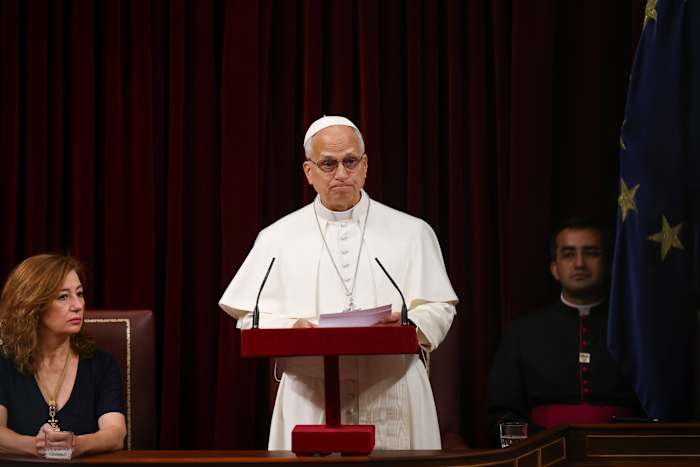


MADRID – On Monday, Pope Leo XIV made a historic appeal in the Spanish parliament, urging for a renewed dedication to upholding both migrant rights and international laws. His speech marked a significant moment for the Catholic Church’s role in a country largely characterized by secular values.
As the first pontiff to address Spain’s legislative body, the American pope emphasized the need for “moral renewal” in politics and society. He called for a commitment to honor the intrinsic dignity of all individuals, particularly focusing on migrants, unborn children, and society’s most vulnerable members.
“A nation’s true moral strength is best demonstrated by its ability to care for and cherish its most fragile members,” stated Pope Leo.
It is quite uncommon for popes to speak before foreign legislative bodies, as such acts can be seen as acknowledging a religious leader’s authority by the government. Notable past instances include Pope Francis’ address to the U.S. Congress in 2015 and Pope Benedict XVI’s speech to the German Bundestag in 2011.
Pope Leo’s invitation to speak at Las Cortes Generales, the Spanish parliament, indicates a growing acceptance of the Catholic Church in a political arena that might have been off-limits not too long ago. Historically, the Church was a strong supporter of Gen. Francisco Franco’s regime, wielding significant influence over Spanish society. However, its power diminished following the advent of democracy in the late 1970s.
Despite a majority of Spaniards still identifying as Catholics, active participation in religious practices has significantly declined, mirroring trends observed in other countries that were once predominantly Christian.
And yet at the end of his speech, lawmakers from across the political spectrum gave Leo a minutes-long standing ovation with chants of “Viva el Papa!” — “Long live the pope!”
Pope calls for peace as Israel and Iran trade strikes
Leo’s speech came as Israel and Iran traded fire in retaliatory strikes that threatened to drag the Middle East back into a full-scale regional war, and the American pope repeated his demand for dialogue to resolve disputes.
“Peace demands diplomatic courage, ethical responsibility and a vision for the future grounded in respect for the identity of every people and in the obligation of states to resolve their disputes through the peaceful means offered by international law,” he said.
He again lamented that European defense budgets were being built up, as countries move to confront the threat posed by Russia following its war in Ukraine and the Trump administration’s threats to reduce its financial and military support for the continent.
“It is therefore a cause for concern that, in various parts of the world — and in Europe as well — rearmament is once again being presented as an almost inevitable response to the fragility of the international situation,” he said.
He repeated his demand for “rigorous ethical oversight” of automated weapons systems created by artificial intelligence “so that decisions regarding life and death are never left to automated systems nor removed from the moral responsibility of the human person.”
A reference to Spanish conquest and the slave trade
Leo cited the 16th century Spanish intellectual tradition, known as the School of Salamanca, that gave rise to concepts of international law and inherent human rights, that arose after Spain’s colonial conquests of the Americas.
He praised the theologians involved in the movement who “understood that reason could not be invoked to legitimize whatever force or self-interest that seemed convenient” and that there were “moral limits of power.”
“It must be acknowledged that society and the church herself did not always live up to these insights found in their own Christian tradition,” Leo said.
It was a reference to the Catholic Church’s own role in the trans-Atlantic slave trade and colonial conquest, and recalled Leo’s recent apology for the role the Holy See itself played in legitimizing slavery and the conquests of the Americas by Spanish and Portuguese sovereigns.
A call for dignity, acceptance and integration for migrants
Speaking of modern-day human traffickers, Leo called for strengthened international and multilateral efforts to prevent the human smuggling of migrants and create conditions where they can choose to stay home.
But for those who do flee conflict, poverty and climate change, he called for welcome and integration. Pope Francis had made the plight of refugees reaching Europe a hallmark of his papacy and Leo has followed suit, insisting especially on the human dignity of migrants in his native United States amid the Trump administration’s migration crackdown.
“This gives rise to a twofold demand for social justice: to offer safe and legal pathways, a respectful welcome and real opportunities for integration; and, at the same time, to promote the right to remain in one’s own land, working to ensure that no one has to leave their home due to a lack of peace, security or decent living conditions, including economic inequalities and the effects of the climate crisis,” he said.
Spain’s Socialist-led government has bucked a general trend in Europe and the United States by defending immigration on economic and humanitarian grounds, launching a legalization push earlier this year for hundreds of thousands of immigrants living and working in the country without authorization. Sánchez has highlighted the benefits of legal migration to the Spanish economy with an aging workforce and low birth rate.
A delicate political moment and an unlikely alliance
Leo’s visit comes at a delicate time for Spanish Prime Minister Pedro Sánchez.
Sánchez’s Socialist Party has been hammered by a series of corruption scandals, though none have directly implicated him, with an investigation opened last month into a former Socialist Spanish prime minister for alleged influence peddling and other crimes tied to a government airline bailout. Separate probes have touched some of Sánchez’s closest confidants, as well as his wife and brother.
As they play out, many Spaniards find themselves in a country increasingly frayed by political polarization, and unable to agree on a common path forward. Sánchez’s leftist minority government has been unable to pass legislation, including a budget for the past three years.
Leo, in an apparent reference to Spain’s polarization, warned: “political pluralism should not degenerate into the constant disparagement of one’s adversary.”
Besides migration, Spain’s progressive leader, who is an atheist, and the American pontiff have converged on major issues in global politics. Last month, after visiting Leo in the Vatican, Sánchez praising Leo as a “moral compass.”
Sánchez has been Europe’s most outspoken voice against the the U.S. and Israel’s wars in Iran, Gaza and Lebanon, with Leo decrying the strikes on Iran as “unjust.”
The Spanish leader has repeatedly called for dialogue and diplomatic negotiation to resolve conflicts, which Leo echoed. “Weapons may impose a temporary silence; but they can never build a genuine and lasting peace,” Leo said.
The overlap is noteworthy since the Catholic Church in Spain has traditionally been closer to the conservative Popular Party than the left, which championed social issues such as same-sex marriage, abortion rights, and euthanasia.
___
Associated Press religion coverage receives support through the AP’s collaboration with The Conversation US, with funding from Lilly Endowment Inc. The AP is solely responsible for this content.