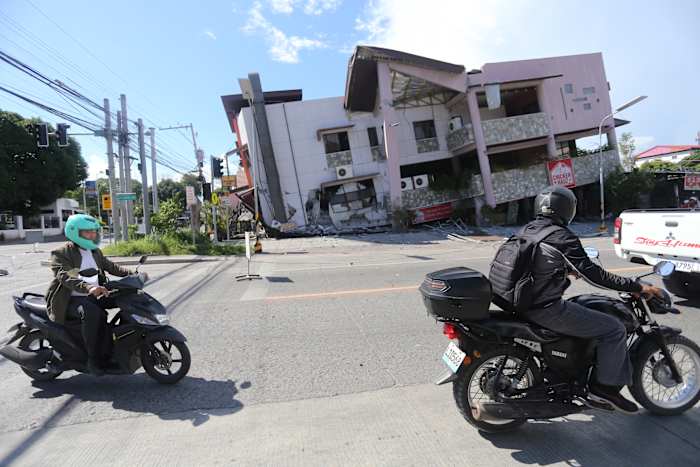


MANILA — Philippine officials said Friday that years of disaster-readiness drills helped keep the death toll from climbing higher after one of the country’s most powerful earthquakes in the past 50 years struck the south, leaving 55 people dead and 31 others missing.
The magnitude 7.8 offshore earthquake hit Monday near Sarangani province, injuring about 1,120 people and forcing more than 45,000 residents from their homes. Roughly half remain in emergency shelters after the tremor damaged more than 12,600 houses in farming communities and urban areas.
Officials said many residents remain too shaken to go back home as strong aftershocks continue to rattle the region.
In the days since the quake, more videos capturing the terrifying scenes have spread across social media, showing frightened crowds watching small buildings collapse and school flag ceremonies descend into chaos as the ground began to move on the first day of classes after the long summer break.
In several clips, students can be heard screaming in fear but are seen staying in place outside school buildings, some shielding their heads with their hands while teachers urged them to remain calm.
One Facebook video that has drawn millions of views shows dozens of elementary school students crying and shouting as they sat on a schoolyard surrounded by trees, swaying visibly from side to side. Nearby, a shed with a tin roof eventually crashed down with a loud bang, causing many children to run, before teachers called them back and told them to stay seated.
The grade school in the coastal town of Malita in Davao Occidental province reported no injuries from the quake.
“This incident serves as a reminder of the importance of earthquake preparedness and the value of regular disaster response drills,” the Mahayahay elementary school said in a statement.
Teresito Bacolcol, director of the Philippine Institute of Volcanology and Seismology, said years of disaster-preparedness drills helped people anticipate and brace for extreme events like Monday’s quake, one of the strongest to hit the archipelago in a half-century.
He said that it was also fortunate that the quake hit at 7:37 a.m., a few minutes before work and classes were to start indoors.
“It’s good that our efforts to educate people on what to do when earthquakes hit somehow paid off,” Bacolcol told The Associated Press.
He expressed concern, however, over the collapse of some buildings that he said should have withstood the powerful quake, if construction standards based on the country’s building code were followed.
Ednar Dayanghirang, director of the Office of Civil Defense in a quake-hit region of about 5 million people, said that regular disaster-preparedness drills helped reduce casualties in many ways, including by preventing deadly stampedes.
“We required all school principals to take one-day courses on incident management, then they appointed disaster-response teams among teachers to deal with earthquakes, tsunamis,” Dayanghirang said. “They listened and they learned.”
The Philippines, one of the world’s most disaster-prone countries, is often hit by earthquakes and volcanic eruptions because of its location on the Pacific “Ring of Fire,” an arc of seismic faults around the ocean.


