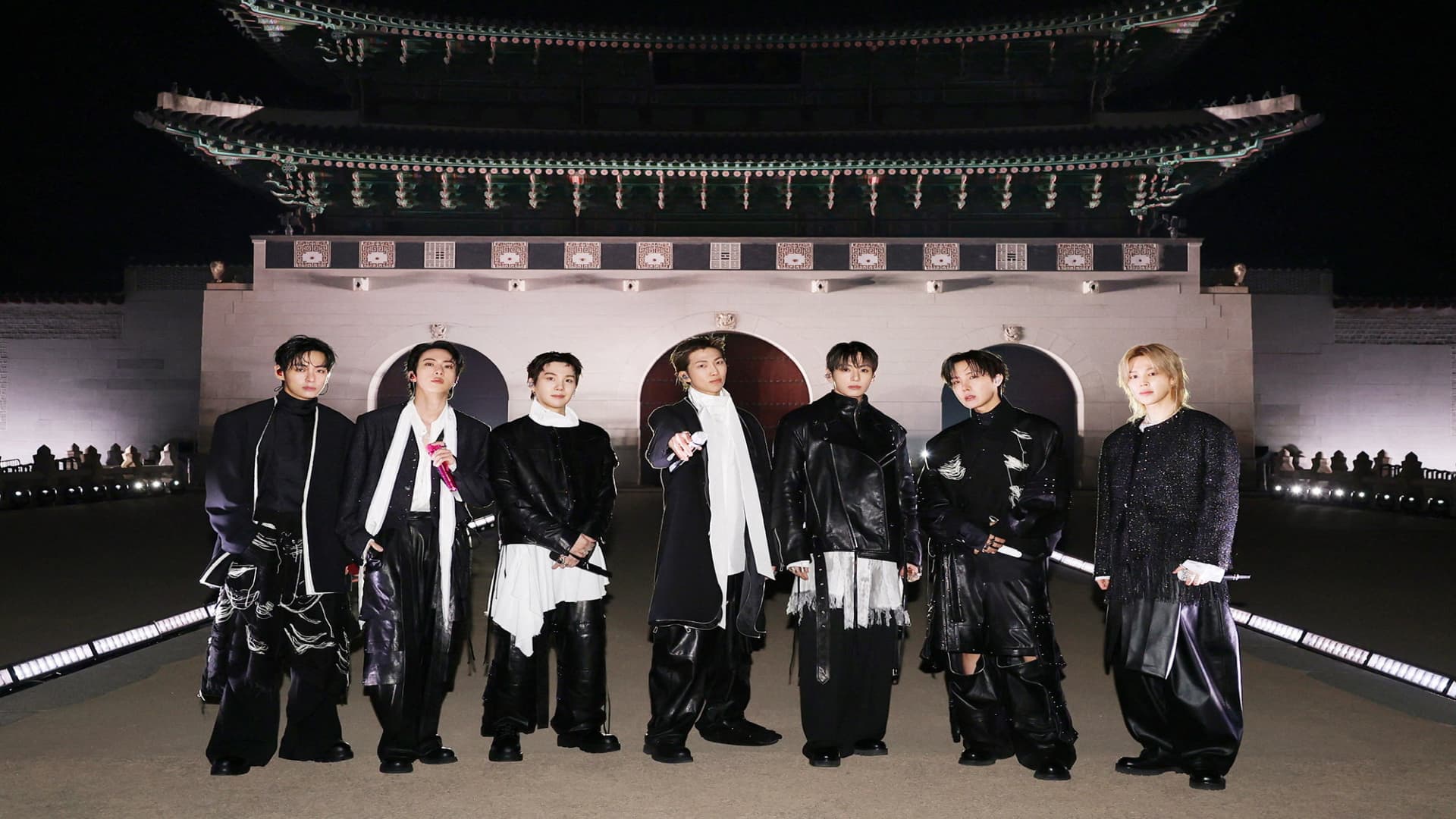

BTS members pose for photos after arriving for the “BTS The Comeback Live Arirang” concert in central Seoul, South Korea, on March 21, 2026.
Handout photo via Reuters.
On Friday, tens of thousands of BTS fans are expected to pour into Busan as the seven-member K-pop group makes its second South Korea stop on its global Arirang tour.
They will come armed with light sticks, banners, and concert tickets — along with plenty of spending power.
The idea that pop culture can drive major economic activity is hardly new. “Swiftnomics” emerged as a popular label for the financial boost tied to Taylor Swift’s Eras Tour, which packed hotels, restaurants, and stadiums across the globe.
Now BTS has inspired a similar phrase in South Korea. Brokerage firm NH Securities has dubbed the phenomenon “Bangtan-nomics,” combining “Bangtan” — taken from the group’s Korean name — with “economics.”
NH described the fan spending pathway like this: online fandom first becomes streaming, albums and merchandise, before widening into Korean beauty, food, fashion and eventually tourism.
In a May 21 note, the brokerage said 84% of global ARMY — BTS’ fanbase — are in their teens and twenties. As they grow older and acquire more spending power, these fans could then come to Korea and contribute to its economy via tourism spending.
In fact, NH predicts that by 2040, BTS fan spending could contribute up to 0.35 percentage points per year to South Korea’s GDP.
To put a number to that, 0.35% of South Korea’s 2024 nominal GDP is about $6.58 billion, according to CNBC’s calculations.
Some early numbers for “Bangtan-nomics” are promising. South Korean media, citing government data, said fans who came for the first BTS concert in April were likely to stay longer and spend more than tourists who did not come for a concert.
This is supported by a 2019 paper by Pyun Ju Hyun, professor of international business and economics at Korea University. Pyun found that BTS concerts held in South Korea attracted many foreign tourists, generating additional spending in the country.
Pyun’s paper, sent to CNBC, surveyed foreign concert attendees in Seoul, and found that 98% said they planned to revisit Seoul within the next five years. Two-thirds said they planned to revisit Seoul five or more times within the next five years.
For the concerts in Busan, demand for accommodation spiked so much that the city’s government had to step in to curb price gouging among merchants and open up more venues to house the massive influx of fans.
Forecasting impact
While it’s reasonable to expect BTS and the broader Hallyu wave to contribute to GDP, it is “overly simplistic” to assume this trajectory is guaranteed, said Natalia Grincheva, associate professor in the School of Creative Industries at Lasalle Singapore.
Geopolitics is one risk. In 2016, China imposed a so-called “soft ban” on Korean cultural exports after Seoul deployed the U.S. THAAD anti-ballistic missile system, restricting performances from K-pop groups in nainland China.
Also, fan behavior is primarily driven by emotional attachments, which are inherently unstable, Grincheva said.
“[While NH’s] model offers a plausible trajectory, any credible forecast must account for these non-linear, disruptive factors rather than assuming a smooth economic pipeline from youth fandom to mature spending,” she said.
Still, that doesn’t mean Bangtan-nomics is imaginary.
Alongside South Korean film, television, beauty and food, it could contribute economic power for a long time, according to Jonathan McClory, managing partner at Sanctuary Counsel and a soft-power specialist.
BTS is a “very successful part of a very successful ecosystem,” he said.


