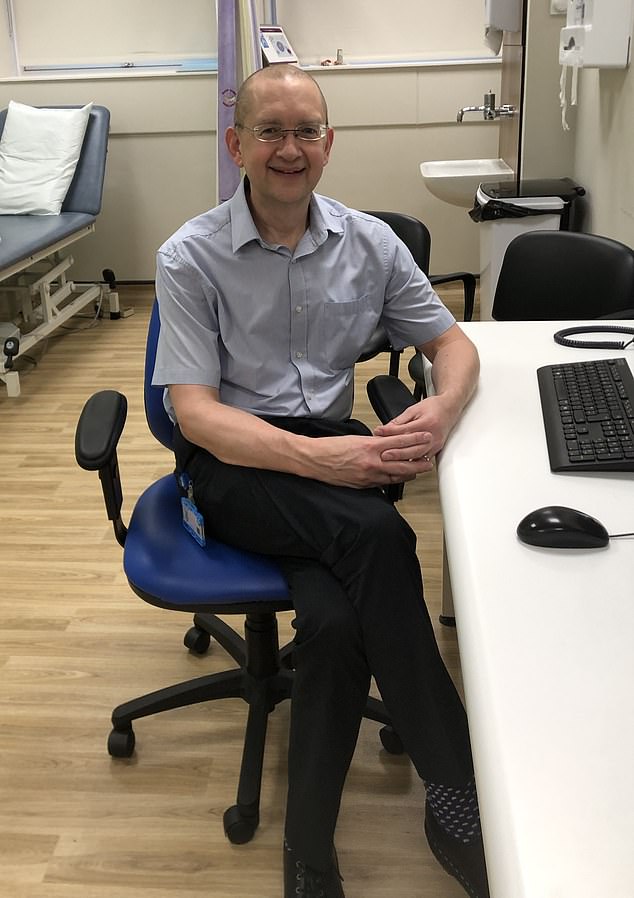

There is never an easy moment to hear you have terminal cancer. For Professor Kevin Mortimer, that life-changing diagnosis arrived on his daughter’s 11th birthday.
The respiratory medicine specialist at Aintree University Hospital in Liverpool had been dealing with back pain for several weeks, initially blaming it on a recent long-haul trip to New Zealand.
But when the discomfort failed to ease, he was sent for scans at the very hospital where he worked.
Professor Mortimer was in the middle of a ward round when a colleague phoned and asked him to come upstairs to discuss the test results.
It was there, in the hospital where he had spent 15 years of his career, that he received the devastating news: cancerous tumours had spread throughout his body, originating in his prostate.
At only 48, he was told the illness could not be cured and that he likely had only a few years left to live.
After getting his diagnosis, Professor Mortimer had to return home and take his daughter out for a birthday dinner. He and his wife decided not to tell her that day. But the next morning, they sat her down.
‘I told her that I was very poorly and that it was a serious diagnosis,’ he says.
‘Her first words were, “Well, we have to be hopeful, Daddy.”’
But Professor Mortimer admits that, at the time, he was far from hopeful.
Professor Kevin Mortimer was in the hospital he had worked at for 15 years when was given a diagnosis of ‘incurable’ prostate cancer by a colleague
He says: ‘It felt like I was experiencing everything for the last time. I was told that my treatment was palliative, which means it would only delay the inevitable. I really thought it was the end.’
However, two years on, Professor Mortimer is not just still alive but, incredibly, he is cancer-free.
More than 64,000 men are diagnosed with prostate cancer every year in the UK – making it the most common cancer in men – and it kills more than 12,000 annually.
However, experts say that Professor Mortimer’s recovery is not an anomaly.
Since 2023, many men with advanced prostate cancer have been offered a so-called triple therapy – combining two standard treatments with a powerful new hormone drug, darolutamide.
Prostate cancer cells feed off the male sex hormone testosterone. But darolutamide binds itself to tumour cells, preventing testosterone from reaching them.
Patients also receive chemotherapy and a tablet that limits testosterone production. When first approved on the NHS, the combination was expected to extend patients’ lives by about four years.
Professor Mortimer says the treatment triggered intense pain that left him unable to walk, but the results were almost immediate, with checks on his prostate-specific antigen levels – a marker for prostate cancer when high – coming back dramatically lower.
‘Each time I went for a scan, the cancer was shrinking,’ he says. ‘When I started treatment my prostate-specific antigen score was over 600, which is just about as high as it can get. Within a few months, it was near zero. Seeing this gave me the motivation to keep going through the pain, because it was clearly working.’
Within six months he was back at work part-time. An avid runner, he completed a half-marathon a few months after that.
His cancer had almost completely shrunk after just a few months of taking darolutamide – a powerful new drug which binds itself to tumour cells

Professor Mortimer is now cancer-free. He, along with around 45 per cent of men, has the characteristics of a ‘super-responder’ – patients who tend to be younger and fitter
Researchers now call men such as Professor Mortimer ‘super-responders’ and believe they have identified the characteristics that they share.
‘The data shows that about 45 per cent of men are super-responders to the triple therapy,’ says Amy Rylance, director of health services, equity and improvement at the charity Prostate Cancer UK. ‘It appears the men who achieve this tend to be younger and fitter.’
Incredibly, researchers believe that future patients could be spared chemotherapy altogether because darolutamide may be doing most of the heavy lifting.
‘It’s uncertain whether the chemo adds anything at all,’ says Professor Gert Attard, a cancer researcher at University College London. ‘We’re now running trials looking at the effect of giving darolutamide to advanced patients without chemo.
‘When I started treating prostate cancer patients 20 years ago, the average survival was two years. Now 40 per cent of patients who go on darolutamide are alive and healthy 12 years on.’
Experts say access to these new treatments needs to improve.
Ms Rylance says: ‘In some hospitals, less than half of men get hormone therapy, while in others 90 per cent do. Prostate cancer patients that were once considered incurable are now being cured. So we need to get more men on to these drugs.’
Professor Mortimer was told he was cancer-free just three months ago. He knows he is at high risk of the disease returning – as it does in about a third of cases.
But he adds: ‘I do get thoughts about it coming back, but I just have to have a positive mindset. I’m a long-term survivor – I just can’t prove it yet.’
Going through treatment, he says there were two things that he wanted to be able to do.
‘I wanted to get back to being a doctor and I wanted to wave my daughter off to university,’ he says. ‘I’ve gotten to do one of those – and I believe I’ll do the other, too.’


