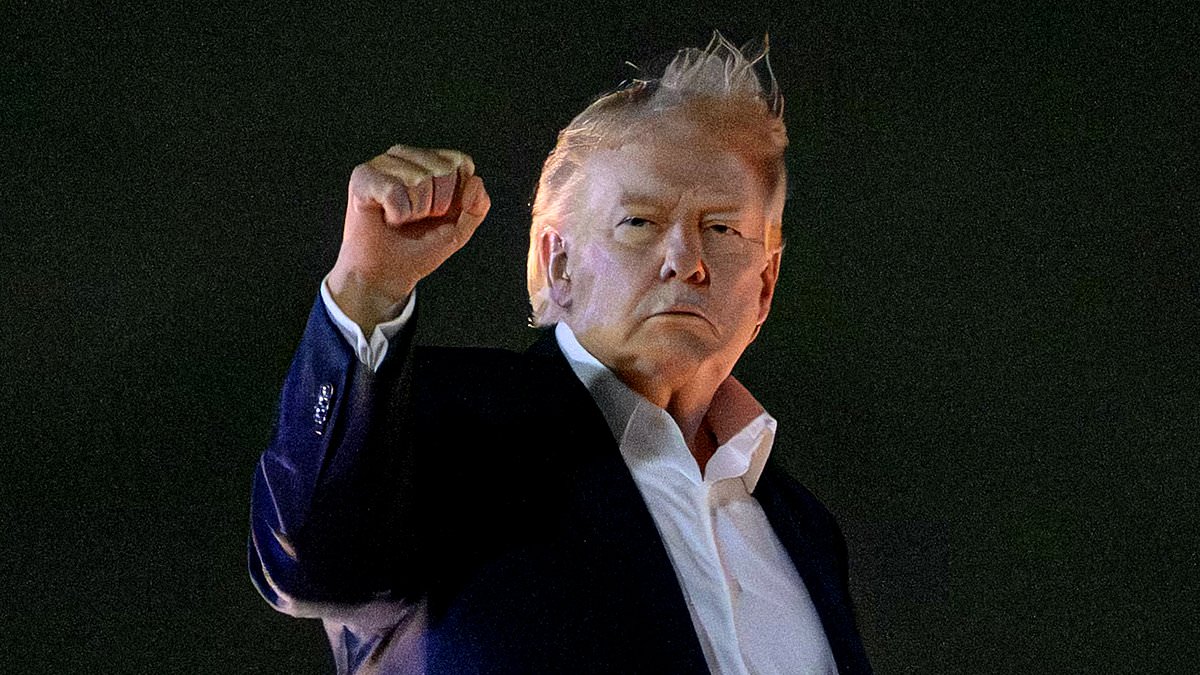

President Donald Trump is asking Americans to do something that does not come easily: place their trust in Iran.
By implication, he is also asking the country to place that trust in his judgment.
Given the circumstances, neither request is a simple one.
Trump says a peace agreement with the Islamic Republic of Iran could bring an end to a conflict that has now stretched beyond 100 days and open the door to a broader period of stability in the Middle East. But as of Monday, with the president in France for G7 meetings with other world leaders, major uncertainties remain.
At a high level, Washington and Tehran are said to have reached a tentative framework that would prolong a ceasefire for 60 days, with a formal signing ceremony expected in Switzerland on Friday. That would then be followed by negotiations over Iran’s nuclear program and its demands for economic relief.
The developing arrangement has also produced an unusual political alignment: a coalition united less by ideology than by skepticism.
Backers of President Barack Obama’s 2015 Joint Comprehensive Plan of Action argue that Trump has arrived, by a different – much more costly – route, at a conclusion not entirely dissimilar from their own: that some accommodation with Tehran, in service of trying to limit the regime’s race to a nuclear capability, is ultimately unavoidable.
Meanwhile, Republican hawks are sounding uneasy.
As of Monday morning, with Trump in France for G7 meetings with world leaders, there are more questions than answers (Pictured: Trump arrives in Switzerland on June 15)
Senator Lindsey Graham notes that Iran’s description of the agreement is different from Washington’s readout. Conservative commentator Mark Levin is more blunt, demanding that the memorandum itself be released.
Privately, while some senior Republican allies of the President who supported the war are pleased, others are outright disgusted. One Trump booster, close to the White House, tells me that this deal is yet another play to bring down energy prices in the short-term as the administration drags out negotiations past the November midterms.
Fair concerns abound.
Take one issue: the reopening of the Strait of Hormuz.
For months, the waterway, which carries 20 percent of the world’s oil, has been at the center of the conflict, as Tehran has targeted tankers, strangling trade and the US has responded with a blockade of its own.
The White House said last week that, once an agreement was signed, commercial traffic would again move freely, yet even basic details are unknown.
Who will guarantee security of ships? What role, if any, will Iran play in management of the waterway – a function the regime did not fill prior to the conflict?
Those particulars will go a long way to revealing who ‘blinked first’.
Administration officials have long claimed that the blockade was exerting unbearable economic and political pressure on Tehran.
The theory was straightforward: unable to export growing reserves of crude oil, Iranian storage facilities would fill to the brim, forcing production to slow. The regime’s revenue would then collapse – forcing a choice between ruin and capitulation.
Now the administration appears to acknowledge something quite different. The Hormuz blockade may have hurt Iran, but it did not bring the regime to its knees. If anything, Tehran demonstrated that it could disrupt global energy markets and endure the consequences, creating a leverage of its own.
For months, the Strait of Hormuz, has been at the center of the conflict, as Tehran has targeted tankers, strangling trade and the US has responded with a blockade of its own

Mark Halperin is the editor-in-chief and host of the interactive live video platform 2WAY and the host of the video podcast ‘Next Up’ on the Megyn Kelly network
Time, in fact, was not on Washington’s side.
With midterm elections approaching, gas prices stubbornly high, strategic reserves under strain, munitions stockpiles depleting and DC types whispering ‘quagmire’, Trump was backed into a corner. Meanwhile, the Islamic Republic remains standing, its military in control and many of its terrorist tools of regional influence still available.
Could it be that America will end up worse off than before the war began?
Under this deal, Iran would apparently keep its missile and drone arsenal and its proxy infrastructure in Lebanon, Iraq and Yemen, remain – albeit in weakened form.
Also, unresolved is the central issue: Iranian nukes. The administration has said that a deal will provide Iran economic relief – by way of unfrozen assets and lifted sanctions – but only after Iran destroys its highly enriched uranium, renounces any pursuit of nuclear weapons and submits to meaningful verification.
If that sequence holds, Trump will be able to argue that he extracted major concessions before offering major rewards but if money starts flowing earlier then the substance of the agreement looks very different.
All this sits uneasily beside Trump’s earlier rhetoric. It was barely a week after a joint US-Israel operation assassinated Supreme Leader Ayatollah Ali Khamenei, devastated Iranian air defenses and leveled regime military assets across the country that the President declared nothing less than ‘unconditional surrender’ would be acceptable.
The phrase echoed across cable television and social media. It sounded like the language of total victory.
Trump told the New York Times in a Sunday interview that Iran folded. The administration is speaking in sweeping terms about a transformed Middle East.
Perhaps. But for now, there is only the next step. Friday’s signing ceremony could prove historic. Or merely ceremonial. It might not happen at all!
The only thing that America can truly trust in right now is uncertainty.


