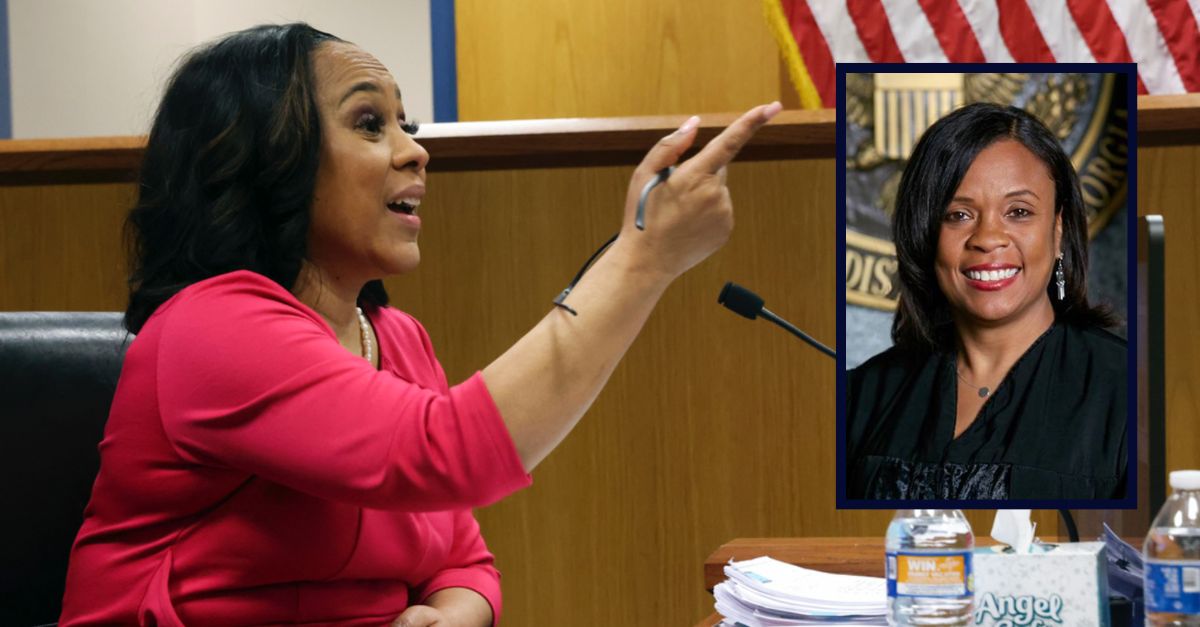

Main: Fulton County District Attorney Fani Willis testifies during a hearing on the Georgia election interference case, Thursday, Feb. 15, 2024, in Atlanta (Alyssa Pointer/Pool Photo via AP). Right inset: U.S. District Judge Eleanor Ross (U.S. District Court).
The Justice Department is escalating its effort to force a federal judge off a high-profile Georgia voter rolls case, warning that it will seek intervention from a federal appeals court if she does not act by Wednesday evening.
In a brief filing submitted Monday, the DOJ said U.S. District Judge Eleanor Ross did not respond to its earlier demand that she decide by Friday whether to recuse herself. The department has now set a new deadline of 5 p.m. Wednesday.
“Judge Ross’s improper attendance at a partisan and political event gave rise to an appearance of bias necessitating her recusal,” the government wrote, pointing to findings from a private reprimand involving Ross’s attendance at an event tied to Fulton County District Attorney Fani Willis’s reelection campaign.
Willis, a Democrat, previously brought a sweeping election interference racketeering case against President Donald Trump, an effort that ultimately failed. Ross, who was appointed to the bench by former President Barack Obama, is currently overseeing the federal government’s lawsuit against Georgia Secretary of State Brad Raffensperger, a Republican, seeking access to a “full and unredacted” statewide voter registration list.
The DOJ’s latest move comes as scrutiny around Ross intensifies. Willis’s own disqualification from the Trump case over what was described as a “significant appearance of impropriety” effectively derailed that prosecution. Now, the department is signaling it is prepared to press even harder for Ross’s removal from the voter rolls case.
If Ross does not rule by the new deadline, the DOJ said it will ask the 11th U.S. Circuit Court of Appeals for a writ of mandamus, an unusual and aggressive legal step used to compel action by a lower court.
A writ of mandamus, if granted, would force Ross to make a decision, a process that has played out in other high-profile matters within the 11th Circuit.
In recent days, Ross has additionally faced scrutiny for “engaging in an extramarital affair with a high-ranking law enforcement officer and having sexual intercourse in the judge’s chambers during business hours within hearing distance of staff” and by “making false statements to the Chief Circuit Judge and Chief District Judge that were material to the investigation of the allegations.”
The officer was reportedly identified by Bloomberg Law as Atlanta Police Department Deputy Chief Kelley Collier; Ross is married to DeKalb County Judge Brian K. Ross, with whom she has two daughters.
Critics are also outraged that Ross’ identity was hidden by the judicial council in a private reprimand, leaving news organizations to do the legwork. Ross’ vague apology to clerks also sparked criticism, so much so that she issued a new and specific apology.
“I am writing to you for a second time to convey my deepest apologies for my harmful, offensive, and unprofessional behavior that made your clerkship an unpleasant experience. My initial letter was entirely deficient, as I did not take full accountability for my actions, and I failed to give you the apology that you deserve,” the do-over apology said, according to The New York Times. “I am profoundly sorry for exposing you to my inappropriate personal relationship during your clerkship, and for the harm that I have caused you. My actions were patently wrong, and there is no excuse. You deserved better than to have your experience marred by my own offensive conduct. I apologize for not affording you an opportunity to serve the public in a professional atmosphere where everyone was always treated with respect and courtesy. I also want to convey my deepest apologies to you for my false accusation against you. Again, I have no excuse and immensely regret my behavior.”
In her previous apology, Ross said: “Thank you for your contributions to our court during your clerkship. I convey my deepest apology for not taking steps to ensure that it was a more positive experience. I wish you all the best in your future legal endeavors and in life.”
Intervenors the Black Voters Matter Fund, represented by the law firm of Democratic Party election lawyer Marc Elias, have argued that the DOJ is engaged in a sideshow meant to distract from losses in “eight district courts.”