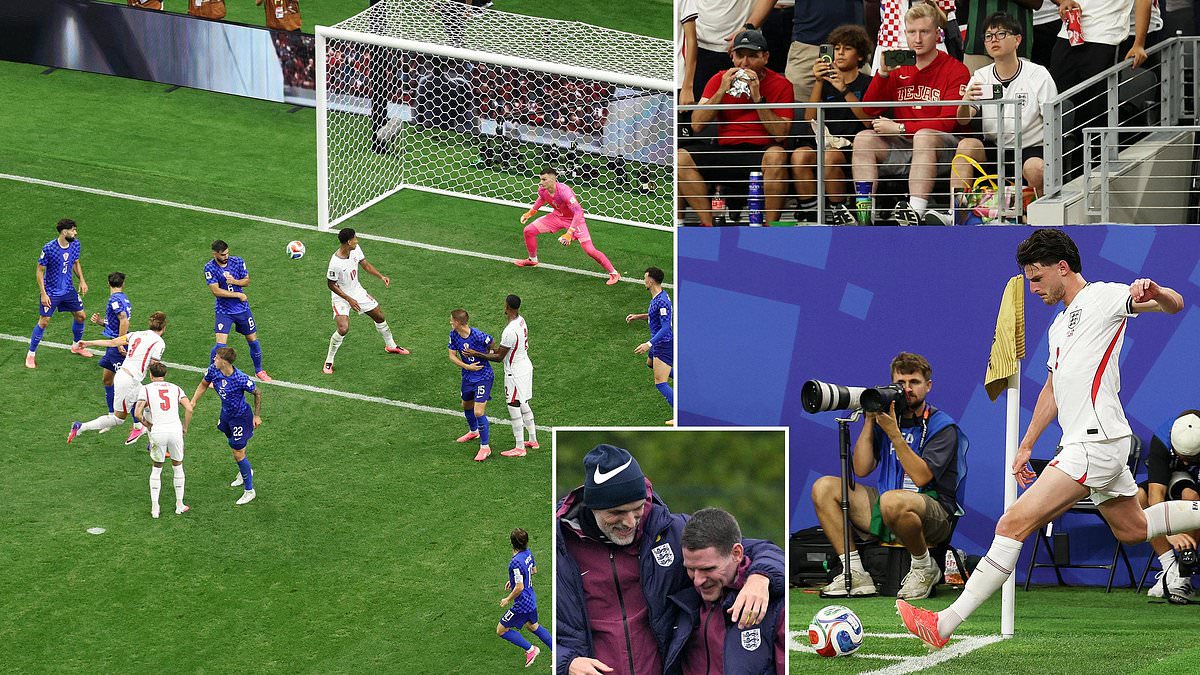

They hovered, watched and waited. Then, the moment the ball was set in the corner quadrant, England sprang into action.
Inside these American stadiums, there is now a distinctly NFL-style sense of anticipation whenever Declan Rice walks over to take a corner. What follows often feels less like improvisation and more like a rehearsed play, lifted from a tactical playbook and executed with precision. England’s runners take their positions like predators, each with a role, each intent on making the delivery count.
England’s corners have effectively become a contest within the contest. Their routines are drawing growing attention from rival coaching staffs, with teams across Europe increasingly discussing how to deal with them.
Yet this was also a reminder that England are not relying on set-pieces alone. On the day, they showed they possess far more than one route to goal, particularly in a second half marked by overwhelming control. That period should serve as a benchmark for what is expected over the next month. The physical edge, the blocking, the grappling and the aggression at corners all have their place, but only when paired with the quality and fluency shown elsewhere in their play.
Thomas Tuchel has made no secret of his desire to tap into the Premier League’s strength in set-pieces, with Arsenal’s expertise an especially clear influence. He has given assistant Anthony Barry and specialist coach Paul Quilter the freedom to shape that side of England’s game. Tuchel has even joked that sitting through their presentations can feel like being back in a mathematics lesson.
There is this sense of NFL expectation within these American stadiums when Declan Rice stands over a corner ready to produce devilish deliveries
England’s work on set-pieces paid off handsomely against Croatia, with both of Harry Kane’s goals coming from dead-ball situations
Thomas Tuchel defers to his experts – in this case Anthony Barry, who once wrote a thesis on 16,000 throw-ins that was ultimately published as an academic paper
But trusting the specialists has brought results throughout this 18-month spell. Barry, whose analytical credentials include a thesis on 16,000 throw-ins that was later published as an academic paper, embodies the level of detail behind England’s approach. In the tight margins of knockout football, that kind of weapon could prove decisive in the weeks ahead.
Such are the oddities of this tournament these days, England are effectively through to the last 32 already, barring a disaster so cataclysmic that No 10 would be expected to wade in. Keir Starmer that is, not Jude Bellingham.
There are of course deficiencies that need ironing out, but what was noticeable in a somewhat fraught first 45 minutes of their World Cup was what England can fall back on. Not playing fluently? Rice is there with his outswingers on a sixpence.
Harry Kane (6ft 2in), John Stones (6ft 2in), Ezri Konsa (6ft) and Nico O’Reilly (6ft 4in) were there to fashion opportunities that few other countries can so routinely manage. Against Croatia, these were consistently uniformed attacks. Precise, cut-throat.
Kane scored from one header but there had already been a penalty awarded from an earlier set play. The anatomy of both is exactly what those opposition coaches talking to each other fear when they meet the Three Lions.
The premise remained the same throughout this game but the variations did not and Croatia head coach Zlatko Dalic squirmed as his defensive shape crumbled.
This was one fundamental routine sliced up eight different ways. England lined up with two men, Bellingham and Anthony Gordon, around the six-yard line occupying a number of defenders who were marking zonally. It allowed the England quartet stationed towards the penalty spot to do their damage. Maximum damage.
Three acted as decoys for Kane’s goal, the captain hanging further back unmarked, surveying the wreckage unfolding before him as Konsa blocked, Stones cleared two out of the way and O’Reilly palmed off a marker with two hands.
Kane wandered in and planted a perfect header into the net, the likes of Josko Gvardiol only able to stand and grimace at its inevitability.
England’s goalscoring setup: Anthony Gordon and Jude Bellingham in the six-yard box, with (L-R) Ezri Konsa, John Stones, Harry Kane and Nico O’Reilly causing chaos
Kane wheels away after powering in his header, which drew him level with Gary Lineker on an England-record 10 World Cup goals
The earlier penalty had arrived after Noni Madueke was alive to a second ball on the edge of the box, drawing a foul from Luka Modric that had come after Croatia were unable to clear their lines.
The second ball, a key principle of Pep Guardiola. If it’s good enough for him then Tuchel, one of the Catalan’s ardent disciples, is on very safe ground.
There were corners when all four of the main characters went directly with their men. When O’Reilly sauntered towards the back post, heading a presentable chance wide. He went very close later on when Gordon blocked Ivan Perisic. Only when England opted to go short were Croatia truly comfortable.
Four of England’s six big chances on the night came directly from corners. That’s four from just eight deliveries. It’s a hell of a record, and the rewards are such that ignoring this facet of the game would be folly.
An interesting aspect to Wednesday’s success was Tuchel and Barry empowering their players to follow their gut. That’s what makes this slightly different to a defined roster of plays from the book that you might see in American football.
Kane had spotted a weakness in Croatia’s setup from the first couple of corners and instructed them to do the blocking in the build-up to his header.
That key players are in tune with the intricacies of the set-piece bodes particularly well at a tournament when the heat will become a far larger factor than it was in the indoor air-conditioned home of the Dallas Cowboys, who themselves must have studied with intrigue.
England gave the six-yard box some room. In previous games, notably the qualifiers, they have crammed that area – while now mindful that referees want to clamp down on physicality from these situations.
The first goal also came from a set-piece, as Noni Madueke was fouled by Luka Modric when Croatia could not clear their lines and England pounced on a loose ball

England are mindful that referees at this tournament will crack down on the grappling that we saw in the Premier League this past season
Mindful privately anyway, Bukayo Saka – a designated taker himself – seemed perplexed when the idea that teams had been well briefed on stricter officiating was put to him earlier this week.
Letting the box breathe a bit reduces the notion of countless fouls going on simultaneously and giving the referee an easy decision to make. In that sense, it might be a decent guess that a less congested style continues as the World Cup progresses.
What Croatia did prove, if proof were needed, is that this is a supplementary positive. Tuchel will not want it to overshadow the way in which they attack and dominate game plans.
Yet as he talks about a tournament of ‘moments’, ignoring the ability of Rice and the ingenuity of his staff and players would be a betrayal.