

Disney/Pixar
Pixar’s debut feature, 1995’s “Toy Story,” remains one of animation’s most enduring landmarks. The adventures of Woody, Buzz Lightyear and their fellow playthings have powered a franchise spanning multiple films, including the newest chapter, “Toy Story 5,” which arrives with the weight of a massive cultural legacy behind it. Part of what makes the “Toy Story” series so remarkable is how it reshaped animated filmmaking while continuing to explore universal ideas — from friendship and loyalty to the pain of saying goodbye — in ways that have kept audiences invested for generations.
With “Toy Story 5” bringing the classic toy box into conflict with modern technology, now is an ideal moment to revisit all five films and consider how they stack up. What separates a great “Toy Story” movie from a merely good one? Which qualities have defined the franchise at its best, and where has it fallen short? Ranking these films means looking closely at the storytelling, humor, emotion and craftsmanship that have made the series such a towering achievement in family entertainment.
Few animated franchises have reached the creative peaks that “Toy Story” has managed across several decades. Still, every series has an entry that lands at the bottom of the list — even if, in this case, “weakest” is a relative term.
5. Toy Story 5
Disney/Pixar
Andrew Stanton’s Pixar journey began on the original “Toy Story,” where he worked as a character designer, screenwriter and story artist. Since then, he has helped shape many of the studio’s biggest successes and has contributed to the scripts and stories of every “Toy Story” sequel, along with additional screenplay material for 2022’s “Lightyear.” “Toy Story 5” marks Stanton’s first time directing a mainline “Toy Story” film, with Kenna Harris serving as co-director and co-writer. His deep familiarity with this universe is evident, though the latest installment still feels less steady than the franchise’s strongest chapters.
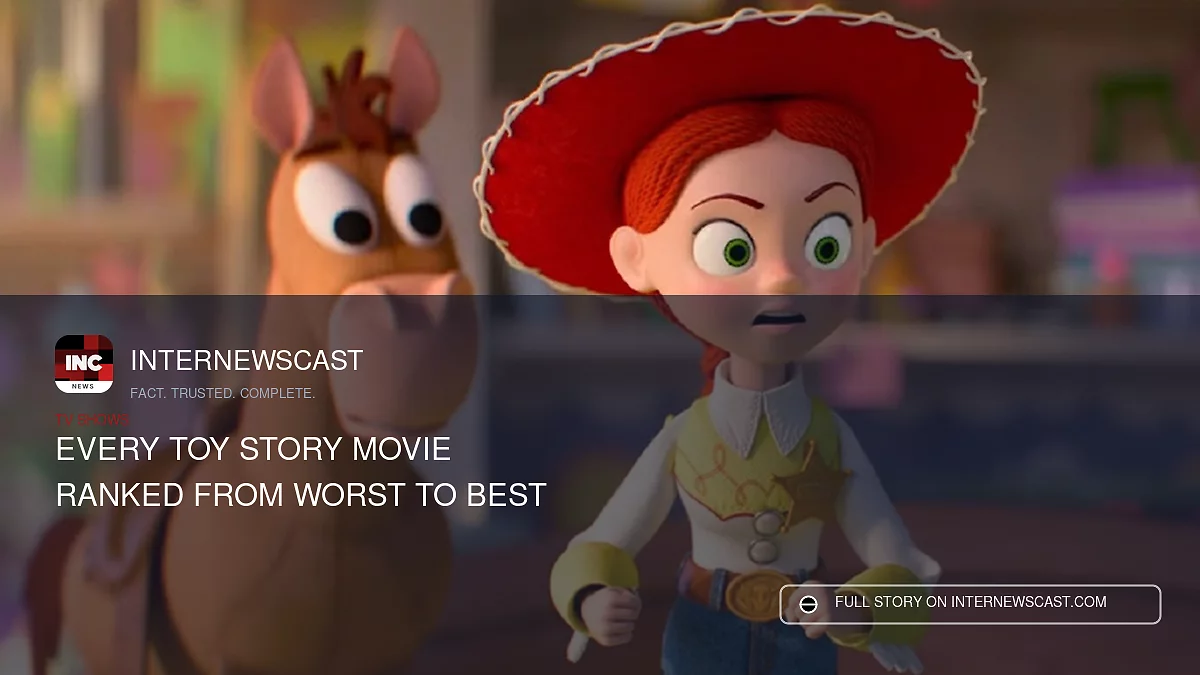
The film’s biggest challenge is tone. “Toy Story 5” sometimes struggles to blend its broad, high-energy comedy with more intimate material centered on Jessie, voiced by Joan Cusack, as she wrestles with fears of no longer being useful. The story also feels overstuffed at times, and Woody’s return is undercut by jokes that lean too heavily on familiar, tired gags. Even so, Stanton and Harris show that the “Toy Story” world remains a warm and engaging place to visit. The livelier sequences — including set pieces built around an army of Buzz Lightyear toys — are full of energy, while Jessie’s emotional moments still land with real feeling.
New voice additions, including Conan O’Brien and Craig Robinson, also bring plenty of comic spark to the ensemble. The franchise may be showing signs of age, but “Toy Story 5” proves these beloved characters still have plenty of appeal.
4. Toy Story 4
Disney/Pixar
After “Toy Story 3,” it was fair to wonder whether the world needed another “Toy Story” movie at all. Woody, Buzz and the rest of the gang had already completed a beautifully structured trilogy about devotion, growing up and learning when to let go. The third film’s closing echo of the original movie’s opening image made a fourth installment seem almost inevitably unnecessary. “Toy Story 4” never fully escapes that feeling, but it is far more charming and inventive than it had any right to be. If the film lacks the sense of necessity that defined its predecessors, it makes up for it with sharp comedy and dazzling visual imagination.
The screenplay by Andrew Stanton and Stephany Folsom gives “Toy Story 4” the feeling of an extended epilogue, recalling the closing passage of “Watership Down,” in which Hazel is finally allowed to rest and move on. In similar fashion, the film allows Woody to recognize that his purpose can extend beyond serving one child. That emotional throughline, combined with the return of Bo Peep, voiced by Annie Potts, and the wonderfully chaotic arrival of Forky, voiced by Tony Hale, gives “Toy Story 4” much of its unexpected strength.
Unfortunately, this does have by far the weakest third act in the “Toy Story” saga, especially in overly hyperactive and noisy cutaways involving an RV that really strain the credulity of toys and humans “interacting.” Still, director Josh Cooley and company wring a surprising amount of enjoyable material out of a sequel that, on paper, should have been a wholly disposable cash-grab.
3. Toy Story 3
Disney/Pixar
Randy Newman’s songs for the “Toy Story” movies are rightfully beloved, but the orchestral scores he composes for them also deserve plenty of love. His artistry in this department is in rare form with “Toy Story 3,” particularly when it comes to the Sunnyside Daycare sequences emulating a prison escape. In these scenes, Newman’s orchestral passages channel “The Great Escape” without lapsing into just hollow pastiche. Instead, his cues radiate propulsive energy and tangible tension. Just because these characters are made of plastic doesn’t mean there isn’t potent danger in this scenario, a reality that Newman’s score deftly conveys.
Delivering such a great score is one of the many ways “Toy Story 3” goes above and beyond the quality of a typical third movie. That excellence is also felt in the commitment to extraordinary emotional sequences in the film’s second half, like a masterfully realized dialogue-free scene depicting Woody and the gang holding hands as they accept their fate in a fiery furnace. Even with so many ruminations on mortality, “Toy Story 3” still makes time for delightful comedic digressions, such as any of the gags involving new character Ken (Michael Keaton).
Whether it’s paying homage to the likes of “Stalag 17” or saying good-bye to the ones we love, “Toy Story 3” is exemplary cinema that firmly solidified the original trio of “Toy Story” installments as one of the greatest film trilogies of all time.
2. Toy Story 2
Disney/Pixar
What’s immediately impressive when revisiting “Toy Story 2,” one of the best movie sequels of all time, is the feature’s breakneck speed. The movie wastes no time in giving Woody a ripped arm, placing him on a shelf, and then giving him an existential crisis about his own usefulness to Andy. This pacing ensures that “Toy Story 2” keeps on delivering imaginative characters and set pieces at an incredible clip. This includes new figures like Jessie (Joan Cusack) and Bullseye, as well as thrilling sequences like Woody navigating a landscape of Cheetos without making a noise. Every new “Toy Story 2” scene is a triumph that makes the soul sing.
Many of the best animated movies of all time have spawned sequels, but few have inspired follow-ups bursting with imagination like “Toy Story 2.” Better yet, this installment established a tendency for the “Toy Story” sequels to deliver extraordinary pathos-driven segments. The “When Somebody Loved Me” flashback depicting Jessie’s heartbreaking experiences with former owner Emily is an extraordinary accomplishment in shattering visual storytelling. Many iconic “Toy Story” tearjerker scenes would follow “Toy Story 2,” but this entry paved the way for those segments.
Oscillating between immense poignancy and tremendous entertainment (the latter element epitomized by any material involving Emperor Zurg), “Toy Story 2” basically gives moviegoers everything they could want. While so many animated movie sequels are soulless would-be cash cows, “Toy Story 2” is extraordinary filmmaking rife with personality and ambition. Plus, how can one argue with its hysterical end credit bloopers?
1. Toy Story
Disney/Pixar
The entire “Toy Story” timeline began with the 1995 original, the first computer-animated film in history. Pixar’s initial foray into big screen entertainment would spawn sequels and countless other CG movies that offered more polished animation and expanded storytelling, but the original “Toy Story” remains an engrossing piece of entertainment and a perfect bedrock for the entire saga. From the get-go, Woody, Buzz, and all the plastic inhabitants of Andy’s bedroom were so much fun to watch, and the sequels build off the charming character dynamics and friendships established in this inaugural installment.
Meanwhile, “Toy Story” also established all the exciting possibilities of filtering the everyday world through the perspective of small toys. Within these stories, a run-of-the-mill gas station or suburban streets become perfect tableaus for dramatic showdowns. It’s thrilling to watch recognizable locales become brand new through the eyes of Woody and Buzz. Their sharply written transformation from rivals to pals, meanwhile, also gives “Toy Story” enduring heart. It’s why the climactic “falling with style” moment is one of the great cheer-worthy moments in cinema history.
Decades after its debut, “Toy Story” remains a masterpiece whose charms can’t be diluted no matter how much CG technology advances. Whether it’s the characters, laughs, or Randy Newman’s bevy of catchy tunes, “Toy Story” offers up an abundance of entertainment.


