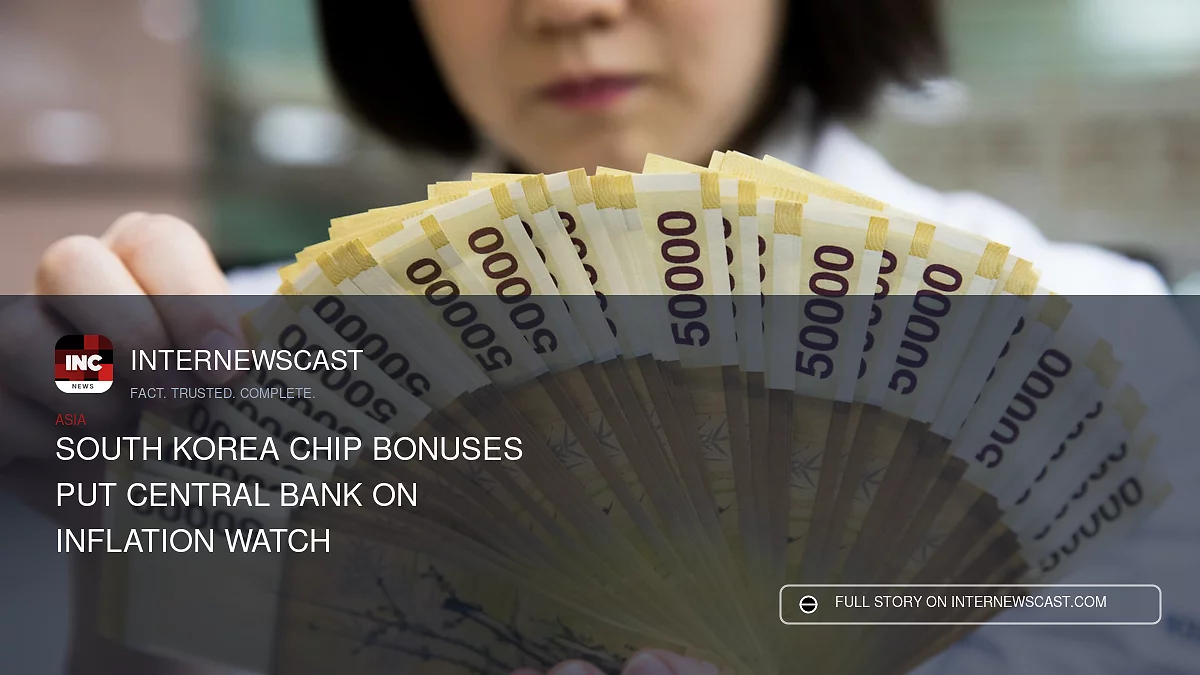

An employee counts authentic South Korean 50,000 won notes in a staged photo taken at KEB Hana Bank’s Counterfeit Notes Response Center in Seoul, South Korea, on Aug. 14, 2017. The won rose for the first time in four days as senior U.S. national security officials moved to ease fears of an imminent war with North Korea after several days of escalating rhetoric. Photographer: SeongJoon Cho/Bloomberg via Getty Images
Bloomberg | Bloomberg | Getty Images
Few employees receive bonuses so substantial that they attract the attention of a country’s central bank.
In South Korea, however, that is increasingly the case. Workers in the technology sector have been awarded bonuses worth millions of won, leading the Bank of Korea to caution that such payouts could add to inflationary pressure.
In a report released June 17, the central bank said inflation this year has been driven largely by higher energy prices linked to the Iran war. Still, it noted that even if the conflict eases, price pressures could build gradually as household income improves and wage gains become more common across the economy.
The BOK specifically pointed to sizable performance bonuses recently handed out by some major information technology companies, warning that these payments could spill over into broader wage increases and, in turn, place additional upward pressure on inflation.
The warning comes as South Korea is already facing inflation above the central bank’s target. The BOK expects consumer prices to rise 2.7% for the full year, exceeding its 2% goal.
The central bank’s comments follow reports of large bonus payments at major technology firms, particularly among employees of chip industry leaders SK Hynix and Samsung Electronics.
While the exact amount was not disclosed by the companies, SK Hynix agreed last September to a wage deal that will set aside 10% of operating profits as bonuses for its workers.
Samsung workers had reportedly agreed that 10.5% of its semiconductor operating profit will go towards special bonuses for chip workers, after threatening an 18-day strike in May.
According to an unidentified union source cited by Reuters, a memory chip worker with a base salary of 80 million won ($52,400) is expected to receive a total bonus of around 626 million won ($410,000) this year.
SK Hynix employees are expected to receive bonuses of more than 700 million won ($454,851) if the firm achieves an annual profit of 250 trillion won this year, according to Reuters calculations.
The BOK said that normally, bonuses would not contribute much to demand pressure, as they are not permanent increases to income.
But when “special bonuses expand unusually and substantially,” wage growth could could spread to other sectors, significantly increasing both supply- and demand-side inflationary pressures, the central bank said.
“In particular, because recent IT-sector performance bonuses have been paid on a highly exceptional scale, the possibility that their actual impact could be larger than expected cannot be ruled out,” it added.
Retail businesses celebrate
While the central bank frets, some businesses are already preparing for these workers to spend their windfalls at their stores.
BOK Deputy Governor Lee Jiho said in a press briefing on June 17 that “sales have increased significantly in places such as Suwon and luxury goods sections of department stores, and this could gradually spread further.”
South Korean media reports have said that some tech industry workers have spent big on luxury items in department stores, with accounts of workers buying bags, jewelry and watches.
The BOK said that in Gyeonggi Province — home to major Samsung Electronics and SK Hynix semiconductor facilities — card spending growth this year was relatively higher in areas near chip production sites and adjacent residential areas than in other regions.
South Korean media outlet Chosun Ilbo said that luxury consumption has “rapidly increased” in the southern Gyeonggi regions, where Samsung and SK Hynix are headquartered.
Luxury sales in a Shinsegae department store branch in Gyeonggi province rose by 53.6% year-on-year, the newspaper reported in May, with luxury jewelry surging by 146.3% and luxury watches growing by 85.3% over the same period. Overall store sales grew by 19%, according to the newspaper.
Shares of South Korea’s major department-store operators have also rallied alongside growing expectations that high-end consumption will strengthen.
Lotte Shopping, the retail arm of the Lotte Group, has surged more than 148% year to date, with a 67% jump in its share price in the past three months alone.
Hyundai Department Store shares are up 120% year to date, with a whopping 113% gain in the last three months, while Shinsegae has led the pack with a 190% gain in share price from the start of the year.
Most of Shinsegae’s gains have come recently, with its shares jumping 107% in the last three months.


