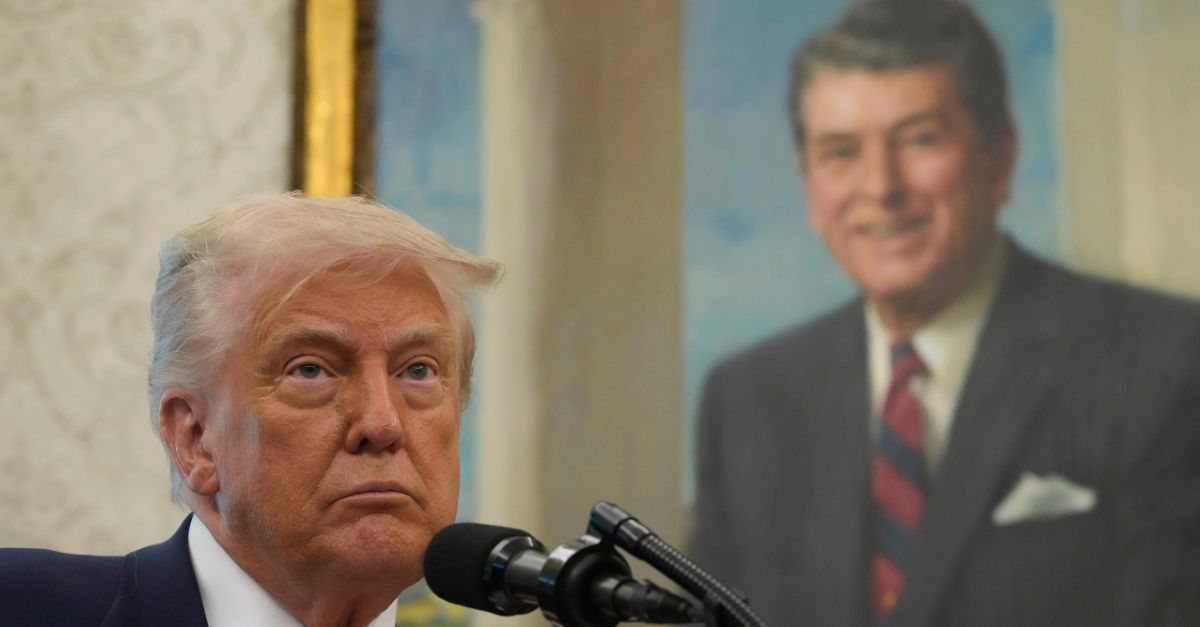

President Donald Trump speaks before Steve Witkoff is sworn in as special envoy during a ceremony in the Oval Office of the White House on Tuesday, May 6, 2025, in Washington, with a portrait of former President Ronald Reagan visible in the background (AP Photo/Mark Schiefelbein).
A group of former federal judges is urging a sitting federal judge to take a closer look at President Donald Trump’s proposed $1.776 billion “anti-weaponization fund,” asking her to keep control of the case and examine how the arrangement came together.
“At issue here are the parties’ extraordinary actions: an obviously collusive suit; an unprecedented, clearly unwarranted settlement premised on the supposed legitimacy of that suit; active steps to prevent the Court from scrutinizing the legitimacy of their invocation of the judicial process; and now, the Justice Department unilaterally walking away from the huge settlement,” the motion says.
Trump’s original lawsuit against the IRS was filed in January in the Southern District of Florida. By mid-May, however, the case had been closed at the plaintiff’s request, with the 45th and 47th president instead pursuing a publicly funded mechanism that would compensate pro-Trump allies and others in similar positions.
U.S. District Judge Kathleen Williams, an appointee of former President Barack Obama, noted concerns about whether the matter had truly reached a proper endpoint in her order closing the case. Still, she appeared prepared to let the dismissal stand, at least temporarily. At the same time, at least four other lawsuits and claims have been brought in an effort to slow or stop what critics have described as a “slush fund.”
Among those claims was one filed by nearly three dozen former federal judges, who asked Williams to reject what they called the “fraudulent nature” of Trump’s voluntary dismissal, “reopen” the case, and investigate “exactly what happened here,” as Law&Crime previously reported.
Trump’s legal team pushed back sharply in a 22-page response, accusing the former judges of filing “a baseless motion to reopen a case that was lawfully and properly dismissed.” They argued that the judges’ professional backgrounds “only makes their frivolous motion all the more damaging to our rule of law.”
The dispute has now escalated further. In a 20-page reply motion, the 35 former judges suggest the plaintiffs’ objections only underscore the need for judicial scrutiny.
“Plaintiffs’ filing only underscores the need to investigate whether the parties have perpetrated a fraud on this Court and corrupted the integrity of the judicial process,” the latest filing begins. “There is reason to believe the parties used this suit and subsequent settlement to give cover for a give-away to the lead Plaintiff, who also controls the Defendants. Plaintiffs now seek to complete that deeply concerning process by insisting that the Court can do nothing.”
The reply goes on to accuse the president’s lawyers of something not entirely unlike hypocrisy in how they previously approached the court:
After Plaintiffs filed the lawsuit, they moved this Court—with Defendants’ consent—to exercise its “inherent authority” to pause proceedings for the parties to engage in “discussions designed to resolve this matter.” This device postponed Defendants’ obligations to answer or move for dismissal. When this Court directed the parties to address whether the parties to this case were actually adverse, they evaded their obligation to respond. Two days before the Court’s deadline, they signed “settlement” papers that invoked this lawsuit as the premise for the settlement…
To hear the ex-judges tell it, the Federal Rules of Civil Procedure, along with the court’s inherent authority, which was previously invoked by Trump’s own legal team, “supply it with options for appropriate relief.”
Trump’s team insisted the procedural vehicle they used divested the court of jurisdiction and that the former judges wholly lacked standing to invoke their own chosen procedural attack on the settlement.
The nearly three dozen jurists pushed back on both arguments.
“Plaintiffs are wrong,” the reply continues. “Their attack on [the ex-judges’] standing and motivation is irrelevant; the Court has broad sua sponte authority to unearth potential fraud on the Court, a power that is ‘beyond question.’ Plaintiffs’ attempted defense of the merits of their suit and validity of the settlement is self-defeating.”
The former judges say the proof is in the pudding.
At the outset, they note how Trump’s team filed “a dismissal notice purporting to strip the Court of all power to investigate and decide whether the rationale for the settlement was a collusive and non-adversarial lawsuit” and then “even warned the Court that ‘[u]pon the filing of this Notice, no judicial analysis is appropriate.'”
Then, after the ex-judges sought to intervene and Williams asked questions, the plaintiffs, in no uncertain terms, told the judge she was bound by the rules to back off, the latest filing observes.
“If Plaintiffs believe they can effectuate all the parts of their ‘settlement’ without the existence of this lawsuit, they would not have tried so mightily to evade this Court’s inquiry into lack of jurisdiction,” the motion goes on. “Contrary to Plaintiffs’ suggestions, the Court’s investigatory power is not defeated by a voluntary dismissal. The court retains jurisdiction to vindicate its integrity even after the underlying action has ended.”
The former judges repeatedly reference what they see as the likelihood of a fraud having been committed on the court – and argue the settlement’s entire context and content are “evidence of fraud.”
“[T]his suit was collusive from the start: the same person controlled it on both sides of the ‘v’; President Trump,” the reply continues. “DOJ’s failure to raise dispositive winning defenses while ‘settling’ the case for an astronomical sum of taxpayer dollars and extraordinarily broad releases to plaintiffs just days before having to answer this Court’s questions about collusiveness is further evidence of both collusion and fraud on the court.”
In their response, Trump’s lawyers argue civil settlements are rational when “the cost of defense exceeds the cost of settlement.”
The ex-judges aim to rubbish this argument as “laughable” by pointing to the amount of the settlement as well as the “capacious and extraordinary general release that purports to forfeit claims for substantial sums in unpaid taxes and other potential damages and fines.”
One of the more controversial aspects of the would-be settlement was an agreement to bar the IRS from auditing the past or present tax returns of Trump, his sons, or the Trump Organization.
Again, the motion, at length:
This monumental relief dwarfs any conceivable “cost of defense.” And on the identity of the parties, Plaintiffs’ only response is suggesting that including the President’s sons and business in the lawsuit somehow solves the problem. It does not. The individual plaintiffs are (1) from the same family who (2) are business partners with the same financial interests and counsel, that (3) own or manage the corporate plaintiff.
“Plaintiffs have no answer for the fact that the lead Plaintiff, President Trump, directs and controls the Defendants,” the reply goes on. “That alone renders this lawsuit non-adversarial, collusive, and jurisdictionally improper.”


