
Investors and personal finance specialists have reacted with fury after it emerged yesterday that Isas are set to face taxation for the first time in their history.
According to fresh proposals unveiled by Labour, anyone holding cash inside a stocks and shares Isa would face a 22 per cent levy on the interest that money generates.
Financial experts warn the move risks creating confusion around what has long been promoted as a tax-free way to save and invest.
So what could the changes mean for your investments — and what little-known loophole might help you cut your tax bill instead?
How are Isas changing next year?
Isas generally fall into two main categories: cash Isas, which allow savers to earn interest free of tax, and stocks and shares Isas, where investment gains are also sheltered from the taxman.
At present, individuals can pay up to £20,000 a year into Isas, either placing the full amount into one type or dividing it between cash and investment accounts.
But in November’s Budget, Chancellor Rachel Reeves set out contentious changes to the annual Isa allowance.

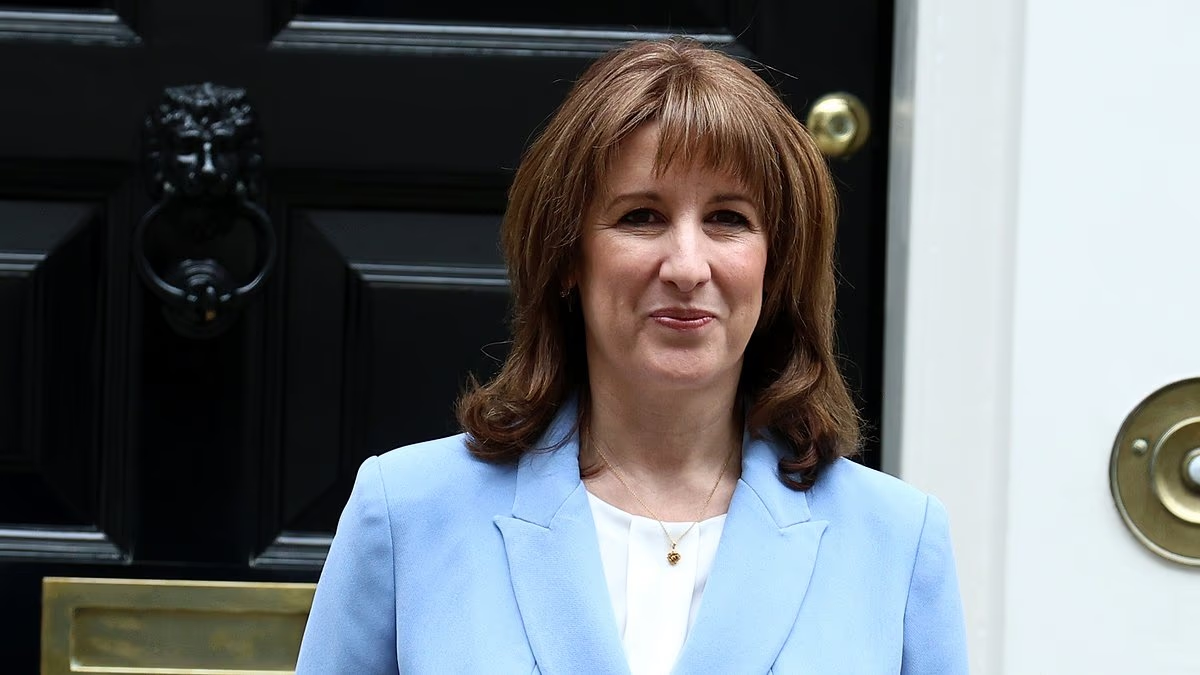
Chancellor Rachel Reeves is targeting Isas in one of her final moves at Number 11
From 6 April 2027, savers under the age of 65 will be able to put a maximum of £12,000 into a cash Isa and if they want to invest the remainder (£8,000), they can put it into stocks and shares.
It is designed to push die-hard savers into investing some of their money, as equities typically give stronger returns over the long term.
But the change has caused sustained uproar among many households who do not want to put any of their cash into risky investments.
What is the new tax charge – and how will it hit my portfolio?
The Treasury yesterday announced a brutal new tax charge that undermines the tax-free Isa promise.
The Treasury announced last night it will introduce a new tax to punish investors for holding cash in these accounts from April 2027.
Those who hold cash in their stocks and shares Isas will be clobbered by a 22 per cent tax charge.
It means if you hold any cash for legitimate reasons in an investment Isa, you will be landed with a tax bill.
The rules have sparked mass outrage among financial insiders and private investors alike who say it ‘undermines’ the principle of the tax-free wrappers.
Why has the Government done this?
Ms Reeves was faced with a conundrum after announcing the cut to the cash Isa allowance in November – cash can also be held in a stocks and shares Isa account.
This is often for legitimate reasons. But Ms Reeves plans to impose the new rate of savings tax on cash in investment accounts to prevent savers sidestepping the raid on cash Isas
However, as many insiders have told the Mail, this is a problem that doesn’t yet exist – and they think the ‘solution’ lauded by the Government is way out of proportion.
Plus, the move will land investors with a genuine reason for holding cash in their investment Isa with a tax bill that eats away into their hard-earned cash.
Why might I need to keep cash in my investment Isa?
There is a myriad of reasons why an investor may need to legitimately hold cash in their stocks and shares Isa account.
For example, you may funnel your annual Isa allowance into your account before the April 5 cut off, but haven’t yet decided where to place your money.
You may be holding off investing during a time of particular market volatility, or selling your investments to avoid market swings ahead of big purchases such as buying a house or paying for children’s university fees.
Investment admin such as receiving dividend income is also often done in cash.
One investor told us they keep cash in their account to pay the annual fees, so the charges are not taken from their portfolio.
But all of these legitimate investors who are not trying to flout the rules will now be penalised by the Treasury in the tax sting.
Can I get around the punishing new tax?
If you hold any cash, no matter how small or how little time, it is expected you will be charged 22 pc on any interest that cash generates.
The Government has yet to release full details of how the charge will work in practice, but under the current plans it seems there will be no grace period for those who are only holding cash for a few days.
More details will be released shortly following a consultation with the investment industry and regulations will be laid out in the autumn.
It’s sparked fury among investment experts who say it will be an administrative nightmare to work out the tax due.
However, if you still want exposure to cash-like investments, without the tax charge, you can exploit a loophole in the new rules.
The new rules allow for investments in money market funds. These funds typically invest in government bonds set to pay out in the next few months, so the income they offer is quite secure.
There were initial fears that these ‘cash-like’ vehicles would be stung too.
But the Government has confirmed that these will be allowed in a stocks and shares Isa, so long as the whole portfolio isn’t invested in them.
It means that, in theory, you could hold 99 per cent of your portfolio in money market funds, and just 1 per cent in equities, to retain a ‘cash-like’ exposure in your portfolio without the tax sting,
Rob Hillock, of consultancy Broadstone, says: ‘The rules appear to leave the door open for investors to hold portfolios that are overwhelmingly invested in money market funds, provided they are not invested 100 per cent in those assets.
‘Some savers may view this as a way of retaining a largely cash-like exposure within a stocks and shares Isa while avoiding the new tax charge on cash balances.
‘It potentially risks adding further to the complexity of the new rules which risk confusing savers and deterring long-term saving – the opposite of what is surely intended.’
The Treasury has yet to confirm whether portfolios that exist purely of money market funds will be drawn into the tax sting, or will simply be prohibited.
Will it be worth keeping cash in an investment Isa?
There is one saving grace to come out of this brutal tax charge – it’s a flat-rate for all taxpayers.
Instead of the charge being levied in accordance with someone’s marginal tax rate, the tax will be levied at 22 per cent for all.
It means that for some taxpayers, it may be more worthwhile to keep their cash savings in a stocks and shares Isa than a traditional savings account.
Basic rate taxpayers have a £1,000 tax-free allowance, £500 for higher rate and additional rate do not get any allowance.
It means that if you’re a higher or additional rate taxpayer, and you’ve used up your existing £12,000 cash Isa allowance and your personal savings allowance, you’ll pay less tax on savings interest by placing it in a stocks and shares Isa.
For example, a higher rate taxpayer would ordinarily pay 40 per cent on any savings interest over their £500 personal savings allowance.
This is rising to 42 per cent in April next year as Ms Reeves hiked savings taxation rates at last year’s Budget.
However, under these new rules, they will only need to pay 22 per cent if the cash is held in a stocks and shares Isa.
It’s the same for additional rate taxpayers, who currently pay 45 per cent on interest, rising to 47 per cent next year.
However, if you’re a basic rate taxpayer, as of next April you’ll end up paying the same amount on your savings interest in a stocks and shares Isa as you do in a traditional savings account – 22 per cent.
It means that the exchequer could lose reams of savings tax revenue if taxpayers cotton on to this loophole.
To work out what the best strategy is from April 2027, you need to check what rate your investment platform offers on uninvested cash, as they vary wildly.


