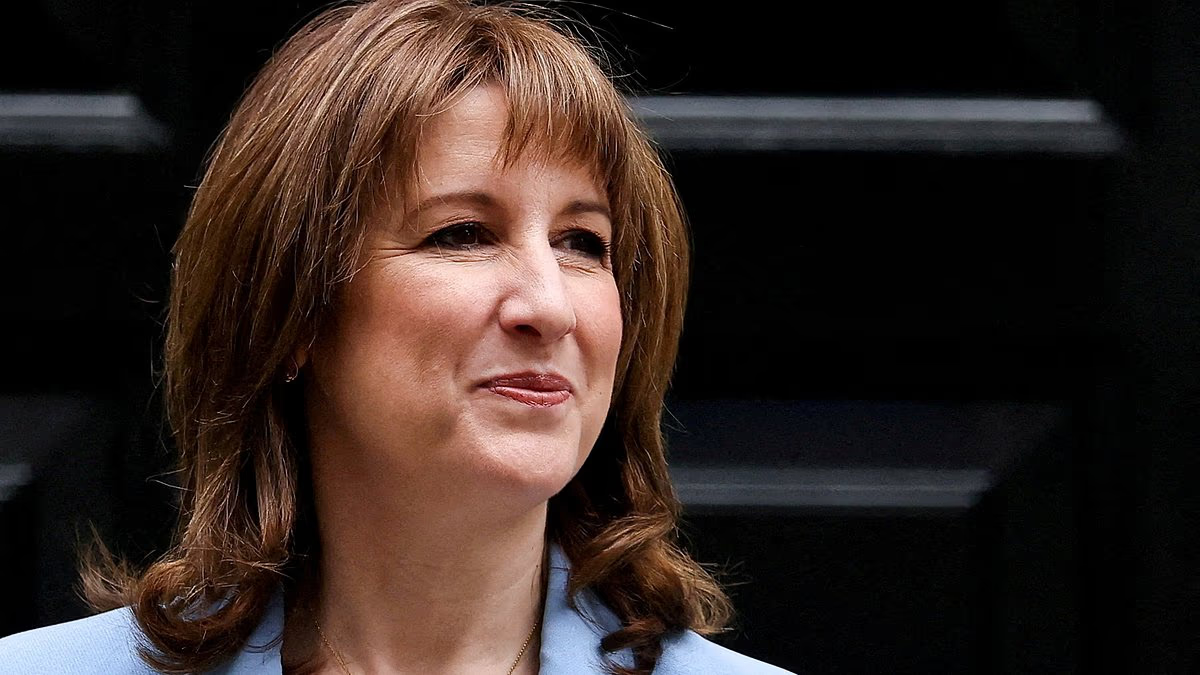

Isas are set to face taxation for the first time under plans announced as one of Rachel Reeves’s final moves as Chancellor.
Savers holding cash inside stocks and shares Isas could soon be hit with a 22 per cent tax charge, in a move critics say breaks the long-standing promise that Isa savings are tax-free.
The Treasury confirmed last night that a new tax will be introduced from April 2027, targeting cash kept within these investment accounts.
The proposed changes have triggered anger across the financial sector, with experts describing the rules as “draconian” and warning they could damage confidence in one of Britain’s most popular savings products.
Senior figures in the industry told This is Money and the Daily Mail that the tax-free principle underpinning Isas has now been “undermined”.
They warned that applying a charge to interest earned on cash would weaken Isas’ reputation as a reliable tax-efficient savings vehicle and add further complexity to an already confusing system.
Ms Reeves is preparing to apply the higher savings tax rate to cash held in investment Isas, in an effort to stop savers from avoiding her Budget squeeze on the cash Isa allowance.

Rachel Reeves targeted the cash Isa allowance in the Budget and is now planning to tax certain Isa savings for the first time to prevent savers from bypassing the changes
Last November, Ms Reeves cracked down on the amount that can be saved in cash Isas, slashing the annual allowance from £20,000 to £12,000 for under-65s from April 2027.
The amount that can be put in an investment Isa will remain at £20,000 in each tax year, in a bid to push more savers to invest in the stock market.
However, the Chancellor has now gone one step further. Savers who hold cash in a stocks and shares Isa will have to pay 22 per cent in tax on any interest they earn from April.
Shadow Chancellor Sir Mel Stride told the Daily Mail: ‘Rachel Reeves’ parting gift to Britain looks set to be a further tax raid on savers. Labour’s tax changes are a double whammy for savers – cutting Isa allowances while raising the tax rate on savings interest.
‘Now it looks like even investment Isas will not be safe. Labour are punishing people who have done exactly what governments have long encouraged them to do: work hard, save, and get ahead.’
Why investors often need to hold cash
There are two main types of Isas – a cash Isa where savers can earn interest without paying any tax, unless with ordinary savings accounts and a stocks and shares Isa where investment returns are tax-free.
However, savers typically hold cash and ‘cash-like’ money funds in stocks and shares Isas. This can happen when money is added to the account but not yet invested in a stock or fund or if someone is holding off investing their money during periods of market volatility.
From April 6, 2027, savers under the age of 65 will only be able to put a maximum of £12,000 into a cash Isa and if they want to invest the remainder (£8,000), they can put it into stocks and shares.
The Chancellor’s swingeing 22 per cent tax charge is designed to stop savers flouting the new cash Isa cap coming into effect next April, amid fears that savers will place all of the remaining £8,000 allowance in cash inside an investment Isa.
Under current rules, this money would earn a high level of interest free of tax.
Those holding cash in their accounts for genuine reasons, such as while they choose where to invest their funds, will also be clobbered by the tax raid.
Jason Hollands, a managing director at investment platform BestInvest, says: ‘This undermines the tax-free promise of Isas. It’s like using a sledgehammer to crack a walnut.’
Plus, there are concerns that appetite for investment risk may sour due to the charge.
Rachael Griffin, of wealth manager Quilter, says: ‘It risks making the product feel more complicated at precisely the point policymakers want cautious savers to take their first steps into investing.
‘In practice, applying a flat-rate charge to interest means investors will simply receive a reduced net return regardless of their personal tax position, effectively introducing a consistent haircut across cash holdings rather than targeting a specific behaviour.’
Simon Harrington, of the Personal Investment Management & Financial Advice Association, added: ‘We remain disappointed that the government has chosen to introduce such draconian anti-avoidance measures and, by extension, further complexity into the Isa regime, with little to no evidence that consumers will behave as these measures assume.’
There were initial fears that ‘cash-like’ money market funds could be swept into the tax sting, too. These funds typically invest in government bonds set to pay out in the next few months, so the income they offer is quite secure.
But HMRC has yet to clarify whether those with portfolios entirely made up of these money market funds will be penalised.
Transfers from non-cash Isas into their cash equivalent will also be banned under the new regime, but the reverse will be allowed.


