

Parisa Taghizadeh/Warner Bros
Birthdays can be hard to celebrate when your home world is gone and your family has been reduced to memory. That is the shadow hanging over Kara Zor-El (Milly Alcock) as “Supergirl” begins. Nearing 23, she is drifting through the galaxy on a bleak, boozy crawl, hopping from one red-sun dive bar to another in an effort to feel anything at all. Calls from her cousin Clark (David Corenswet) go ignored. She passes out on the toilet, while Krypto manages to turn her ship into his own bathroom. But Kara’s spiral is interrupted when a newly orphaned girl, armed with a sword and hungry for revenge, crashes into her life and pulls her into a dangerous journey across the stars.
By the time “Supergirl” reaches its conclusion, the drunken, grief-stricken 23-year-old has been reforged into the symbol of hope Clark always believed she could become. The movie’s final stretch plays almost like a victory lap: once Kara confronts the despair that has been quietly defeating her from the inside, no external villain seems capable of truly stopping her.
As superhero space operas go, this one does not reinvent the genre. The sci-fi henchmen are dispatched with minimal depth or ceremony, and many of the worlds Kara visits blur together in shades of brown rock, dust, and rusted frontier settlements. Still, Milly Alcock gives the film its spark. Her performance, paired with a familiar but sturdy emotional arc, gives “Supergirl” a clear momentum that carries it through to its final act.
With that in mind, here is a closer look at the road that brings Kara to that ending, and what “Supergirl” is really building toward.
A galactic adventure
Warner Bros.
“Supergirl” begins in rough-edged fashion, following Kara on a grim galactic bar crawl as she tries to drown her grief in cheap alcohol and space cereal. Krypto, however, remains the one presence able to bring her back down to earth — or something close to it. So when an encounter with the Brigands, a gang of spacefaring human traffickers, ends with Krypto being struck by a poison dart, Kara is forced into action. The clock is brutal: she has three days to find the antidote before her dog dies.
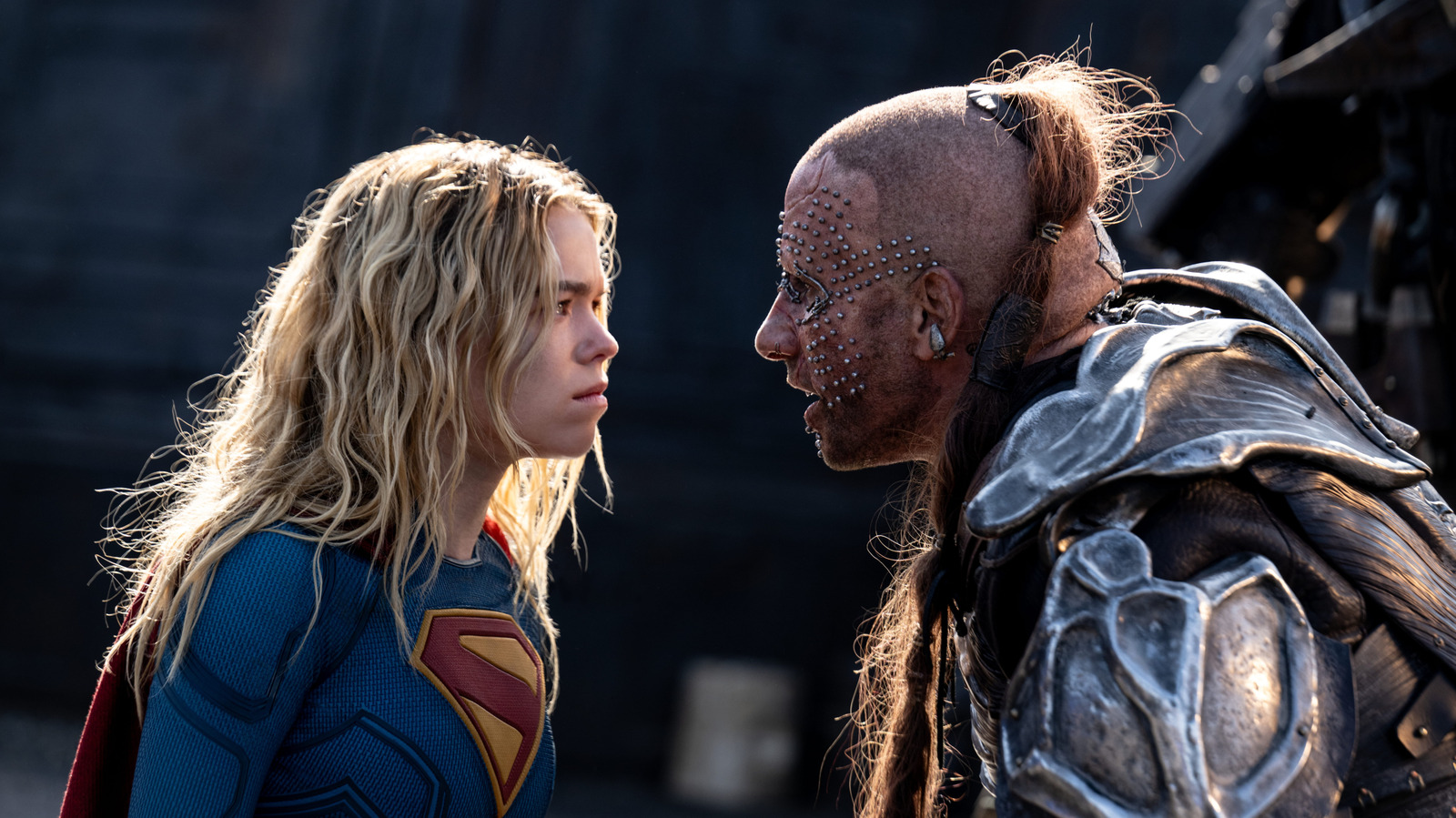
Along the way, Kara crosses paths with Ruthye (Eve Ridley), another person in need of protection, though not one eager to be protected. Ruthye is determined to avenge her family after the Brigands and their leader, Krem of the Yellow Hills (Matthias Schoenaerts), destroy her life. Her father (Ferdinand Kingsley), a respected swordsmith, is killed alongside her mother (Emily Piggford) and brother (Emond Knoll). Kara tries to steer Ruthye away from vengeance, but the girl’s resolve is not easily broken.
From there, the story moves through a fairly conventional run of action sequences, reversals, and revelations. Kara and Ruthye survive an attack on their space bus before arriving on Bilquis, where they encounter the notorious intergalactic mercenary Lobo (Jason Momoa), who is also hunting the Brigands. The pirates soon strike again, searching for more “brides” to sustain their all-male bloodline, and Kara and Lobo join forces to fight them off. When the Brigands get away, Kara pressures a local informant into leading her to their base, only to discover it sits on a planet caught between green and yellow suns. The green sun’s effects nearly kill her. Just when the situation appears hopeless, Ruthye defies Kara’s instructions and pulls her to safety.
What happens at the end of Supergirl?
Warner Bros
The final act of “Supergirl” unfolds largely on Barenton, the planet where Krem has parked his flagship between raids. Barenton is defined by its exposure to both a yellow sun and a green sun, with the latter weakening Kara in a way comparable to Kryptonite — a detail explored more fully in the “Supergirl: Woman of Tomorrow” comic series that inspired the film.
After Ruthye drags Kara to a cave for safety, she goes out in search of water but is captured by the Brigands. In their ship, Ruthye encounters Lobo again, who has also been captured. The two escape, but Ruthye is caught again on the ship’s deck by Krem. Thankfully, the green sun sets and the yellow sun rises, and Supergirl emerges in full costume (delivered to the planet by Ruthye) to wreck shop.
In short order, and with a little help from Lobo, Kara dispatches the Brigands and saves the women they abducted. When Ruthye has a chance to kill Krem and avenge her slain family, Kara persuades her to let it go. After Ruthye walks away, Kara kills Krem herself. They then return to Krypto with the antidote and save him. After a tearful goodbye with Ruthye, Kara goes back to Superman to say that she’s done bouncing around the galaxy, and is ready to stay in one place for a while and be the hero he knew she was.
Supergirl returns as a protector
Warner Bros.
Throughout “Supergirl,” but especially at the end, Kara’s transformation into a true hero is all about protecting the helpless. She takes clear joy in beating up cronies earlier in the film for the sake of it, but gets a hard jolt during the battle on Bilquis when Krem kills a whole family in front of her. Ashamed and guilt-ridden, Kara pursues him alone, even though the plan is reckless.
In the final battle on Barenton, much of the action is framed around Ruthye. It’s like we’re seeing Kara in her full glory from the girl’s perspective. While Ruthye brandishes her sword many times during the battle, Kara always jumps in right before she strikes. Not only does she protect her, but she keeps her from committing the kind of violence Kara is familiar with.
This desire to “save” Ruthye extends to the confrontation with Krem. Kara and Ruthye bond over their shared loss of home and family, which Kara tells her can’t be cured by simple revenge that could leave Ruthye worse off in the long run. By killing Krem herself, she steers Ruthye clear from future harm, but she also shields her from the burden of having killed a man in cold blood. Like her cousin, Kara’s moral root is that of a protector. And yes, she saves the captured women, too.
Lobo saves the day (kind of)
Warner Bros.
Jason Momoa’s public love of Lobo came full circle when he was formally cast in “Supergirl.” The addition also helped realize part of the original plan for the “Woman of Tomorrow” comic. According to writer Tom King, the initial vision for the series was inspired by “True Grit,” with Supergirl and Lobo acting as differing role models to the young Ruthye. Lobo was cut from the comic, though most other core details are adapted faithfully in the film (artist Bilquis Evely even gets two planets named after her).
While Momoa kills it in the role and the character’s inclusion makes good on the original comic pitch, Lobo feels a bit out of place in the movie. He is given little development and an extremely convenient connection to Kara’s request that avoids any real dynamic between the two. Lobo’s powers and abilities are on full display, though, and he uses them to great effect to help Kara in the climax.
After Kara lays waste to the Brigands, there’s a distant shot of Lobo watching from afar, cigar chomped between his teeth, nodding in approval. It’s a shame they don’t spend more time together, but Momoa has made it clear that he wants to return to the role in a bigger way. As of yet, there are no such confirmed plans, but the character’s introduction to the DCU is as a helpful antihero leaves many possibilites.
Be good, not nice
Warner Bros.
In flashbacks to the fall of Krypton, Kara’s mother urges her to be good, but clarifies that it doesn’t always mean to be nice. Later, when Kara is suffering beneath the glow of the green sun, Ruthye says something similar — that Kara is not always nice, but she is kind.
That distinction is one of the core thematic principles of the film. Kara’s crudeness and willingness to embrace temporary darkness for the greater good are a stark contrast to Superman, and even when she rises in full garb at the end — arguably the best Supergirl has ever looked in live-action, by the way — she maintains her edge. What could have been a generic story about the dangers of revenge becomes a more nuanced tale of how tragedy changes you, all because Kara, unlike her cousin, is willing (and even a bit invigorated) to kill Krem.
At one point, about midway through the story, Kara describes Clark as being “younger” than her, even though he is about a decade older. When Ruthye asks what she means, Kara says that his heart is lighter, because he never experienced the kinds of things that Kara, and now Ruthye, have gone through.
Supergirl is a story about healing from grief
Warner Bros.
There is no confusion as to what “Supergirl” is about. The film hits its main theme repeatedly, but most powerfully in the quiet moments between Kara and Ruthye. Their conversation on Bilquis, when Kara explains the fall of Krypton, is a much-needed respite in the midst of a breakneck plot, and it’s where Kara delivers the film’s big treatise on grief.
After telling her story, Kara urges Ruthye to reconsider her revenge plot, saying that loss and grief can push you to all kinds of dark places and revenge won’t make it better. It’s a nice sentiment, but Ruthye cuts through it almost instantly, asking Kara when she finally stopped being angry about what happened to her. In a prestige moment of her performance, Milly Alcock scoffs quietly, and then, as much to herself as to the girl, responds, “Any day now.”
Even when she returns to Earth, it’s clear her journey isn’t over. She has made the first major step of choosing to become something greater than her grief, but the work is ongoing, and the film thankfully doesn’t judge her for her continued bouts of fury. By taking on the burden of killing Krem, Kara allows Ruthye to return to her life in peace. We are told that she will live with her aunt, and plans to take up her father’s craft of making swords. Hopefully, she will rarely have to use them.
Supergirls, Supermen, and turning 23
Warner Bros.
While the grief theme is thoroughly explored in “Supergirl,” the film unfortunately doesn’t spend as much time on its other interesting ideas. There’s a brief nod to the inherent sexism in Superman being a “man” and Supergirl being a “girl” — an idea intrinsically questioned by the title of the source material, “Supergirl: Woman of Tomorrow.” When it’s revealed that the Brigands are kidnapping girls to be their “brides,” it seems like the film might engage deeper with its inherently gendered themes.
What we get instead is standard superhero action, with almost no time paid to how the specific crimes of the Brigands might resonate with Kara or Ruthye. While a female superhero movie is not required to engage in gender politics, it feels odd that “Supergirl” puts so much emphasis on explicitly gendered violence, only to dodge it.
There’s some more interesting material in how age and maturity aren’t directly linked. Though she is young, Kara carries the weight of a dead race with her. She carries her father’s pocket watch, adding to the running theme of time, but again, the film doesn’t pull these threads together. You can read the character as a person out of time, with a three-day deadline to save Krypto yanking her back in a visceral way. But the film spends so much time on CGI battles and plot-centric dialogue that these ideas don’t get space to breathe.
What the cast and crew of Supergirl have said about the ending
Fred Duval/Shutterstock
In a May 2026 interview with Variety, Milly Alcock discussed how Kara’s arc in “Supergirl” is symbolized by her finally putting on the costume. “She realizes that being Supergirl has nothing to do with her and has to do with everybody else around her,” the actress said. “She needs to put her own feelings aside to help others, and through that she can save herself. So that’s what the suit is for her.” Kara finally returning to Earth in full costume, matching her cousin, closes out the journey nicely.
Director Craig Gillespie shared similar sentiments with The Playlist. “Bizarrely, sort of miraculously, through her journey with Ruthye, whom she’s helping along the way very reluctantly, she realizes it’s almost like holding a mirror up to herself,” he explained. The director elaborated on the similarities with his previous films, like “Cruella” and “I, Tonya,” in their depictions of complicated women. “I’ve gotten into this section of very strong female characters that are flawed and human and overcoming obstacles. It’s a space that I love to be in.”
For Eve Ridley, the production helped their arcs click into place by the third act. “I think it was really lovely to see [Ruthye and Kara’s bond] over time because the film was shot in chronological order,” Ridley told SciFiNow, “so as our characters developed, my and Milly’s relationship also developed … it was definitely very fun to shoot in that way.”
When will Supergirl appear next in the DCU?
Warner Bros.
Kara’s return to Metropolis at the end of Supergirl shows that she is finally ready to heal. That’s not the same as healing. Her grief still burns, but she’s done running from it and drowning her sorrows in self-destructive behavior. Putting on the costume in the third act, which she initially tells Ruthye doesn’t have any special powers or meaning, itself signals her growth.
Beyond the character arc, there are also implications for the larger DCU story. Having two Kryptonians on Earth is a huge boon for the human race, and with Brainiac as the main villain in James Gunn’s upcoming “Man of Tomorrow,” the planet will likely need them both. The “Superman” sequel is currently scheduled for a theatrical release on July 9, 2027, and Supergirl is confirmed to be a part of it.
Gunn’s DC Universe timeline has a lot more on the docket, but we don’t know yet if Kara will get a proper sequel outside of her appearance in “Man of Tomorrow.” The critical response to “Supergirl” has been pretty mixed, and the likely merger between Warner Bros. Discovery and Paramount Skydance could have looming implications for the DCU as a whole, should the deal go through. At the very least, we’ll see Alcock put on the cape and boots once more in 2027.