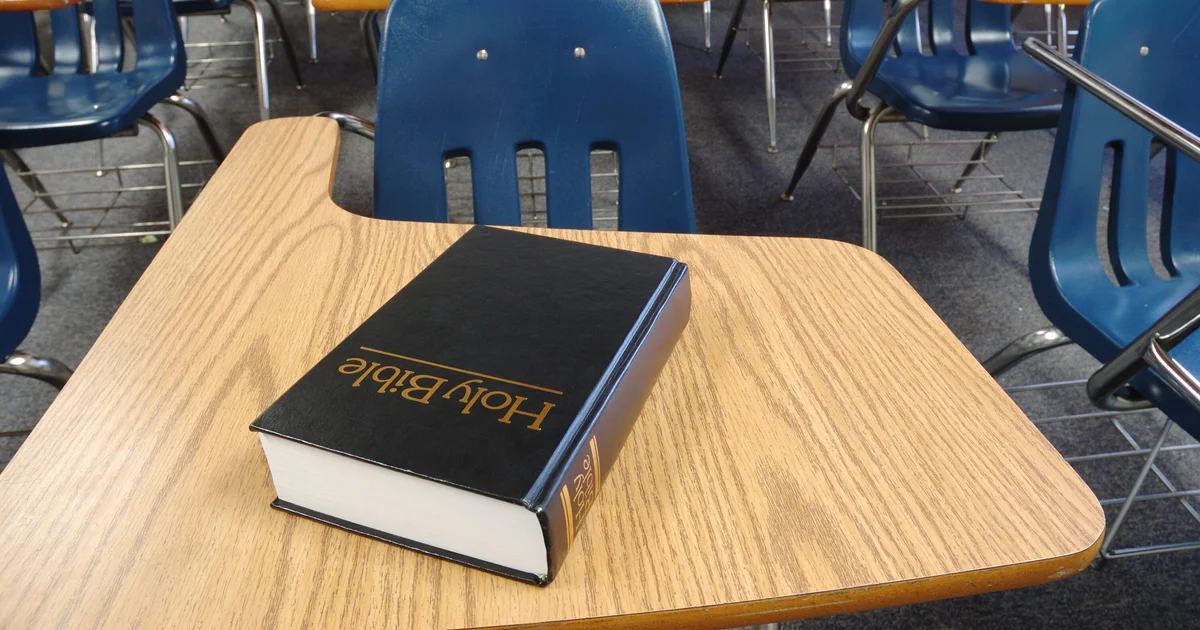
Texas public school students will be required to read selected Bible stories under a new reading list approved Friday by the state’s education board, expanding a broader conservative push to introduce more Christian-themed material into U.S. classrooms.
The Republican-led Texas State Board of Education adopted the list despite objections from critics who said the selections are not sufficiently diverse and risk weakening the constitutional separation between church and state.
The requirement will apply to more than 5 million students in Texas public schools. Along with classic works such as E.B. White’s “Charlotte’s Web” and Charles Dickens’ “Great Expectations,” students will also have to read Bible passages, including selections from the New Testament and excerpts from the Book of Job. The policy will be phased in over time, beginning with elementary students in 2030.
Opponents have spent months criticizing both the inclusion of required Bible readings and the state’s decision to dictate specific books for students, choices that have traditionally been made by classroom teachers. Educators would still be allowed to assign additional books beyond the mandated titles.
Backers of the measure argue that Judeo-Christian traditions played a central role in the nation’s founding and should therefore be represented in public school instruction.
Texas, home to about 1 in 10 public school students in the United States, has become a leading battleground in conservative efforts to incorporate more religion into classrooms. The state already permits public schools to employ chaplains as student counselors, requires classrooms to display the Ten Commandments and has approved an optional curriculum infused with biblical references.
A focus on Christianity
Critics say the reading list offers too narrow a range of perspectives, muddies the church-state divide protected by the Constitution and gives teachers and students limited flexibility in choosing what to read.
“Texas schools serve children from every faith tradition, as well as students with no religious affiliation, and all of them should feel that they belong,” said Elva Mendoza, legislative communications associate for the progressive Texas Freedom Network. “But this sends children the message that only one religious text — a Christian one — deserves a place on the required reading list.”
Others have applauded the possibility of mandated Christian religious reading in public schools. Brooke Mazel, a retiree from Lubbock, encouraged the board to adopt biblical materials, saying her children and grandchildren grew up with “strong faith and family values.”
“America should celebrate our 250 years that started as a nation of unwavering Christian values,” Mazel said.
The board is also set to vote Friday on a social studies curriculum that links Bible stories with American history.
Texas may be a trailblazer
A state law passed in 2023 required a mandatory list of at least one literary work be taught in each grade level. The proposed new list contains around 200 texts, including Bible passages, essays and books, far in excess of that requirement.
Antero Garcia, president of the National Council of Teachers of English and a Stanford University professor, said he doesn’t know of any other state with a mandatory reading list that includes religious texts. Educators at the district and school level usually choose the texts their students will read, Garcia said.
Kasey Meehan, director of PEN America’s Freedom to Read program, agrees the move is “unique” to Texas.
ALSO READ: Mom’s Chilling Final Warning Before Husband’s Murder-Suicide Shocks Family
Picture-book stories for elementary students, including “David and Goliath” and “Daniel and the Lion’s Den,” are on the required reading list. By fourth grade, students would encounter passages about Jesus in the New Testament.
By middle school, students would be expected to read several passages about Jesus, including passages from his most famous sermon, and another where he instructs people to cast aside earthly anxiety and seek the kingdom of God.
For high schoolers, the list requires the reading of specific Bible passages as supportive materials for literary works, including works by Dickens and Jane Austen’s “Pride and Prejudice.”
Holding diversity in check
Such strict requirements amount to “almost de facto censorship,” Meehan said, comparing the list to book bans.
“It certainly leans ideologically more conservative,” she said. “It excludes a lot of diverse voices from the reading list.”
The list mandates that students reading Shakespeare’s “The Tragedy of Julius Caesar” also read a eulogy for President Ronald Reagan written by former British Prime Minister Margaret Thatcher, a staunch conservative.
Frank Strong, an English and journalism teacher and co-founder of the student advocacy group Texas Freedom to Read, said diversity is not only important for students needing to see themselves in what they read but also as a way to learn about different cultures.
Many of the books on the reading list are not controversial, but Mendoza asks why books like “Chicka Chicka Boom Boom” need to be required for kindergartners.
“Can’t our kindergarten teachers be trusted to choose board books?” Mendoza asks.