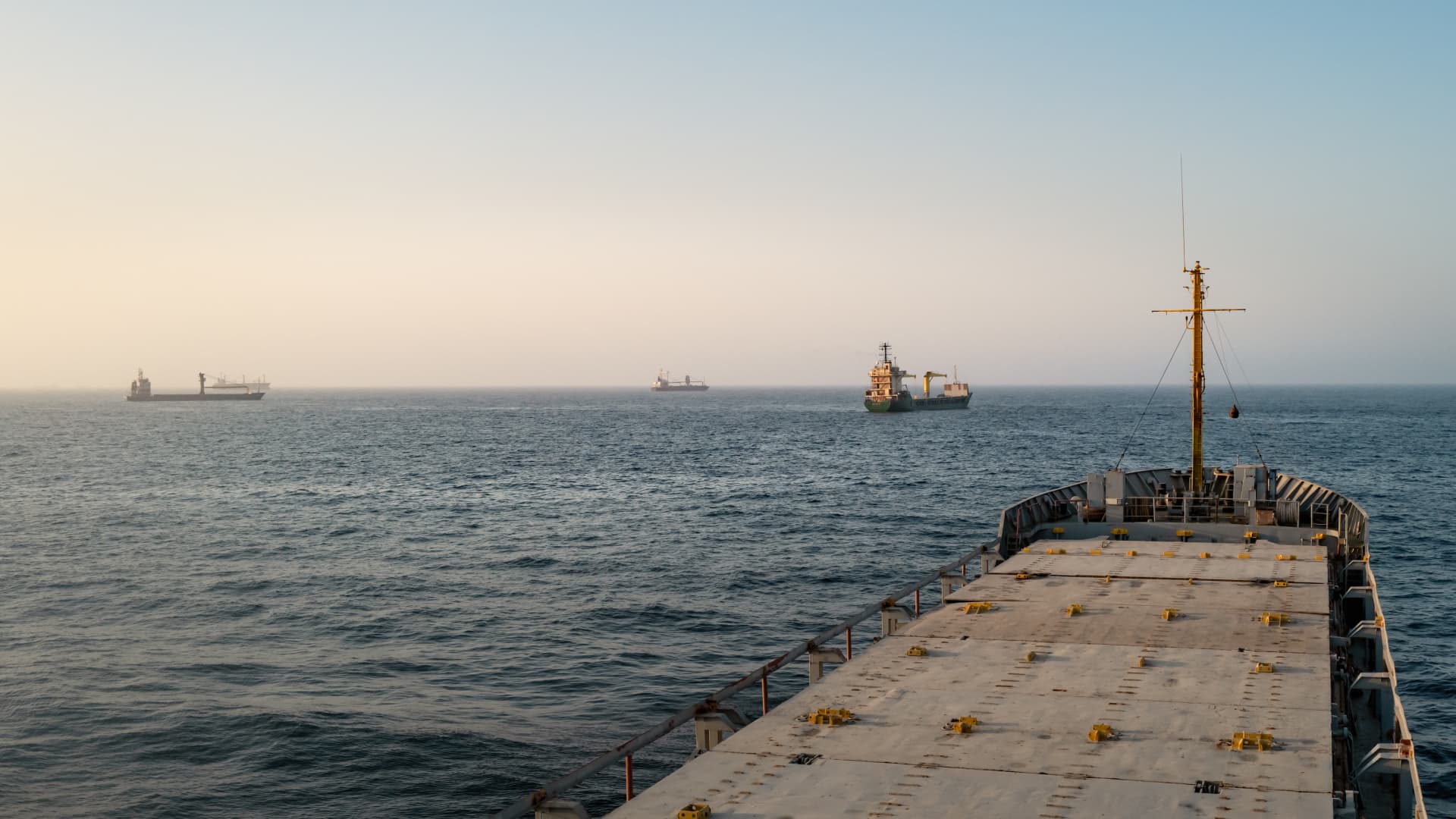

Oil tankers and cargo ships sit at anchor off Oman’s coast on June 23, 2026, after days of delays caused by congestion at Port Sultan Qaboos in Muscat, which has kept vessels from berthing.
Elke Scholiers | Getty Images News | Getty Images
Maritime traffic through the Strait of Hormuz has begun to rebound a week after the United States and Iran reached an agreement to reopen the vital waterway. But a fresh strike on a cargo vessel Thursday renewed concerns over the security of the route, disrupting a United Nations evacuation plan and prompting some tankers to turn back.
Following the ceasefire announcement, 125 vessel transits were logged between June 15 and June 21, the strongest weekly total since the conflict began in late February. The increase came as tankers moved quickly to transport Gulf crude held in storage before the 60-day truce period runs out.
AXS Marine recorded 62 commercial vessel crossings on June 24, the highest daily figure since the start of the war. Even so, that total represented only 53% of the traffic recorded on the same date a year earlier.
On Wednesday, Iran’s Islamic Revolutionary Guard Corps said all ships must follow its northern route and comply with Iranian navigation instructions. Hours later, the Ever Lovely, a Singapore-flagged Evergreen container ship, was hit on its starboard side by a projectile off the coast of Oman. A U.S. official attributed the strike to the IRGC, marking the first attack on a cargo vessel since the ceasefire began.
The Strait of Hormuz, situated between Oman and Iran, is widely viewed as one of the world’s most important energy chokepoints. Under normal conditions, roughly one-fifth of global oil shipments pass through the narrow channel.
Shipowners now face a complicated and risky operating environment, with no shared rules between rival authorities. Iran controls a northern corridor, while a southern route runs through Omani waters. The commercial lane commonly used before the war remains closed because of mines.
Until there is a more concrete set of guidelines on safe navigation, people are going to be very reticent to go through.
Tim Huxley
CEO of Mandarin Shipping
Iran warned it would take action against ships not using its northern route or coordinating with Iranian authorities. The U.S. and Oman backed a separate southern corridor, with Oman issuing navigational guidance and American Navy providing naval oversight.
Companies are confronted with a difficult choice: take the risk to transit, or hold back and potentially cede ground to rivals willing to take that risk.
Bruce Tan, a Singapore-based electronics manufacturer who held back deliveries to Middle East clients for four months, said he had begun moving goods through the corridor again, but only in small batches, in case the Strait closes again. Tan is also routing some orders through alternative corridors as a hedge against another closure.
People unload goods from a small boat along the coast of Bandar Abbas, southern Iran, following a reduction in military tensions in the Strait of Hormuz on June 25, 2026.
Anadolu | Anadolu | Getty Images
Aristidis Alafouzos, CEO of Okeanis Eco Tankers Corp, a crude oil shipping company headquartered in Greece, said he doesn’t expect Thursday’s attack on a ship in the Gulf of Oman to “significantly change” the trend of transits through the waterway.
“We’ve seen a large increase, especially on the crude oil passages, and I think this is set to continue and maybe this one-off event isn’t enough to really disrupt the recent events of the large exports of Kuwaiti and Emirati crude oil from the Gulf,” Alafouzos told CNBC’s “Squawk Box Europe” on Friday.
“The one big missing factor is the Saudis. For now, we haven’t seen them export almost anything from inside the Arabian Gulf and everything is coming from Yanbu in the Red Sea.”
What next for the Strait of Hormuz?
Analysts have warned that passage through the waterway remains risky, and shipping companies are pushing for clarity on safe navigation, as well as the likelihood of tolls and how sanctions could interplay with whatever passages are open in the future.
“We don’t know how much of the straits is mined — it can be very dangerous going through that,” said Tim Huxley, CEO of Singapore-based Mandarin Shipping, which manages 50 vessels globally and has kept all of them out of the strait.
“You’ve got this debate about who is authorizing ships to go through, what level of control the Iranians have on one side, the Americans have on the other. A lot of ship owners are just saying: I’m going to wait and see how these talks progress before I commit to sending a ship, its cargo, and most importantly, its crew,” Huxley said.
“Insurance premiums are still very high on ships and cargoes going through the straits,” Huxley said. “Until there is a more concrete set of guidelines on safe navigation, people are going to be very reticent to go through.”
Han Shen Lin, China country director of The Asia Group, was more blunt about the predicament facing corporate executives.
“Boardrooms aren’t asking about cargo safety — they’re asking if it is insurable. War-risk premiums have shot up from 0.05% to over 0.7% of hull value per transit. That’s not a risk premium, that’s a serious business model stress test,” Han said.
“One vessel seizure doesn’t just cost you the cargo — it costs you the client relationship, the insurance renewal, and your board’s confidence. Speed is worthless without survivability,” Han said.


