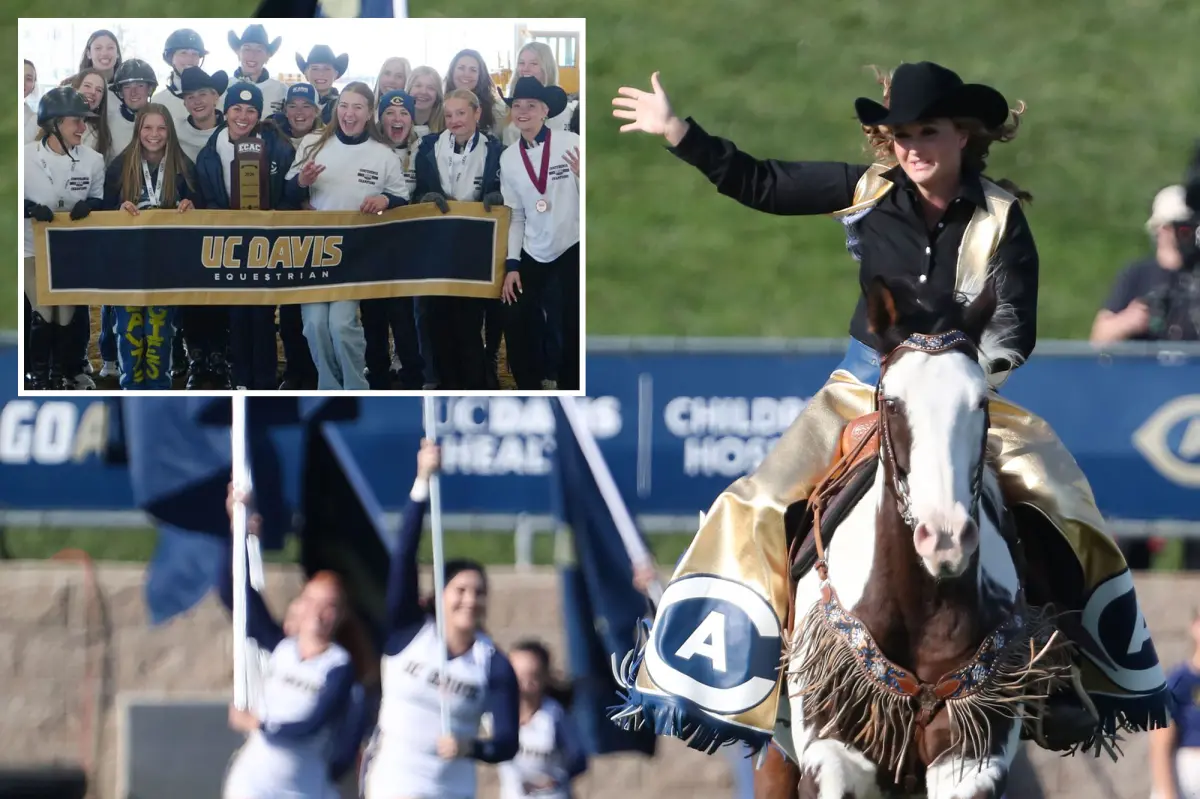

Just weeks after capturing its third conference championship in March, UC Davis brought an abrupt end to its nationally ranked equestrian program, leaving student-athletes without a team and, in some cases, without a clear path forward at the university.
The school announced in January that it would discontinue equestrian as an intercollegiate sport, pointing to an outside review by Collegiate Consulting that examined the program’s costs, The Chronicle reported.
Parents said the decision devastated the team and created immediate uncertainty for riders, many of whom had already missed key transfer deadlines to join other college programs.
The fallout has also affected incoming recruits. Some students who had recently committed to the team were later turned away and denied regular admission to UC Davis.
Although university officials framed the move largely as a financial decision, emails and documents obtained by parents and shared with The Chronicle suggest a more complicated timeline. According to those records, school leaders continued recruiting athletes and seeking donations until roughly a month before the announcement, even as internal discussions about eliminating the program had been underway for about a year.
An independent audit of the university’s report has also drawn scrutiny, with critics alleging it overstated the program’s true expenses. Supporters contend that, rather than draining resources, the equestrian team could generate as much as $700,000 a year for the university.
Rosemary Fritsch, whose daughter Rayna was recruited in October 2024 while university officials were allegedly already weighing the program’s elimination, said the email announcing the cut was crushing.
“She knew she would have been overlooked” at other colleges, Fritsch told The Chronicle, “because she didn’t have fancy clothes or the most expensive horse.”
While Fritsch said he daughter was offered a chance to still attend the university, other parents told the outlet their student-athletes were either wait-listed or denied.
The timeline of the events and the financial audit used to justify the decision are now under scrutiny.
In February 2025, UC-Davis Chancellor Gary May told all university administration to plan for a 10 percent budget cut, a month later the equestrian team was on the chopping block as it would reportedly save just over a million dollars annually.
ALSO READ: Married Trump-Linked Pastor Faces Renewed Miss Oklahoma Scandal After New Texts Surface
By early April, it seemed the decision was set in stone and other possibilities no longer needed to be considered “due to elimination of the equestrian program moving forward,” the Chronicle reported citing and an internal spreadsheet.
The was seemingly confirmed in August, when an athletic budget spreadsheet said axing the program was approved pending an external review, according to the outlet.
But that third-party analysis was completed after the university announced its decision to end the equestrian program sparking outrage from parents and student-athletes.
Supporters of the team are now pushing back, telling the Chronicle that UC-Davis athletics director Rocko DeLuca was merely looking for an excuse to frame the program as too expensive.
“I don’t understand why they’re not reinstating the team,” said Sigrid Elschot, a parent of an equestrian athlete. “We don’t even have a locker room.”
Supporters are suing De Luca and other school officials, alleging the athletics director “fraudulently inflated the Equestrian program’s budget” and misled recruits when they knew for months the team was being cut.
The University’s police department is also investigating potential wire fraud as school leadership effectively decided to end the program while still soliciting donations, the Chronicle reported.
Andy Schwarz, one economist who was hired by supporters to conduct an independent audit, told the Chronicle the numbers from the external review don’t add up when determining the actual cost of the program.
The biggest error was a $665,000 price tag to purchase the horses, despite the animals being donated to the University, Schwarz told the outlet.
Schwarz also said the report didn’t take into account that many of the students pay out-of-state tuition, and estimated the university could bring in up to $700,000 annually.
UC-Davis issued a statement back in April, defending its decision to cut the program.
“We believe that all policies and practices were followed and that decisions regarding the Equestrian program were made appropriately and with the best interests of the UC Davis community in mind,” the university said in a statement.
The school is conducting its own review to determine the reliability of the financial information that was used to evaluate the program and the fundraising practices — but its findings won’t be released until June 30, the equestrian team’s final day, the Chronicle noted.