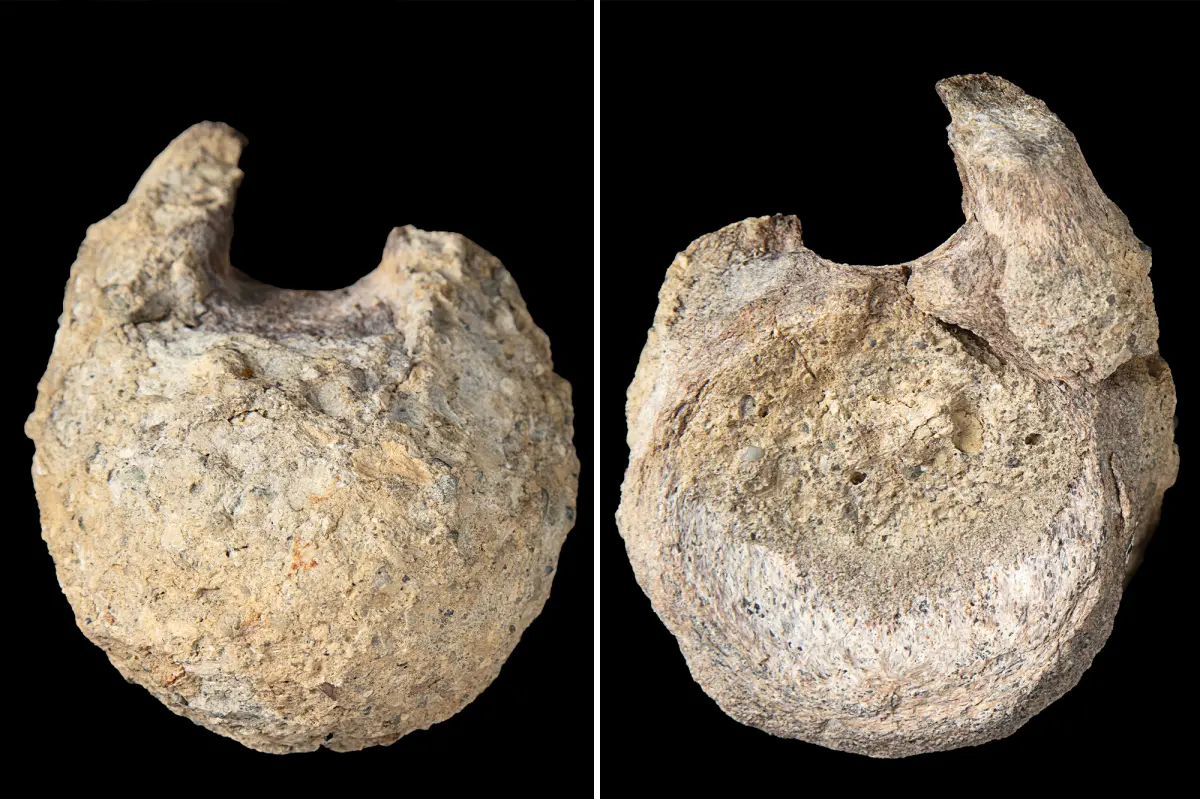

A dinosaur bone discovered in Antarctica has finally been identified decades after it was quietly placed in a collection drawer and largely overlooked.
The fossil, a tail bone from a titanosaur, was first found in 1985 on Antarctica’s James Ross Island during an expedition led by geologist Mike Thomson, who recorded it at the time as the remains of a large reptile.
After the expedition, the specimen was stored in the geology collection of the British Antarctic Survey in Cambridge, where it remained tucked away in a drawer, according to the BBC.
Years later, paleontologist Mark Evans came across the bone again and worked with a team of researchers to compare it with more complete dinosaur fossils.
Their analysis confirmed Evans’ hunch: the bone belonged to a long-necked, plant-eating titanosaur.
The discovery was detailed in findings published Monday in the journal Acta Palaeontologica Polonica.
Dinosaur fossils are especially uncommon in Antarctica because much of the continent is locked beneath thick ice sheets, even though it once supported lush forests.
Researchers believe the titanosaur represented by the rediscovered bone measured roughly 23 feet long, making it relatively small compared with many members of its group.
Scientists believe the prehistoric creature could have died young and may have floated from the coast before sinking to the seafloor and becoming fossilized in marine rock.
Thomson, who initially stumbled upon the bone, died in 2020 before it could be identified as dinosaur remains through new, innovative technology.
“If he were still with us, he would be delighted to know what this was,” Evans, the study’s co-author, told the Associated Press.
With Post wires