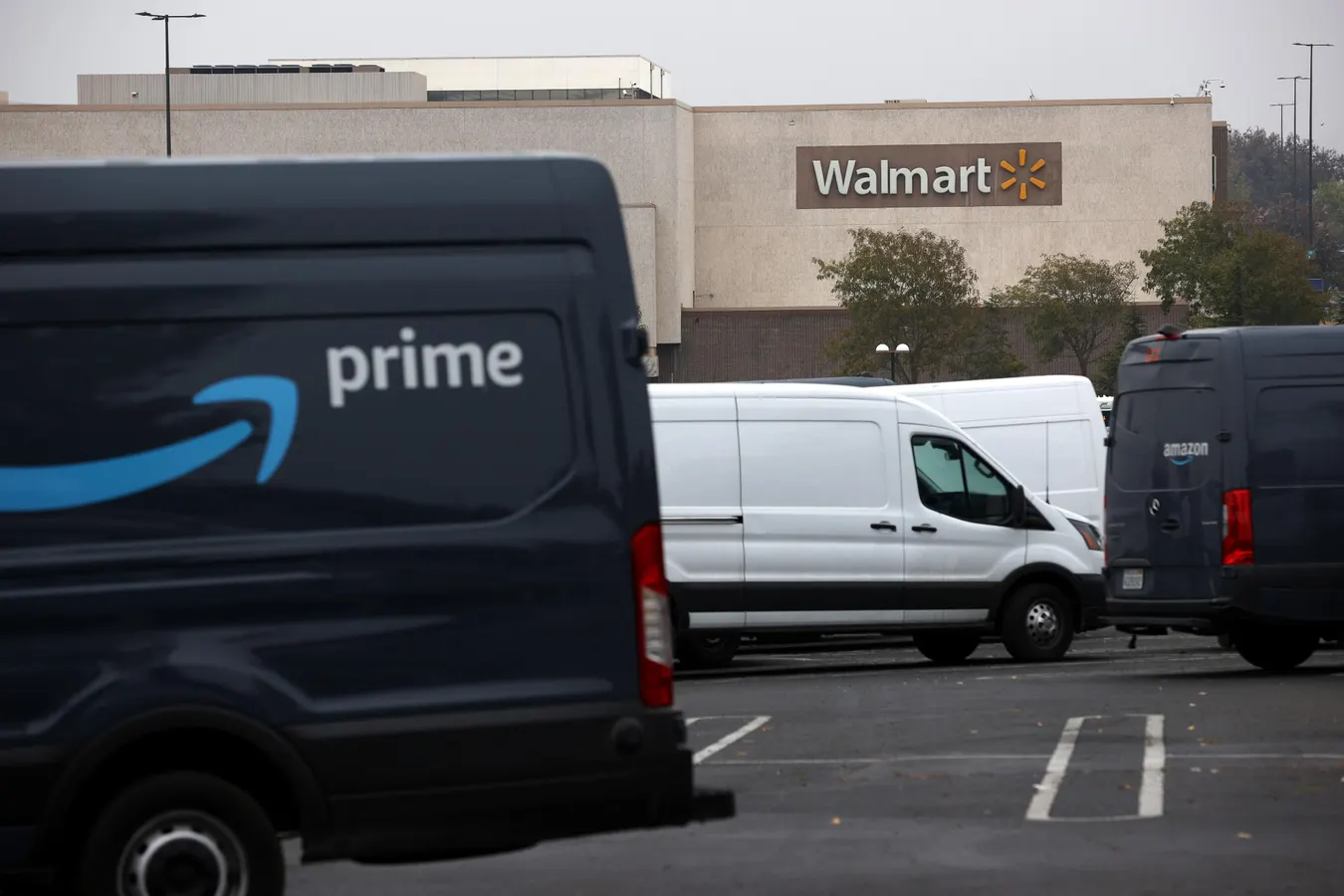


Amazon Prime delivery vans parked near a Walmart store (Photo by Justin Sullivan/Getty Images)
Getty Images
Amazon last month introduced Amazon Supply Chain Services (ASCS), making its vast logistics infrastructure available to businesses beyond its own marketplace sellers — including companies that have never sold on Amazon.com. Days later, Walmart said it would buy Vibe.co, a connected-TV advertising platform, further expanding the advertising operation it has been building around Vizio. Taken together, the moves from two of the world’s biggest retailers point to a clear shift: the future of retail is no longer defined simply by selling goods.
At the center of both strategies is control. For years, retailers streamlined their operations by outsourcing or distancing themselves from parts of the customer relationship. That approach is beginning to reverse. Omnichannel retail, once seen as the end goal, now looks more like an early step. To compete in the next phase, major retailers are moving into adjacent businesses, reclaiming functions they once left to others and building ecosystems that stretch far beyond the store. The result is the rise of the “omnivore” retailer — a company with multiple revenue engines and a far broader role in commerce.
New Multi-Hyphens
Advertising posters for Vibe.co streaming TV (Photo by Smith Collection/Gado/Getty Images)
Gado via Getty Images
Walmart’s U.S. footprint is already enormous, with more than 4,600 stores nationwide and 90% of Americans living within 10 miles of a Walmart or Sam’s Club. With that level of reach, adding more stores is no longer the obvious path to growth. The company has made major gains in e-commerce and strengthened its position as an omnichannel powerhouse, but advertising has become one of its most important expansion opportunities. Walmart Connect, the retailer’s ad division, generated $6.4 billion in revenue last fiscal year, a 46% increase.
Amazon is dealing with its own version of a growth ceiling. Its advertising revenue reached $68 billion in fiscal 2025, up 22%, while the company controls roughly 37.6% share of U.S. e-commerce sales. Amazon has also pushed into physical retail through Whole Foods and a series of in-house store concepts, though many of those efforts have been reduced or abandoned. Amazon Go, Amazon Fresh, Amazon Style and Amazon Books have all been scaled back or exited. The company’s biggest growth engines have instead come from businesses built alongside its retail operation, rather than within it — most notably Amazon Web Services (AWS) and Amazon Fulfillment Services (AFS).
Amazon logo is displayed on a smartphone screen with an Amazon Web Services logo in the background. (Photo Illustration by Algi Febri Sugita/SOPA Images/LightRocket via Getty Images)
SOPA Images/LightRocket via Getty Images
AWS generated $128.7 billion in revenue in 2025, growing 20% year-over-year and equating to 57% of Amazon’s operating profit. ASCS is an expansion to capitalize on the logistics network with AFS established to compete with UPS and FedEx. When Amazon announced the opening of its freight, distribution, fulfillment, and parcel shipping services to other businesses, regardless of whether they sell on Amazon, UPS and FedEx stock dropped. Wayfair, with Castlegate, Shein, with its manufacturing network, and Beyond, with its stated goal of being the ‘everything home company’ are each trying to replicate the success of these models.
Gap, Sephora, and Home Depot also seem to have observed similar signals, though aimed at a different layer of the business. Rather than continuing to route influencer marketing through LTK, each has built its own platform for creator storefronts. By building a discovery layer directly into their business, they hold onto the customer relationship and own the valuable data that comes with it.
The Single Hyphen
The single-hyphen is not dead. There are still real innovations and experiments happening in more familiar categories of retail extension such as experiential retail, vertical and horizontal acquisitions, and store-within-a-store (SWAS) concepts.
A barista preparing a drink at the counter of Ralph’s Coffee (Photo by: Jeffrey Greenberg/Universal Images Group via Getty Images)
Jeffrey Greenberg/Universal Images Group via Getty Images
In experiential retail, coffee shops continue to serve, from Ralph’s Coffee to the newer Coach Coffee Shop. New SWAS partnerships are being explored as well. IKEA now operates shop-in-shops inside select Best Buy locations, and Best Buy has reciprocated with consultation spaces inside IKEA stores. Despite the failed partnership with Ulta, Target has a new partnership with Warby Parker shops in select locations. Home Depot has been aggressive with vertical acquisitions to strengthen its supply chain, buying up suppliers and service providers that serve its core contractor customers. It acquired SRS Distribution, GMS, and Mingledorff’s. Walmart and Dillard’s made horizontal moves of a different kind, both acquiring shopping malls.
The Risk Of All Things
The risk of being all things to all people is of course real, and it has already shown up in this industry more than once.
Walmart’s attempt to take on streaming services through its Vudu acquisition, and its more recent retreat from Walmart Health, are both examples of a retailer biting off more than it can chew. Having failed with Vudu in the past, Walmart’s acquisition of Vizio and Vibe.co are its second chance to own the screen.
Oak Street Health clinic (Photo by Spencer Platt/Getty Images)
Getty Images
Walmart is not alone in costly lessons. CVS committed $10.6 billion to acquire Oak Street Health, betting that owning primary care clinics would deepen its hold on the same customer who already filled prescriptions at its stores. Walgreens committed more than $8.7 billion for a majority stake in VillageMD, and a subsequent acquisition of Summit Health. Both companies have since pulled back, weighed down by reimbursement structures and operating costs that have little in common with running a pharmacy. Although these appeared to be synergistic acquisitions, the cost structures, regulatory exposure, and margin profile showed otherwise.
The difference in these failures from the current bets is the health of the overall business and supporting structure. Whether the core business has a bridge to support the new business is critical. With Vudu, Walmart acquired a streaming platform without having first developed its own retail media network. CVS and Walgreens are still working through fundamental issues in their own pharmacy and insurance businesses, the foundation their healthcare expansion was supposed to sit on top of. Before extending capabilities, data, scale, or logistics, the core business needs to be stable.
Hunger For Margin
Retail’s new hyphenated revenue models, which include retail media, marketplace fees, logistics and sourcing services, and financial products, already accounted for 15% of sales and 25% of profits in 2024. That share could approach half of industry profits by 2030. These moves also reinforce where margin in retail is going. With giants like Amazon and Walmart expanding further, making announcements within weeks of each other, these figures show no signs of slowing down.
Diversification of revenue streams is also a safeguard. A retailer that controls its own logistics, advertising, and discovery layer answers to no one else’s outage, price hike, or policy change. It is also better positioned to leverage its scale. A store can no longer be just a store, and thus needs to become an omnivore. Control will matter more than size. Before consuming a business, it is however important to make sure that it fits your diet.


