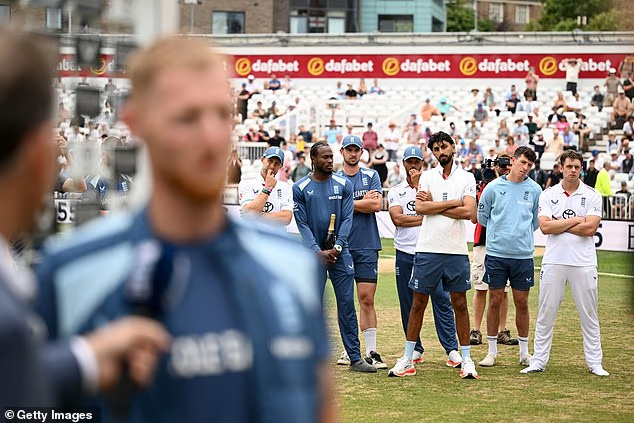

While cricket’s dignitaries and well-wishers queued up to embrace and congratulate Ben Stokes over the final two days of the third Test in Nottingham, it almost seemed impolite to mention the uncomfortable truth: England were sliding towards one of the heaviest defeats in their Test history.
That should not take anything away from New Zealand, who produced a magnificent victory despite being without Glenn Phillips, their standout batter across the first two Tests, and Matt Henry, fresh from claiming 11 wickets at the Oval and rising to joint-top of the ICC bowling rankings. The tourists absorbed their losses and adapted in a way England could not.
Even so, England are rarely beaten on home soil. This was only the sixth occasion in their 149 years as a Test-playing nation — and the first this century — that they had lost a home series after winning the opening match.
A captain’s imprint is measured not only by results but by the condition of the team he leaves behind, and it is difficult to claim Stokes has England thriving. They are, admittedly, in a stronger position than when he succeeded Joe Root in 2022, when they had won just one of their previous 17 Tests. Yet their current run of two wins in 10, both achieved on poor surfaces at Melbourne and Lord’s that gave proceedings a lottery-like feel, hardly suggests sustained progress.
More concerning is how far they appear to have fallen from the exhilarating early months of the Bazball era. Within less than a year, England had swept New Zealand 3-0 through three fourth-innings chases ranging from 277 to 299, pulled off a national-record pursuit of 378 against India at Edgbaston, recovered to beat South Africa, and become the first touring side to complete a 3-0 series win in Pakistan — a campaign launched by that astonishing 500-run day in Rawalpindi.
That some critics were already beginning to turn on them while they were still tearing up the record books remains a damning reflection of the caution that has so often held English cricket back.

As cricket’s leading figures lined up to congratulate Ben Stokes after the third Test, it was hard to ignore that England had endured one of the most damaging defeats in their history.

England achieved remarkable feats in the early stages of Stokes’ captaincy, including their record 378-run chase to defeat India at Edgbaston in 2022.

They became the first visiting team ever to win 3-0 in Pakistan with a string of epic displays led by Stokes’ fantastic captaincy
Yet from that high point the successes grew fewer and further between. Starting with the careless one-run defeat by New Zealand at Wellington in February 2023, England have won 17 Tests and lost 19. In four marquee series against Australia and India, the ratio gets worse: six wins, 12 losses.
Between 2005 and 2015, England won four successive home Ashes. Between 2011 and 2018, their home record against India was 11 wins and two defeats. On both counts, England under Stokes went backwards.
It felt symbolic, too, that their final run chase under his leadership, a near-impossible 373 on an increasingly capricious Trent Bridge pitch, should begin with a bit of uber-Bazball. Promoting himself to open because England felt they needed quick runs against the new ball before the old ball became hard to manoeuvre, Stokes set the tone for the kind of hour his team were supposed to have left behind.
For a side still trying to reconnect with the public after the Ashes, their mad thrash to 103 for four off 15 overs felt as tin-eared as McCullum’s suggestion after losing the second Test at Brisbane that England had over-trained. Both scenarios contained a grain of truth, but it was not what the public wanted to hear.
The ECB’s rationale for keeping McCullum has been his willingness to ‘adapt and evolve’ since Australia, yet Harry Brook’s nine-ball 21 in particular emitted vibes so carefree it was as if we were back in the early days of Bazball, when Stokes overdid the aggression to ensure his team-mates got the message. His performance looked less like evolution than the dying splutters of a revolution in which most others had already waved the white flag.
When Stokes took over four years ago, he had at his disposal some major players: Jimmy Anderson, Stuart Broad, Jonny Bairstow, plus a fresh-faced Brook and, in Root, an ex-captain freed from the burden of leadership.
But the team England fielded for the second Test against New Zealand at the Oval, which included five players with a combined total of two caps, was not just a consequence of the chaos wrought by the Rex Rooms saga: it was a worrying reflection of county cricket’s failure to top up the talent pool. McCullum enjoyed the newcomers’ enthusiasm, but was startled by their naivety.
And it is at this delicate moment in the team’s narrative that Stokes has called it a day.

But the wheels came off in the final few years, unable to beat Australia or India at home as England usually have done this century

England stopped growing under Stokes’ leadership, as if the giant shadow he cast blocked out the light, and they have been left without an identity only 12 months before the next Ashes
| Year | Tests | Won | Drawn | Lost | Win % |
|---|---|---|---|---|---|
| 2022 | 10 | 9 | 0 | 1 | 90.0 |
| 2023 | 8 | 4 | 1 | 3 | 50.0 |
| 2024 | 13 | 6 | 0 | 7 | 46.2 |
| 2025 | 9 | 4 | 1 | 4 | 44.4 |
| 2026 | 3 | 1 | 0 | 2 | 33.3 |
That he’s had enough is indisputable. There also can be no doubting his work ethic or his passion or the memories he has created for a generation of fans. He will go down as one of England’s most significant cricketers.
But England stopped growing under his leadership, as if the giant shadow he cast blocked out the light, and they have been left without an identity only 12 months before the next Ashes.
The ECB believe there is no rush to appoint his successor, with the first Test against Pakistan not starting until August 19. But the fact that, after Monday’s defeat, McCullum felt unable to commit to Brook, the official vice-captain, did not speak volumes for England’s succession planning. Suddenly, Root is back in the mix, which would represent a funny kind of progress.
England are in a rare old mess, though also a familiar one. Even without Stokes, whatever happens next will be compelling.