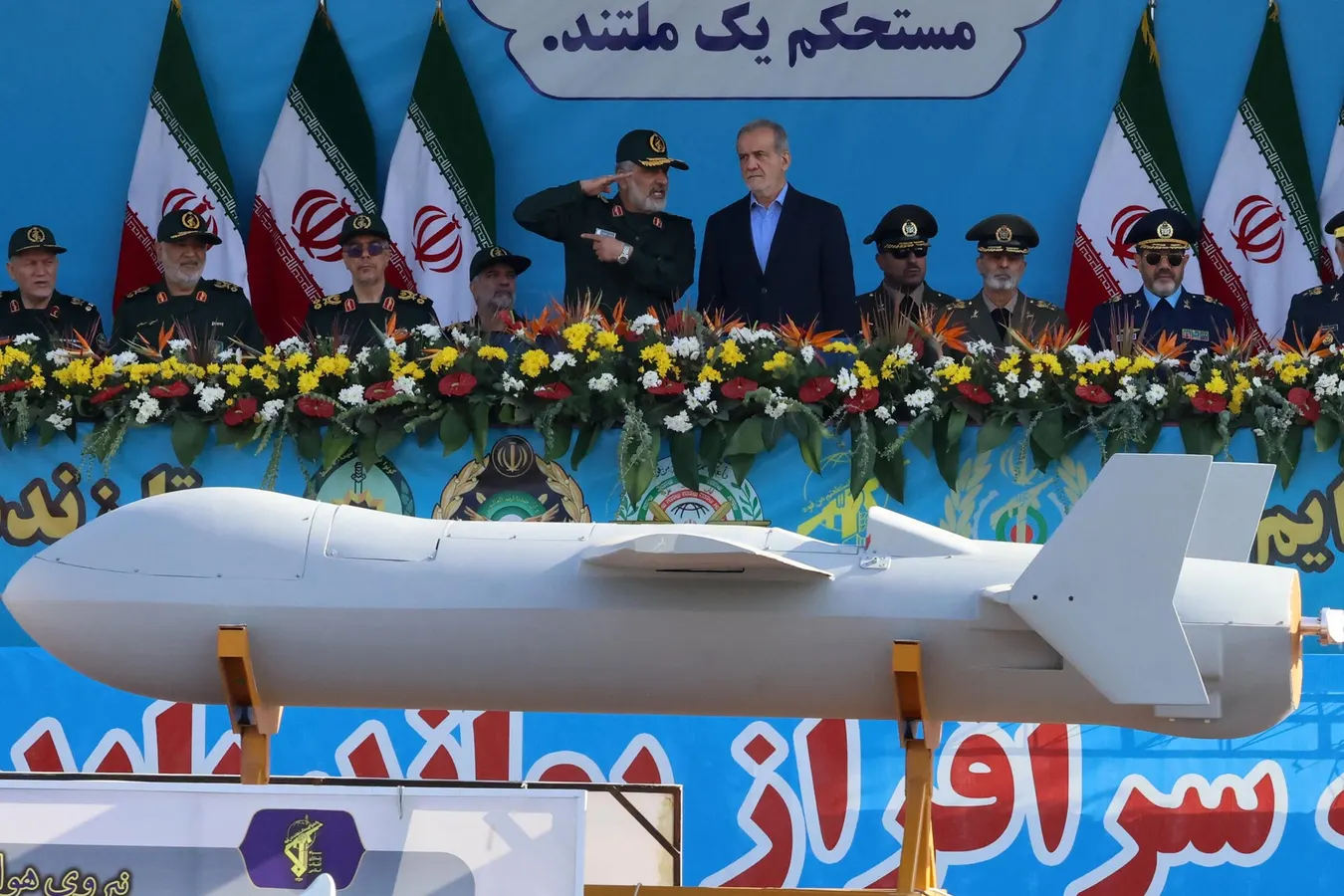


Iranian President Masoud Pezeshkian (R) and Islamic Revolutionary Guard Corps Aerospace Force commander Amir Ali Hajizadeh watch as Iran’s new Shahed 136-B drone is shown during the annual military parade marking the anniversary of the start of the 1980-1988 war with Saddam Hussein’s Iraq, in Tehran on September 21, 2024. (Photo by ATTA KENARE / AFP) (Photo by ATTA KENARE/AFP via Getty Images)
AFP via Getty Images
In the early months of the Second World War, Europe experienced a strange and deceptive lull. After Poland fell in September 1939, and before Germany moved against Denmark and Norway in April 1940, the conflict entered what became known as the Phony War — or, in German, the Sitzkrieg. Major operations were limited, daily life appeared to retain a measure of normalcy, and the absence of sustained fighting gave leaders and civilians alike a misleading sense that events were still manageable. Behind the quiet, however, armies were planning, shifting positions, rebuilding supplies and preparing for the next stage of war.
The current pause involving the U.S., Israel, the Gulf states and Iran carries echoes of that earlier moment. A ceasefire, or even the appearance of one, should not be mistaken for a resolution. The deeper strategic pressures remain intact, including Iran’s ambition to project power across the Middle East and, by doing so, gain greater leverage over Europe and the United States. Recent developments suggest this may be less an end to confrontation than a temporary interval before the next round. Tehran’s own combative rhetoric has done little to ease that concern.
Much Ado About Markets
Energy markets offer one of the clearest ways to assess the seriousness of the situation. The Strait of Hormuz remains the Gulf’s critical hydrocarbon chokepoint, with roughly 30 percent of global oil production and about 20 percent of global LNG trade moving through the narrow waterway between Iran and Oman. It is central to the crisis. At the time of writing, Marine Traffic data shows tanker movement through the Strait has slowed sharply, with many vessels holding back because insurers will not provide coverage or owners consider the risks too high. Even without a fresh exchange of fire, threats from Tehran are already changing commercial behavior.
That is why stability cannot be judged simply by counting the number of days without missile strikes. The more important question is whether the conditions needed for the reliable movement of energy have improved. So far, there is little evidence that they have.
Markets have taken some comfort from the lack of immediate escalation, with WTI crude hovering around $70 per barrel. Yet the strategic realities that produced the crisis have not disappeared. Iran still sits astride one of the world’s most important maritime chokepoints, and its network of regional partners — particularly the Houthis — continues to threaten shipping routes through the Gulf of Aden, Bab el-Mandeb and the Red Sea. The Houthis, meanwhile, are not standing still; they are expanding and improving their missile capabilities.
Trends and Leadership
The 19th-century Prussian theorist and general Carl von Clausewitz famously wrote that “war is the continuation of politics by other means.” By that measure, the current campaign has produced only limited results. U.S. and Israeli forces have imposed real costs on Iran, but they have not yet secured the political outcome that would fundamentally alter Tehran’s behavior. That leaves open the risk of a more serious setback: Iran appears to be preparing for a long contest, while many in the United States show little appetite for one.
The decimation of Iran’s naval and air capabilities, which President Trump has repeatedly emphasized, has proven insufficient to transform the Iranian military-religious leaders into responsible guarantors of security in the Persian Gulf or reliable stakeholders in preserving global freedom of navigation.
Developments in the field are accompanied by internal divisions within both the Islamic Republic and the U.S. In Tehran, there appears to be increasing disagreement over the appropriate path forward after the recent confrontation. Whether tactical or strategic, these differences suggest that the Iranian leadership is actively debating how best to preserve its position while avoiding what it considers to be unacceptable costs.
The fate of the newly appointed Supreme Leader is unclear; the Islamic Revolutionary Guard Corps appears to have seized power at the expense of other agencies, and the President of Iran reportedly offered his resignation, citing a “total takeover” by the IRGC. He and his foreign minister were reported to have been explicitly threatened by the hardliners, whether this occurred in reality or was used as a tactic to scare the West that “worse” leaders may be waiting in the wings. In an earlier era, the Western media duly reported that the “moderate” Soviet dictator Joseph Stalin was being threatened by the “hardliner” Vyacheslav Molotov (whose wife Polina was arrested and sent into exile, but Molotov remained Stalin’s loyal follower).
Recent comments by Iran’s Deputy Foreign Minister Gharibabadi reflect the regime’s repeated willingness to harden its positions. His warning that Iran will implement its “new sovereignty and policy” in the Strait of Hormuz, even without an agreement with Oman, should not be dismissed as mere rhetoric. Instead, it underscores that Tehran continues to view the attempted seizure of military control over international waters as an instrument of statecraft rather than, post-World War I, a settled question governed by the norms of public international law.
Washington is experiencing its own divide. One camp, represented by Secretary of State and National Security Advisor Marco Rubio, appears to recognize that Iran will continue to exhibit the same level of aggression it has historically displayed unless confronted with substantial pressure. Another faction, associated with Vice President JD Vance and influenced by a more isolationist outlook, seeks to contain the crisis and avoid further escalation, ignoring periodic attacks on Gulf countries and ships attempting to traffic the Strait of Hormuz as well as the firebrand anti-American rhetoric coming from the IRGC and its allies and regional proxies.
Political calculations surrounding the 2028 presidential election inevitably shape these competing perspectives, but electoral considerations cannot replace strategic reality.
Paths Forward
If there is no fundamental change in the Iranian leadership’s rhetoric and policy, the United States must begin preparing, alongside its partners, for a more decisive phase of wartime policymaking. That preparation should involve close coordination with allies across the Gulf, Europe, the broader Middle East, and East Asia, whose economies remain deeply dependent on uninterrupted access to Middle Eastern energy resources.
The objective should not be war for its own sake. Rather, it should be to compel Iran to comply with the conditions necessary for lasting regional security. Those include freedom of navigation through the Strait of Hormuz without tolls or fees; an end to belligerence toward all countries in the Middle East, including Israel; the verifiable dismantling of the nuclear program, including the full cessation of uranium enrichment; and the dismantling of the regime’s long-range ballistic arsenal. Iran must permanently cease attacks on commercial shipping. It must also cease training, equipping, and financing terrorist proxies throughout the Middle East, including Hezbollah, the Houthis, and the Iraqi militias. Nuclear disarmament obligations must be fulfilled completely and verifiably.
Credible diplomacy ultimately rests upon credible force. The United States should therefore replenish critical military inventories while strengthening its capabilities for any future contingency, including Tomahawk cruise missiles, Patriot batteries, THAAD systems, unmanned platforms, and the maritime assets necessary for mine clearing and the protection of commercial navigation. Allied participation should likewise be expanded so that deterrence is shared rather than carried by Washington alone for the benefit of freeloaders who consume Middle Eastern hydrocarbons and fertilizers.
The Phony War ended in the Spring of 1940 because one side eventually concluded that the strategic environment favored renewed military action. History rarely repeats itself precisely, but it often rewards those who recognize when a flawed ceasefire merely conceals one side’s belligerence and preparations for the next conflict. The current ceasefire is likely a prelude to the next round of war. Markets, investors, and policymakers should treat it accordingly.