
Losing signal in remote areas may eventually become far less common if Elon Musk’s latest telecom ambitions come to fruition.
Reports suggest SpaceX is weighing a major expansion: a Starlink-backed mobile phone service that could put the company in direct competition with the biggest wireless carriers in the United States.
Should the plan advance, SpaceX could challenge AT&T, Verizon and T-Mobile by offering customers connectivity built on a blend of satellite coverage and conventional mobile network infrastructure.
According to the Financial Times, SpaceX leaders told investors during the company’s recent IPO roadshow that they are considering a direct-to-consumer mobile service powered by Starlink.
The outlet reported that Gwynne Shotwell, SpaceX’s president and chief operating officer, said the company is examining the possibility of a retail wireless offering and may even develop its own terrestrial mobile network in the US.
Such a push would represent one of Musk’s most aggressive moves into a new sector, extending Starlink’s reach beyond satellite broadband and into America’s fiercely contested $1.6 trillion telecommunications industry.
SpaceX has already made an initial move into mobile connectivity through its deal with T-Mobile, which relies on Starlink satellites to support emergency messaging and service in cellular dead zones via its T-Satellite offering.
However, selling a full consumer phone plan directly under the Starlink brand would take that effort to an entirely new level.

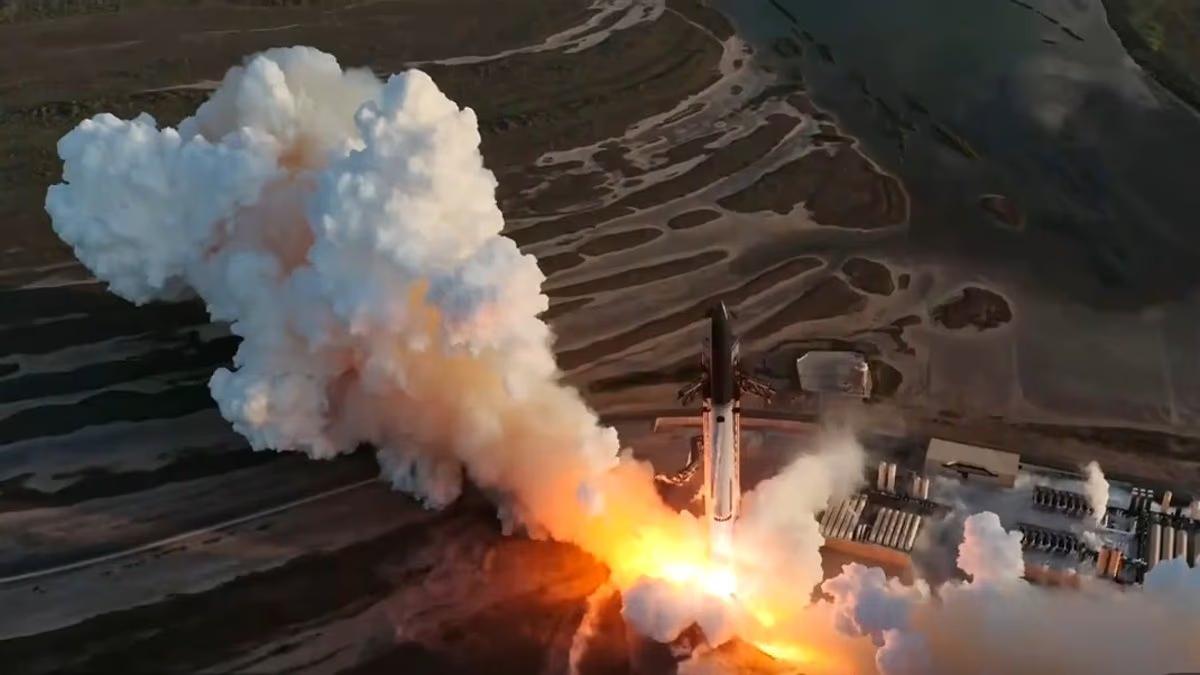
Elon Musk’s SpaceX is weighing an ambitious plan to launch its own Starlink-powered mobile phone service, potentially taking on America’s wireless giants head-to-head
The speculation has been building for months. SpaceX’s IPO filing said the company wants to become customers’ ‘preferred connectivity experience’ whether they’re in rural America, the suburbs or major cities.
The company has also been quietly buying wireless spectrum, including licenses acquired from EchoStar, giving it access to airwaves that could help support future mobile services.
More recently, SpaceX successfully bid for additional spectrum licenses in the Federal Communications Commission’s AWS-3 auction, fueling fresh rumors that it could eventually build parts of its own wireless network.
Industry insiders are still divided over exactly what Musk is planning.
One possibility is that SpaceX launches a mobile virtual network operator (MVNO), leasing capacity from an existing carrier while using Starlink satellites to fill coverage gaps.
Another theory is even more ambitious – that SpaceX could eventually build its own nationwide wireless network or even acquire one of the major carriers.
READ MORE: Alex Karp Parents: Father Robert And Mother Leah Jaynes
There has even been speculation that Musk could attempt to buy T-Mobile outright, although analysts say such a deal would face enormous financial and regulatory hurdles.
In another twist, Bloomberg recently reported that SpaceX held executive-level talks with Charter Communications about a possible consumer mobile partnership.

If the plans move forward, the company could compete directly with AT&T, Verizon and T-Mobile, offering consumers a new way to stay connected using a mix of satellite and traditional mobile technology

The move would mark one of Elon Musk’s boldest expansions yet, taking Starlink beyond satellite internet and into the highly competitive $1.6 trillion US telecommunications market
A deal would allow Starlink customers to use Charter’s network of Wi-Fi hotspots and small-cell infrastructure in cities while relying on satellites in rural areas.
However, analysts say that would still leave SpaceX without access to a true nationwide cellular network.
Tim Farrar, president of TMF Associates, believes a more likely scenario is that SpaceX develops a portable Starlink device that pairs with smartphones over Bluetooth or Wi-Fi rather than replacing traditional cellular service altogether.
Satellite technology remains slower than conventional wireless networks and struggles to penetrate buildings, making it unlikely to fully replace existing mobile infrastructure anytime soon.
‘Threats to buy a mobile operator or build a terrestrial mobile network seem like a paper tiger,’ Farrar wrote in a recent analysis, arguing that such moves would do little to leverage SpaceX’s strengths in satellite communications.
Others believe the reports could simply be part of SpaceX’s strategy to pressure major carriers into agreeing to a broader partnership.
For now, SpaceX has not officially confirmed plans for a standalone mobile phone service.
But with more than 10 million Starlink subscribers already using its satellite broadband network worldwide, and investors closely watching its next moves, many believe it’s only a matter of time before Musk makes his biggest play yet in the wireless industry.