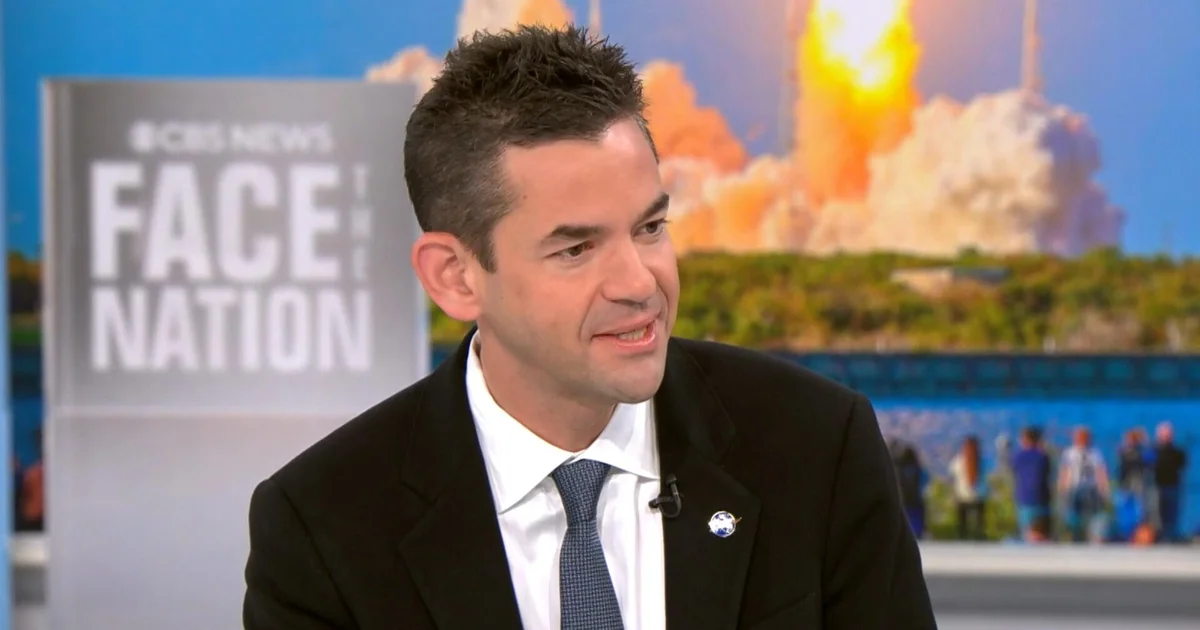

Washington — NASA Administrator Jared Isaacman said Sunday that the United States is “very much in a space race right now” with China, as both nations push to put astronauts on the moon and establish a lasting presence on the lunar surface.
“The Chinese are moving at incredible speeds, and they are certainly capable of doing what the Soviets were not during the first space race,” Isaacman said on “Face the Nation with Margaret Brennan.”
The U.S. is targeting a crewed lunar landing in 2028, while China has said it hopes to send its own astronauts, known as “taikonauts,” to the moon before 2030. Isaacman cautioned, however, that the two schedules are separated by far less time than they may suggest.
“They are thinking in 2029, we’re saying end of 2028 is when we’re targeting the landing,” he said. “That is months, not years.”
Isaacman said he has no doubt that China will eventually land its taikonauts on the moon.
“The question is, will the United States return before them, and will we do so in a different way this time?” he said. “Will we build the base, establish that enduring presence? I think the answer is yes.”
Following the Artemis II mission, in which four astronauts traveled around the moon in April, NASA earlier this month announced the crew for the next mission in the Artemis program, planned for next year. Artemis III is expected to test key lunar landing systems, an important step before NASA attempts to return astronauts to the moon’s surface in 2028.
Isaacman said Artemis III will bring “three of the world’s most powerful rockets” together to demonstrate their capabilities in Earth orbit. He compared the plan to Apollo 9, saying the test would help give NASA “the confidence in our landers for Artemis IV in 2028.”
“This is an achievable plan to put astronauts back on the surface of the moon,” he said.
Meanwhile, Isaacman said NASA will work on its moon base, with missions launched on a nearly monthly cadence in 2027 “so we have that enduring presence; that proving ground for Mars.”
Isaacman predicted that starting next year, NASA could begin building the base. Then, when the astronauts get to the surface of the moon in 2028, he said “there’s going to be a buggy there, a lunar terrain vehicle, there’s going to be a start of infrastructure,” followed by more in 2029.
“But I would say, early 2030s, the moon is going to be like the International Space Station,” he said. “You’re going to have crews that are there on pretty extended periods of time, as we learn in that environment and prepare for Mars.”