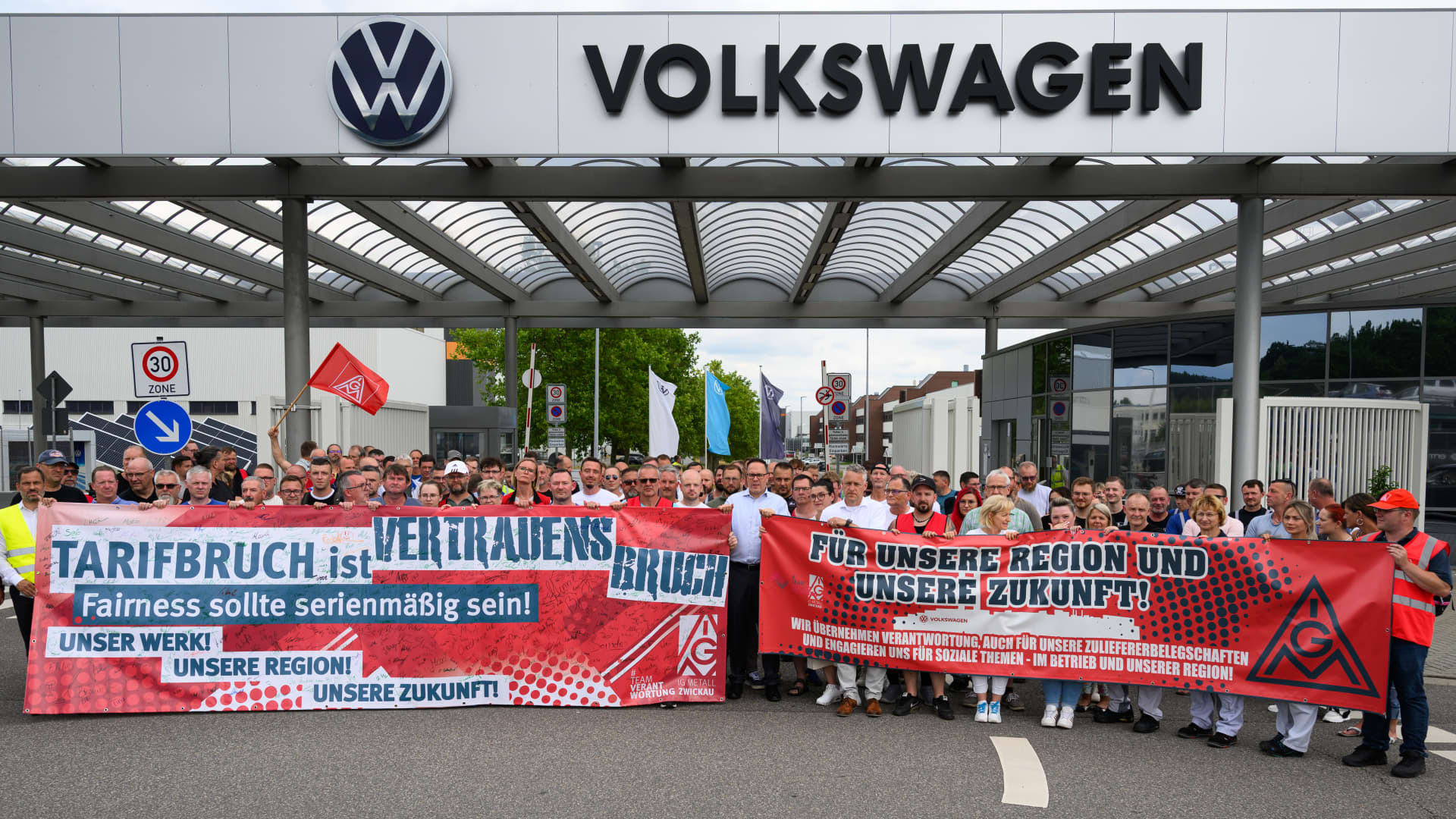

Workers from Volkswagen Sachsen GmbH gather with Dirk Panter (SPD, center), Saxony’s economy minister, outside the entrance to a Volkswagen plant.
Picture Alliance | Picture Alliance | Getty Images
Volkswagen is preparing for a potentially explosive boardroom clash after reports suggested the struggling automaker is considering closing four plants in Germany and cutting up to 100,000 jobs.
Such sweeping layoffs would amount to the most dramatic restructuring in the company’s almost 90-year history, and the proposal has already drawn fierce resistance from German politicians and influential labor unions.
The dispute is setting the stage for one of the most closely watched corporate confrontations in German industry this year, as Volkswagen executives prepare to seek backing from the company’s supervisory board on July 9.
The supervisory board must approve the cost-reduction program, according to Manager Magazin, which first reported details of Volkswagen’s restructuring plans on Friday.
Industry analysts say Volkswagen’s famously intricate governance structure could make management’s push for approval especially difficult.

A Volkswagen spokesperson declined to comment before the July 9 meeting. The automaker had earlier refused to address the reported job cuts and factory shutdowns directly, saying any decisions would be made and authorized by the appropriate corporate bodies.
“The entire Group—including its brands and subsidiaries—must undergo profound change,” a Volkswagen spokesperson said.
Europe’s largest automobile manufacturer had already laid out plans to implement sweeping job cuts and launched a major product offensive, seeking to counter pressures ranging from U.S. import tariffs to intensifying competition from Chinese car brands.
The latest reported layoffs, however, would be double the 50,000 job cuts previously announced and now purportedly include the closure of four German plants: Hanover, Zwickau, Emden, and the Audi facility in Neckarsulm.
The Volkswagen Law
Volkswagen’s management will need to show that there is no alternative to these measures at the July 9 supervisory board meeting, said Thomas Besson, head of automotive research at Kepler Cheuvreux.
“It is going to be a very complicated move to implement,” Besson said, particularly given that the German state of Lower Saxony, where Volkswagen is based and where it operates multiple facilities, is a key shareholder.
The state, which has a 20% voting stake in Volkswagen, holds significant sway at the company, in part due to the so-called Volkswagen Law. This decades-old measure changed the company to a joint stock corporation and effectively limits management’s ability to close plants.
“They have no choice but to adjust. It is just going to be a very complicated process with their stakeholders — and so, it is a tough job for VW management now,” Besson told CNBC’s “Europe Early Edition” on Wednesday.
An employee of Volkswagen Sachsen GmbH stands with his arms crossed in front of the Volkswagen factory gate.
Picture Alliance | Picture Alliance | Getty Images
Volkswagen’s General Works Council and German industrial union IG Metall pledged to push back against the reported job cuts and plant closures. “If such plans were to be pushed forward, we would prevent them with all our might,” they said in a joint statement, according to a translation.
Volkswagen’s decision to weigh layoffs and plant closures has also been met with stiff opposition from Chancellor Friedrich Merz’s coalition government, which is grappling with historically low approval ratings.
German government spokesperson Stefan Kornelius said at a news conference on Monday that the ultimate goal of the government is “to preserve the locations of the German manufacturers and to guarantee jobs,” according to a translation.
Volkswagen agreed a deal with unions in late 2024 to avoid factory closures in Germany and rule out compulsory redundancies until the end of 2030.
‘A strategic step’
The resistance to Volkswagen’s reported restructuring plans paves the way for a turbulent period of negotiations, said Rico Luman, a senior sector economist with a focus on transport and logistics at ING.
“It’s very complicated but something needs to happen, that’s for sure. So, the supervisory board should be aware of the urgency as well,” Luman told CNBC by video call.
Volkswagen’s challenges are illustrative of the headwinds facing the broader European automotive industry, Luman said, citing challenges on the road to full electrification, competition with Chinese car brands and export problems in major markets.

Shares of Volkswagen so far this year.
“They are still profitable, right? But the reported plans are to prepare for the demise or losses over the next couple of years. So, this is a strategic step for what is coming up in the future,” he added.
Shares of Volkswagen were slightly lower on Wednesday, trading at levels not seen since the summer of 2010. The stock, which is down nearly 33% year-to-date, has notched a fresh 52-week low since news of the accelerated restructuring first came to light last week.


