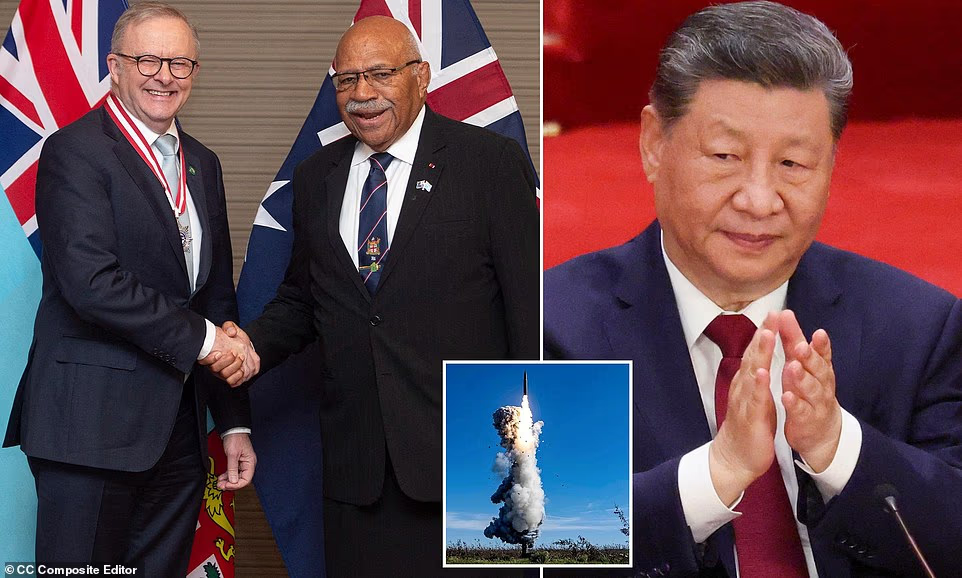


China has fired a nuclear-capable long-range missile fitted with a dummy warhead into the Pacific Ocean, describing the launch as part of a scheduled military training exercise. State-run news agency Xinhua said a “strategic nuclear submarine of the Chinese People’s Liberation Army Navy” successfully launched a submarine-launched ballistic missile carrying a simulated training warhead into the Pacific high seas at 12.01pm on Monday. Earlier, sources suggested the test was a response to Fiji’s new defence agreement with Australia, as Beijing continues to push for greater influence across the Pacific. Xinhua insisted the launch was a “routine” element of China’s annual military training program and said relevant nations had been notified beforehand. Chinese officials briefed governments about the test on Monday. The missile, Xinhua reported, landed accurately in its designated zone, adding that the exercise complied with international law and practice and was not aimed at any particular country or target. Foreign Minister Penny Wong was among the ministers who received advance notice and criticised the move, saying Australia had made clear to China that it viewed the launch as destabilising for the region.
Pacific alliance expands mutual defence ties

A source told The Australian the missile launch was linked to Prime Minister Anthony Albanese and Fijian Prime Minister Sitiveni Rabuka signing the Ocean of Peace Alliance on Monday. The agreement contains mutual defence commitments, declaring that an armed attack on any party in the Pacific would pose a danger to each nation’s peace and security, as well as to the wider security of the region. The treaty also leaves room for other Pacific countries to join, stating that the parties may unanimously invite any Pacific state capable of advancing the agreement’s goals and principles and contributing to regional security.
Albanese deepens Pacific security ties

Australia already has mutual defence arrangements with the United States, New Zealand and Papua New Guinea, including the PukPuk treaty, which is set to take effect on Wednesday. After his stop in Fiji, Albanese is scheduled to travel to the Solomon Islands for talks with Prime Minister Matthew Wale, following agreement between the two countries to continue discussions on a potential security pact. While in Honiara on Tuesday, Albanese will also attend celebrations marking the Solomon Islands’ 48th Independence Day. His Pacific diplomatic push comes after Australia finalised the long-awaited $500 million Nakamal Agreement with Vanuatu, under which Port Vila agreed not to allow foreign military bases on its territory.
Pacific leaders join rugby diplomacy

As part of efforts to deepen Australia’s key Pacific partnerships, Albanese will host the leaders of Papua New Guinea and Tonga at Wednesday night’s State of Origin rugby league decider between New South Wales and Queensland in Brisbane. The Center for Strategic and International Studies (CSIS) says Beijing has become increasingly frustrated by Australia’s growing web of Pacific security deals, which are aimed at limiting China’s regional reach. In February last year, the Cook Islands, a self-governing country in free association with New Zealand, signed a broad package of agreements with China.
China deepens Pacific ties for resources and influence

That development caused concern in both New Zealand and Australia and helped spur a renewed regional push to reinforce ties across the Pacific. Earlier in 2022, China also signed a secret security agreement with the Solomon Islands, with the details withheld from the public. Charles Edel, the inaugural Australia chair at CSIS, said China’s expanding Pacific relationships are motivated less by commerce than by the pursuit of strategic resources. He said the Pacific offers Beijing access to vital assets such as fish stocks, timber and critical minerals, while also supporting broader geostrategic aims, including weakening the United States’ position in its near region and complicating contingency planning by the US and its allies.
China’s growing influence reshapes Pacific security

Edel said economic support from any development partner is welcome in a region facing major challenges, but warned that China’s use of financial pledges to influence Pacific security arrangements and undermine democratic norms presents a direct national security threat to Pacific nations. He added that when Kiribati and the Solomon Islands switched diplomatic recognition from Taiwan to China in late 2019, it marked Beijing’s shift from being primarily an economic partner to becoming a major strategic force in the Pacific. Those diplomatic victories, he said, coincided with China’s expanding development assistance across the region, delivered through both grants and more controversial loans, alongside a growing diplomatic footprint.


