If it feels like referees have been reaching for red cards unusually often at this World Cup, the numbers suggest you are right.
New analysis shows the total has more than tripled compared with each of the previous two tournaments.
Researchers at Northeastern University examined match data and found that 13 red cards have already been shown during the tournament in North America.
By contrast, only four red cards were issued at the 2018 tournament and the same number again in 2022.
So what is driving the sharp increase in dismissals?
Experts say improvements in video assistant referee technology, better known as VAR, appear to be a major factor.
“Three of the red cards issued, for example, were initially designated as yellow-card offenses but were upgraded after referees viewed the VAR footage, the data shows,” the researchers explained.
They said those incidents included Qatar defender Homam Ahmed’s last-man foul on Canada’s Tajon Buchanan in a June 18 group-stage match; Qatar midfielder Assim Madibo’s tackle on Canada’s Ismaël Koné in the same game; and Iraq defender Rebin Sulaka’s denial of an obvious goal-scoring opportunity against Senegal’s Sadio Mané in a group-stage fixture on June 26.

Scientists from Northeastern University reviewed match data, and found that a whopping 13 red cards have already been given out at this year’s tournament. For comparison, just four were issued in both 2018 and 2022

Referee Raphael Claus, of Brazil, holds up a red card after sending USA striker Folarin Balogun for an early bath
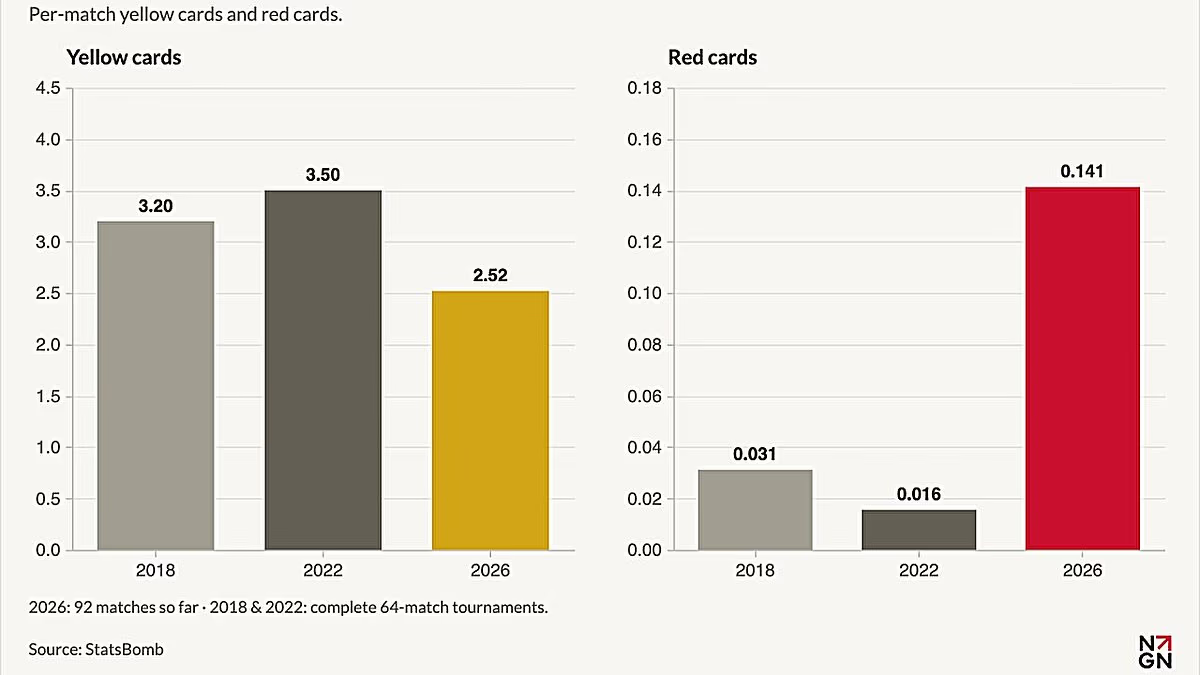
For their analysis, the team looked at the number of red and yellow cards given out at the World Cups in 2018, 2022, and so far this year.
Their results showed that yellow cards are actually down this year, with an average of 2.52 given out per game, compared to 3.20 per game in 2018, and 3.50 per game in 2022.
However, red cards are massively up.
On average, a game at this year’s World Cup has seen 0.141 red cards given out, compared to just 0.031 in 2018, and 0.016 in 2022.
As well as advancements in VAR, the researchers say that FIFA’s new rules and regulations around safe and ethical play could be influencing this rise.
‘Two of the 13 red cards issued this year, for example, were given to players who violated FIFA’s new rule that players cannot cover their mouths when talking to their opponents,’ they explained.
‘The first was issued to Paraguay’s Miguel Almiron in the country’s group-stage match against Turkey on June 19, and the second was issued to Ecuador’s Piero Hincapie during the country’s Round of 32 match against Mexico on Tuesday, June 30.’
As for why yellow cards are down – as well as fouls – the researchers also say FIFA’s new rules are to thank.

Balogun reacts after being sent of for USA in their round of 32 match against Boznia and Herzegovina
They added: ‘[We attribute this] to FIFA allowing games to flow more smoothly without stopping for minor skirmishes.’
The news comes shortly after a supercomputer revealed which nations are most likely to take home the trophy.
Built by scientists at the University of Liverpool, the supercomputer ran 1,000 simulations to predict every nation’s chance of winning the tournament.
According to the results, Spain are most likely to win, with their probability of glory at 26.1 per cent.
England are next on the list (17 per cent), ahead of France (13.5 per cent), Argentina (12.4 per cent) and Portugal (10.6 per cent).
‘Whilst our model agrees with the bookmakers in making Spain the favourites, Norway emerge as the standout dark horse, with a 3.6 per cent chance of winning the trophy across our simulations,’ said Dr Benjamin Holmes.


