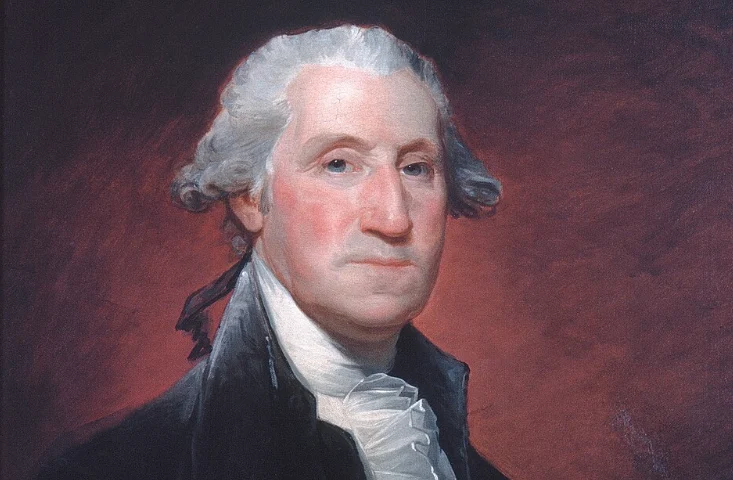

What was George Washington’s Net Worth?
George Washington was an American military leader, statesman, plantation owner, and Founding Father whose fortune has been estimated at an inflation-adjusted $525 million.
Washington served as the first president of the United States from 1789 to 1797 and remains a towering figure in the nation’s founding story. He led the Continental Army during the Revolutionary War, chaired the Constitutional Convention, and helped define the customs and expectations of the presidency. Beyond his public service, Washington was also among the wealthiest Americans of his era, with assets built through land ownership, farming, inheritance, marriage, and the forced labor of enslaved people.
For more than 200 years, Washington was widely regarded as the richest president in U.S. history. In CelebrityNetWorth’s inflation-adjusted list of the wealthiest American presidents, he ranks No. 2 with an estimated $525 million fortune, trailing Donald Trump, whose net worth is placed in the $6 billion to $8 billion range, and ahead of Thomas Jefferson at $212 million. Washington’s wealth was extraordinary for the 18th century, but it also reflected the harsh economic realities of the time, when land, agricultural production, and enslaved human beings were all treated as property in financial calculations.
Net Worth Analysis
When Washington died, his estate was worth the equivalent of about $525 million in today’s dollars. That figure made him the wealthiest president by a wide margin for over two centuries, with Thomas Jefferson a distant second at an inflation-adjusted $212 million. Donald Trump surpassed Washington in 2016, when his net worth was estimated at roughly $2 billion. In more recent assessments, Trump’s wealth has been placed between $6 billion and $8 billion.
Washington’s fortune came from several sources, including extensive landholdings, his marriage to Martha Dandridge Custis, surveying work, military land grants, agricultural output, and the large plantation economy based at Mount Vernon.
Land was Washington’s most valuable asset. During his lifetime, he accumulated thousands of acres across Virginia, Pennsylvania, Maryland, New York, Kentucky, Ohio, and present-day West Virginia. His signature property, Mount Vernon, began as a modest family holding before expanding into a major plantation estate. By the late 1700s, Washington controlled about 8,000 acres in Virginia through Mount Vernon and nearby farms. He also invested in western lands, a common path to wealth among elite Virginians of the colonial period. His early career as a surveyor gave him practical insight into frontier territory, property lines, and land with future development value.
Washington’s financial position grew substantially after his marriage to Martha Dandridge Custis in 1759. Martha was a wealthy widow, and the marriage gave Washington control over a significant dower estate tied to her late husband, Daniel Parke Custis. That estate included land, income-generating assets, and enslaved people. Under the legal structure of the time, Washington managed much of this property, although some of it was not his to sell outright. Even so, the marriage moved him from the ranks of a successful Virginia gentleman into the upper tier of colonial landowners.
Any complete assessment of Washington’s wealth must confront the role of slavery. Around 300 enslaved people lived and labored at Mount Vernon, though Washington did not personally own all of them; some belonged to the Custis estate and were legally designated as dower slaves. In 18th-century financial records, enslaved people were counted as assets, a brutal fact that underpinned the fortunes of many early American elites. Washington benefited from enslaved labor across his farms, household, livestock operations, workshops, and broader commercial activities.
Washington’s businesses extended beyond traditional farming. He experimented with crop rotation, moved away from tobacco toward wheat, operated mills, maintained fisheries, and, late in life, launched one of the largest whiskey distilleries in the young United States. His distillery at Mount Vernon became highly productive and profitable, turning grain from his farms into a valuable commercial product. These enterprises made Washington more diversified than many plantation owners who relied heavily on a single crop.
His public salary was also significant. As president, Washington earned $25,000 per year, an enormous amount at the time and equal to a meaningful share of the federal government’s early budget. He initially hesitated to accept the salary because he wanted to appear above personal financial interest, but Congress insisted that the president be paid so the office would not be limited only to independently wealthy men. Even so, the salary was not the main source of his fortune. Washington was already extremely rich before he became president.
Washington’s finances were not always liquid. Like many land-rich planters, he sometimes faced cash-flow problems. His wealth was tied up in acreage, crops, livestock, equipment, buildings, and enslaved labor rather than cash in a bank. He also spent heavily on Mount Vernon, hospitality, public obligations, and the lifestyle expected of a Virginia gentleman. Still, compared with many other founding-era figures, including Thomas Jefferson, Washington was financially disciplined. He kept meticulous records, monitored expenses, pursued new revenue streams, and died with one of the largest private fortunes in America.

(public domain)
Early Life
George Washington was born on February 22, 1732, in Westmoreland County, Virginia. He was the son of Augustine Washington and Mary Ball Washington. His family belonged to Virginia’s landowning class, though they were not among the colony’s richest families when Washington was a child. His father died when George was 11, which limited his formal education and changed the trajectory of his life.
Unlike some of his older half-brothers, Washington did not attend college in England. Instead, he received a practical education in mathematics, surveying, land measurement, and plantation management. Those skills became extremely valuable. As a teenager, he worked as a surveyor, a job that introduced him to frontier lands and gave him insight into property ownership and western expansion. Surveying also helped him build relationships with powerful Virginia families, including the Fairfax family, whose patronage opened doors for him socially and professionally.
Washington inherited Mount Vernon after the deaths of his half-brother Lawrence and Lawrence’s widow. Over time, he expanded and transformed the estate into the center of his personal, agricultural, and financial life.
Military Career and the Revolutionary War
Washington first gained military experience during the French and Indian War. In his early 20s, he served as a Virginia militia officer and participated in dangerous frontier campaigns. His record during this period was mixed, but the experience gave him a reputation for courage, endurance, and leadership under pressure. It also exposed him to British military culture and the frustrations colonial officers faced when dealing with the British hierarchy.
By the 1770s, Washington had become an increasingly prominent critic of British policy. When the American Revolution began, the Continental Congress chose him to command the Continental Army. The decision was partly strategic. Washington was a respected Virginian, and appointing a southerner helped unify the colonies behind what had begun as a New England-centered conflict.
Washington’s military leadership was defined less by dazzling battlefield victories than by persistence, discipline, and political judgment. He suffered major defeats in New York and endured the brutal winter at Valley Forge, but he kept the army intact. His surprise attack at Trenton after crossing the Delaware River became one of the most famous moments of the war. With French assistance, Washington ultimately helped force the British surrender at Yorktown in 1781.
After the war, Washington voluntarily resigned his commission. That act stunned observers around the world and reinforced his image as a leader who placed republican principles above personal power.
Presidency
Washington was unanimously elected as the first president of the United States and took office in 1789. Everything about the presidency was new, and Washington understood that his actions would set precedents. He created the first cabinet, supported the establishment of a national bank, oversaw the implementation of the Constitution, and tried to balance the competing visions of Alexander Hamilton and Thomas Jefferson.
His administration faced enormous challenges, including war debt, regional tensions, disputes over federal power, and conflicts between Britain and France. Washington favored neutrality in foreign affairs and believed the young nation needed time to strengthen itself before becoming entangled in European wars. His Neutrality Proclamation was controversial but helped define early American foreign policy.
Washington was elected to a second term but refused to serve a third. His decision established the two-term tradition that lasted until Franklin D. Roosevelt and later became part of the Constitution through the 22nd Amendment. In his Farewell Address, Washington warned against permanent foreign alliances and extreme political factionalism.
Mount Vernon and Business Interests
Mount Vernon was more than Washington’s home. It was the center of a large business operation. Washington constantly experimented with ways to make the estate more productive. He shifted away from tobacco, which depleted soil and left planters dependent on British merchants, and focused more heavily on wheat and diversified agriculture.
He operated a gristmill, fisheries, blacksmithing operations, textile production, livestock programs, and later a whiskey distillery. The distillery, launched in the final years of his life, became one of Mount Vernon’s most successful businesses. Washington also closely tracked the performance of his farms, workers, animals, and equipment. His surviving records show a man deeply interested in management, efficiency, and long-term asset building.
Despite his wealth, Washington was often frustrated by the economics of plantation agriculture. He complained about debt, unreliable tenants, fluctuating crop prices, and the difficulty of converting land wealth into cash. His financial success came from constant management rather than passive inheritance alone.
Slavery
Washington’s life and fortune cannot be separated from slavery. He inherited enslaved people as a young man, acquired more through purchase and estate arrangements, and relied on enslaved labor throughout his adult life. Enslaved people worked in the fields, inside the mansion, in skilled trades, at the mill, at the distillery, and throughout Mount Vernon’s operations.
Washington’s views on slavery appeared to shift over time, particularly after the Revolutionary War, but he did not free the people he enslaved during his lifetime. In his will, he arranged for the emancipation of the enslaved people he personally owned after Martha Washington’s death. Martha freed them earlier, in 1801. However, this did not apply to the Custis dower slaves, who were legally tied to the Custis estate and were not Washington’s to free.
That distinction does not soften the reality that Washington’s wealth and lifestyle were built in large part on forced labor. His decision to provide for emancipation in his will was significant among major founders, but it came only after decades of personal benefit from slavery.
Personal Life
George Washington married Martha Dandridge Custis in 1759. Martha was a wealthy widow with two surviving children from her first marriage, John Parke Custis and Martha Parke Custis. George and Martha did not have biological children together, but Washington helped raise Martha’s children and later played an important role in the lives of her grandchildren.
Washington was known for his formality, self-control, and concern for reputation. He enjoyed fox hunting, dancing, theater, cards, and entertaining guests at Mount Vernon. He was also intensely private and carefully managed his public image. His marriage to Martha was a durable partnership, and she spent time with him at winter encampments during the Revolutionary War.
Death
George Washington died on December 14, 1799, at Mount Vernon. He was 67 years old. His death came after a sudden throat illness that worsened rapidly. In keeping with medical practices of the time, doctors treated him with bloodletting, which likely weakened him further.
Washington’s death prompted national mourning. He was celebrated as the “Father of His Country,” a title that reflected his central role in the Revolution, the Constitution, and the creation of the presidency.
Legacy
George Washington’s legacy is unmatched in American history. He led the army that won independence, helped create the constitutional system, and established the presidency as an office defined by restraint rather than monarchy. His voluntary surrender of power after the Revolution and his refusal to seek a third presidential term became foundational acts in the American political tradition.
At the same time, Washington’s legacy is inseparable from the contradictions of the founding era. He championed liberty while enslaving human beings. He built a republic while living as one of the wealthiest plantation owners in America.
For generations, Washington was not only America’s first president and most revered founder. He was also the richest man ever to occupy the White House. Only in the modern era, with Donald Trump’s multibillion-dollar fortune, was Washington finally pushed to #2 on the inflation-adjusted list of the richest presidents in American history.
All net worths are calculated using data drawn from public sources. When provided, we also incorporate private tips and feedback received from the celebrities or their representatives. While we work diligently to ensure that our numbers are as accurate as possible, unless otherwise indicated they are only estimates. We welcome all corrections and feedback using the button below.
(function() {
var _fbq = window._fbq || (window._fbq = []);
if (!_fbq.loaded) {
var fbds = document.createElement(‘script’);
fbds.async = true;
fbds.src = ”
var s = document.getElementsByTagName(‘script’)[0];
s.parentNode.insertBefore(fbds, s);
_fbq.loaded = true;
}
_fbq.push([‘addPixelId’, ‘1471602713096627’]);
})();
window._fbq = window._fbq || [];
window._fbq.push([‘track’, ‘PixelInitialized’, {}]);