
LONDON – Nearly a millennium later, the Bayeux Tapestry has returned to England.
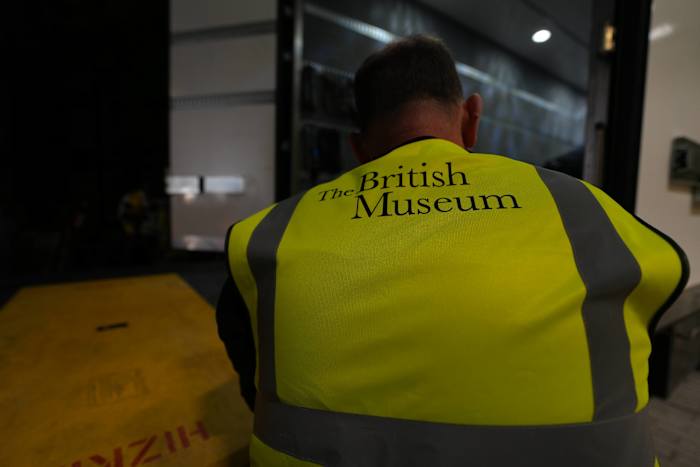
In a scene resembling a heist film played backward, the priceless medieval masterpiece was quietly brought into the British Museum late Friday night, following a highly technical and tightly guarded operation in which even a minor mistake could have had serious consequences.
Loaned from its longtime home in France, the tapestry is scheduled to be exhibited at the London museum from Sept. 10 through July 2027. The display marks a public return for one of the most vivid surviving accounts of the Norman invasion of 1066, the last successful conquest of England.
Its arrival in London had been eagerly awaited, but security considerations meant that the timing and logistics of the transfer were kept strictly confidential.
“It feels extraordinary that after so much work and planning and care and thought that it’s actually happening,” British Museum Director Nicholas Cullinan said while waiting for the artwork to complete its secretive journey.
“It’s the first time in 1,000 years that such an important piece of British — French too — history is going to be on these shores,” he said. “It’s incredibly exciting.”
The 70-meter (230-foot) work was folded in an accordion-like arrangement inside a climate-controlled case, which was then secured within a shock-absorbing cradle. From there, it was loaded into a truck that traveled from France aboard a vehicle shuttle train through the Channel Tunnel.
Following an 11-hour, 350-mile (560-kilometer) police-escorted journey, the truck carefully reversed into a British Museum loading bay. Workers then delicately lowered the container, roughly the size of a small car, to the floor as museum staff and British and French diplomats watched in near silence before breaking into applause.
The priceless cargo will spend several days acclimatizing before it is carefully unpacked and unfolded for an exhibition that the museum expects to be one of the most popular in its history. Some 100,000 tickets were sold in their first day on sale this month.
“It was like trying to get tickets to Glastonbury,” Cullinan said. “I don’t take for granted that people care that much about a 1,000-year-old embroidery. I think that’s an amazing thing.”
The tapestry is a symbol of Anglo-French relations
Stitched in wool thread on linen fabric, the artwork depicts the events leading up to the Battle of Hastings in October 1066, when William, Duke of Normandy defeated King Harald’s Anglo-Saxon army. The invasion ended Saxon rule and made William the Conqueror the first Norman king of England.
Historians believe the tapestry was commissioned by Bishop Odo of Bayeux, William’s half brother, and was probably sewn by women in England — possibly nuns — before being taken across the Channel. It has spent most of the last millennium in the town of Bayeux in northwest France, apart from two short periods at the Louvre in Paris.
The tapestry symbolizes the sometimes fractious, intertwined histories of France and Britain, and securing the loan was a high-stakes diplomatic mission. It was announced during a state visit to the U.K. by French President Emmanuel Macron in July 2025. The loan coincides with renovations at the museum in Bayeux that houses it.
In return, the British Museum will loan treasures from the Sutton Hoo hoard — artifacts from a 7th century Anglo Saxon ship burial — and other items to museums in Normandy.
Retired British diplomat Peter Ricketts, who helped secure the deal as the U.K.’s special envoy for the tapestry, said “it’s an extraordinary mark of friendship and confidence in the U.K. to entrust this object to us for a year.”
“Macron, when he offered us the tapestry, I think he understood that it would have far more impact in the U.K. than it does in France, because it’s more fundamental to our national story,” he said. Everybody (in Britain) knows 1066.”
It’s a vivid record of 11th century life and death
It features 627 people and 737 animals and tells its story in 58 scenes brimming with vivid and sometimes gory detail. There are scenes of hand-to-hand combat, mutilated bodies and the unlucky Harold, felled by an arrow through his eye.
“It has an emotional richness that is really difficult to get from written sources,” said Millie Horton-Insch, project curator for the British Museum exhibition. “It just brings people closer to this history than any other object can. It’s not the same as reading a text. You are looking at something that was handled by the people who lived through it and felt compelled to record these events in this way. “
She said the document’s survival for 10 centuries despite myriad dangers — “moths, mice, mold damp, fire” — is miraculous, and may be partly due to its humble materials.
“It’s not really made of any blingy fabric,” she said. “It’s not gold, it’s not silver. There wasn’t the same temptation to cut it up and make it into vestments or repurpose it for anything.”
Some French cultural figures opposed the loan, arguing that moving the tapestry was too risky. Cullinan said the expert teams went to great lengths to ensure its safety, including making two trial runs of the journey to show it would not cause the fragile item too much stress.
“Such care has gone into it. I can’t think of a level of care for any other museum loan,” he said.
He said he understands why there are concerns.
“The tapestry arouses great interest and passion,” he said. “Which is a wonderful thing.”