

President Donald Trump’s proposal for a 20,000-member international peacekeeping force in Gaza, designed to help secure the enclave and prevent Hamas from rebuilding its military capabilities, is facing major obstacles. According to people familiar with the planning who spoke to The Wall Street Journal, the proposed International Stabilization Force has so far struggled to assemble even an initial deployment of 10 to 20 troops. U.S. military officials and others briefed on the effort say the plan has been slowed by significant logistical and political challenges. Moroccan soldiers, initially expected to deploy in June, are now reportedly delayed by several months. Even when they arrive, they are not expected to enter Gaza right away; instead, they would train inside Israel near the border before undertaking any limited operations in the devastated territory. While the administration still hopes more countries will eventually contribute personnel, the sweeping security plan has, for now, been reduced to a small and delayed contingent preparing outside Gaza.
Kushner’s Gaza resort dreams clash with war’s reality

For Gaza’s roughly 2.1 million residents, still living amid the destruction left by two years of war, the slow movement offers little immediate relief. When Trump’s 20-point peace plan was launched in October, he described it as the “historic dawn of a new Middle East” and spoke of major investment that could transform the battered coastal strip. The proposal also echoed ideas promoted by members of his inner circle, including his son-in-law Jared Kushner, who previously drew attention for referring to Gaza’s “waterfront property” as having potential value for future development.
Trump’s Gaza Riviera dream stalls

Trump has repeatedly floated the idea of remaking Gaza’s coastline into a Mediterranean-style “Riviera,” a vision that critics say is wildly disconnected from the humanitarian crisis on the ground. While officials discussed reconstruction and future tourism projects, the more immediate goal of building a functioning security force has barely advanced. The broader framework, overseen by Trump’s proposed “Board of Peace,” was intended to move from a temporary ceasefire to the disarmament of Hamas and the arrival of international peacekeepers. Instead, the process has stalled: Hamas has not agreed to give up its weapons, Israeli strikes have continued after the ceasefire with a heavy death toll, and promised reconstruction funding has yet to materialize at the scale envisioned.
Gaza’s new police force faces hurdles

The plan has also been complicated by escalating conflicts elsewhere in the region, including in Iran and Lebanon, which have made potential troop-contributing countries more cautious. As a result, commitments to the stabilization force have largely frozen, further weakening the peace initiative. In Cairo, a proposed interim administration known as the National Committee for the Administration of Gaza says it is prepared to assume authority once conditions allow. The body has begun early work on forming a new police force that would be tasked with helping remove Hamas’s weapons, but that strategy depends heavily on the militant group agreeing to surrender its arsenal voluntarily.
Hamas resists disarming despite reforms

That outcome appears increasingly uncertain after Hamas’s latest political move on Monday. The group’s governing authority said it would dissolve and transfer civilian administration to a new technocratic council, but it did not agree to disband or disarm its military wing. Some regional analysts view the announcement as a possible opening for negotiations, while others see it as a symbolic gesture that does little to change the balance of power in Gaza, where Hamas remains a dominant armed force.
Gaza’s population faces impossible choices

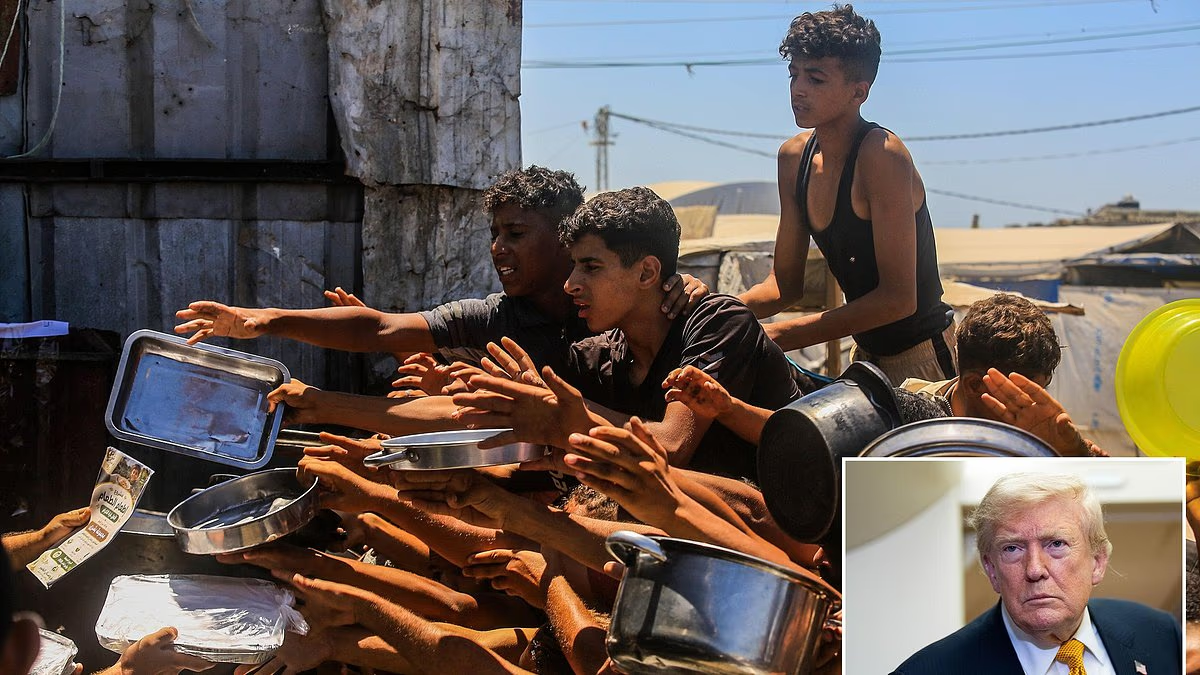
Meanwhile, conditions inside Gaza continue to deteriorate. As Israel expands its control over parts of the enclave, civilians are being pushed into increasingly crowded areas with few safe options. Many families are living in damaged buildings that remain structurally dangerous, while others are packed into large tent camps plagued by poor sanitation and infestations. “The ceasefire last October offered a glimpse of hope, but it needs to translate into meaningful improvement in the lives of Palestinians in Gaza,” Pat Griffiths, a spokesman for the International Committee of the Red Cross in Jerusalem, told The Wall Street Journal.