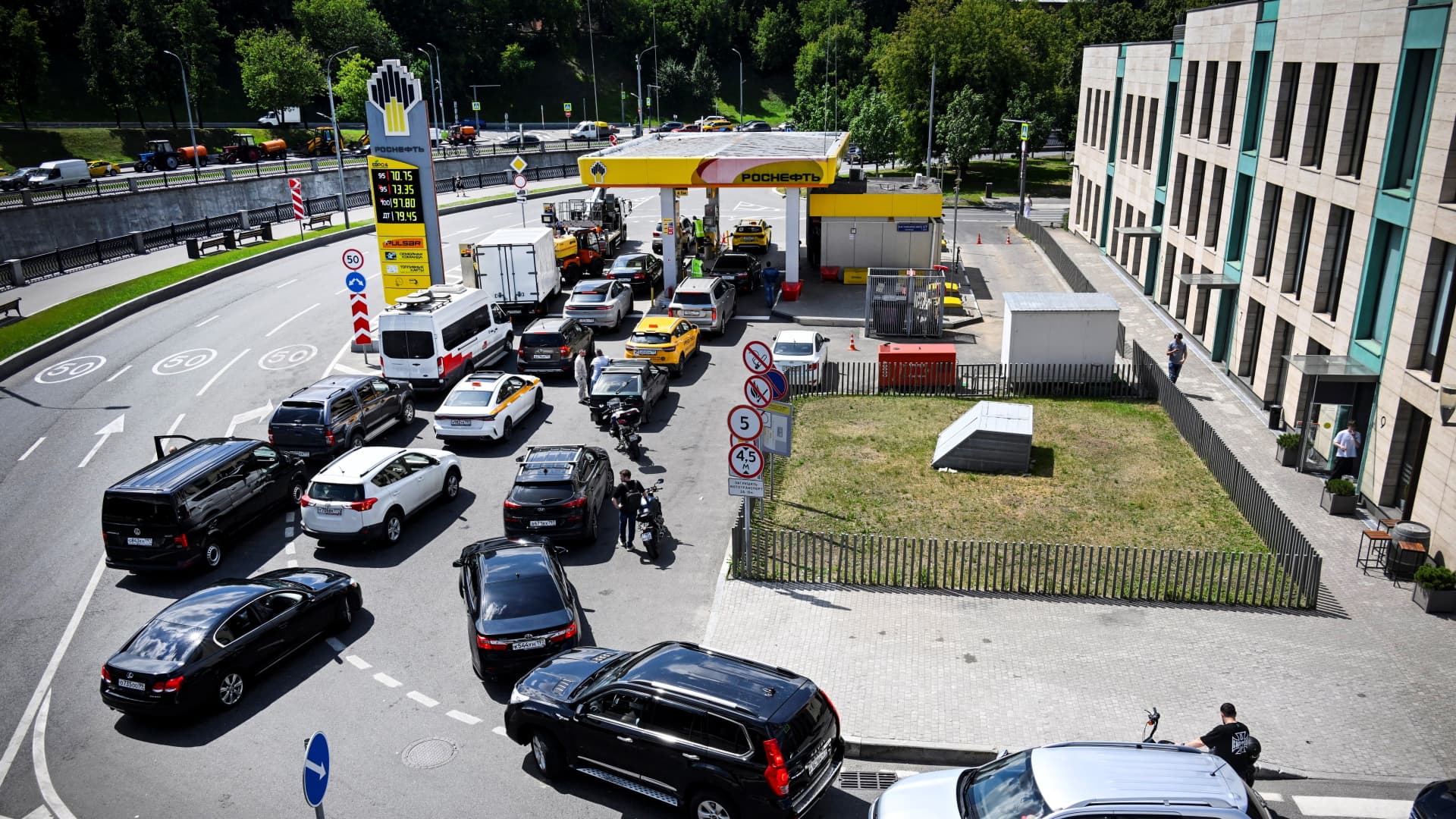

Cars queue for fuel at a Lukoil gas station on July 8, 2026, in Nakhabino, outside Moscow, Russia, as cities across the country grapple with gasoline shortages linked to a wave of Ukrainian drone attacks on oil refineries.
Contributor | Getty Images News | Getty Images
Ukraine has intensified strikes on Russian fuel tankers in the Sea of Azov, aiming to disrupt supply routes into occupied Crimea as drone attacks on refineries contribute to fuel shortages across Russia.
Robert Brovdi, the commander of Ukraine’s drone forces who is widely known as Magyar, said on Telegram that 14 Russian ships were hit in the Sea of Azov on Thursday evening. He said the latest attacks brought the total number of Russian vessels struck by Ukrainian drones to 35 over the past 96 hours. CNBC has not independently verified the claim.
The strikes are part of a broader Ukrainian effort to squeeze supply and transport links serving Crimea, the peninsula Russia forcibly annexed in 2014.
The Sea of Azov, a shallow inland body of water northeast of the Crimean Peninsula, lies off the southern coasts of both Ukraine and Russia and has become an increasingly important theater in the conflict.
Defense analysts and strategists say Ukraine’s drone operations have played a significant role in slowing Russia’s military momentum, though they also caution that Kyiv’s ability to strike deep behind Russian lines has sharply increased the danger of escalation.
“The Ukrainians have successfully brought the war into the mindset and the reality of Russian life,” Beat Wittmann, chairman and partner at Porta Advisors, told CNBC’s “Squawk Box Europe” on Friday.
“The reaction can be escalate or back down and negotiate, and historically the action, of course, in such situations is escalation. So, I would except that they escalate from [an] increasingly difficult situation and that will happen within the next few months,” Wittmann said.
Ukraine has frequently targeted high-profile oil refineries in major cities such as Moscow and St. Petersburg in recent weeks as part of a sustained push to cut off Russia’s energy revenues.
Earlier this week, Ukraine marked what appeared to be one of the country’s deepest attacks on Russian territory in the war so far.
Plumes of black smoke were seen billowing from a key oil refinery in the city of Omsk on Tuesday, prompting Ukrainian President Volodymyr Zelenskyy to declare that the country’s upgraded drone capabilities have put Siberia “within reach.”
The Omsk facility is situated nearly 2,500 kilometers (1,553 miles) from Ukrainian territory and close to Russia’s border with Kazakhstan.
Russia’s economic situation
Long queues have been seen at Russian petrol stations as the country grapples with a worsening fuel crisis. Indeed, Russia’s president, Vladimir Putin, recently acknowledged the impact of Ukrainian drone strikes on Russian fuel production for the first time.
Holger Schmieding, chief economist at Berenberg, said the “costs of war are mounting” for the Kremlin.
Russian gross domestic product, or GDP, growth stalled in the first quarter, according to official data, following a sharp slowdown last year and a temporary boost from surging military spending in 2024 and 2023.

“While the private sector seems to be contracting due to labour shortages, a scarcity of some materials and high interest rates, the military sector continues to thrive,” Schmieding said in a research note published Friday.
“Unless the Strait of Hormuz is closed again for a sustained period of time, sending energy prices and Russian export proceeds skywards, Russia’s economic and fiscal situation will likely worsen significantly further,” he added.
Russia is still open to diplomatic talks with Ukraine, Kremlin spokesman Dmitry Peskov said Friday, accusing Kyiv of lacking the willingness to move toward a peaceful settlement.
A man refuels a car at a Gazpromneft petrol station in Moscow on June 24, 2026.
Igor Ivanko | Afp | Getty Images
“Russia remains open to achieving its goals through peaceful political and diplomatic negotiations, and President Putin remains open,” Peskov said, according to Russian state news agency RIA Novosti.
“But in circumstances where this is impossible, due to the Kyiv regime’s lack of willingness, we are continuing the special military operation,” he added, per a translation.
Ukraine’s Zelenskyy penned an open letter to Russia’s Putin last month, proposing talks and saying Kyiv is ready for a full ceasefire for the duration of the negotiations. Putin responded by saying he saw no point in an in-person meeting with Zelenskyy for now.


