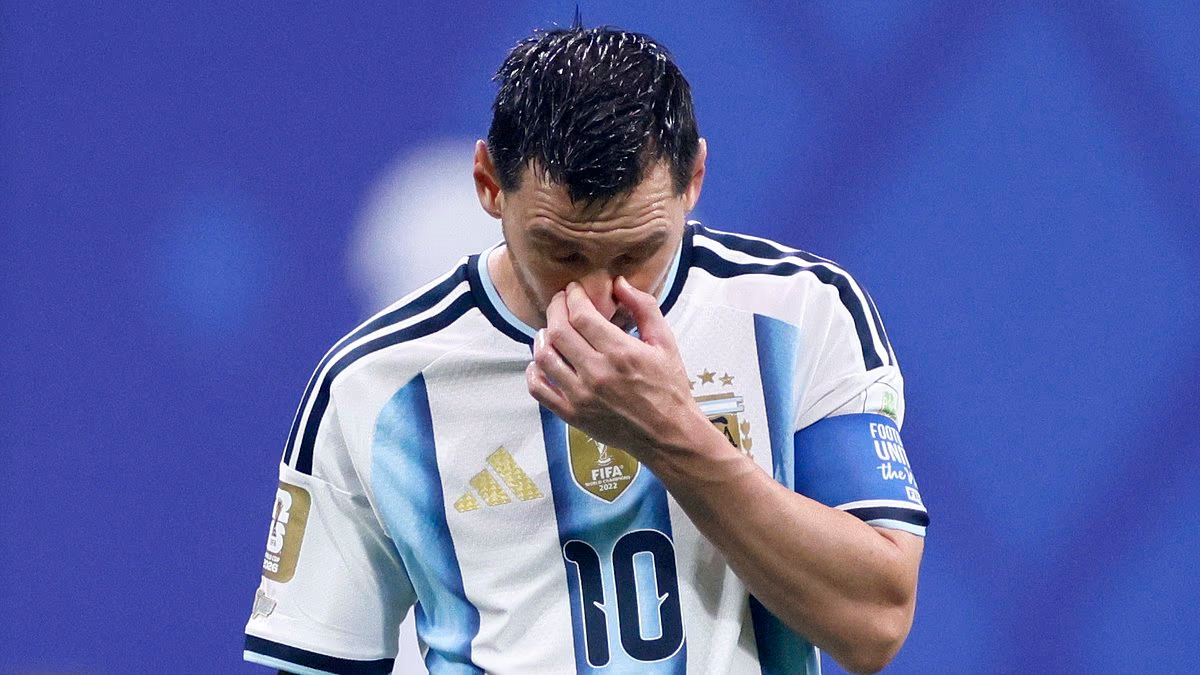

When Egypt goalkeeper Mostafa Shobeir flung himself low to his left to keep out Lionel Messi’s penalty in Argentina’s last-16 showdown, it was more than just a dramatic save — it was a moment for the record books.
Messi has now stepped up for more penalties at World Cups than any other player, with eight attempts, and has also failed to convert more than anyone else, missing four.
The miss also made him the first player to waste two penalties in a single World Cup, after he had earlier fired off target against Austria during the group stage.
Remarkably, Messi has now failed from the spot at three different World Cups, while his wider career numbers stand at 116 successful penalties from 150 attempts.
So how does a player widely regarded as one of football’s all-time greats end up with such an underwhelming record from 12 yards?
Daily Mail Sport asked Geir Jordet, professor of psychology and football at the Norwegian School of Sport Sciences and widely considered the foremost authority on the psychology of penalty-taking, to explain what might be going on.

Lionel Messi’s penalty record remains surprisingly modest given his status as one of football’s biggest superstars
An ‘ordinary’ taker
Across his extraordinary career with Barcelona, PSG, Inter Miami and Argentina, Messi has scored 946 goals, but his 34 misses from 150 penalties leave him with a conversion rate of 77 per cent.
For reference, the xG value for a penalty ranges from 0.76 to 0.79 depending on the circumstance.
‘While Messi is an extraordinary player, he is simply an ordinary penalty taker,’ Jordet explains.
‘We’re expecting more from him but his stats are the average. He has consistently performed in the middle of the pack when it comes to penalties across his career.’
Where is he going wrong?
Although it is strange to see an incredible player performing at the average rate, Jordet believes there are clear deficiencies in Messi’s penalty-taking technique.
Like many other superstars including Harry Kane and Robert Lewandowski, he switches between two methods.
One of these is known as a ‘goalkeeper-dependent technique’, when the 39-year-old approaches his penalty slowly and looks to see where the goalkeeper moves before choosing where to go.
The other is independent of the goalkeeper, and the taker picks a side and sticks to it.
‘His foundational skills of how to kick a ball and read a goalkeeper are top-notch,’ Jordet says. ‘Having two techniques also makes him hard to read for goalkeepers. The problem is his execution.’

Daily Mail Sport spoke to Geir Jordet, the world’s leading expert on the psychology of penalties
Austria miss – goalkeeper-dependent technique
This technique is usually when the player stutters in their run-up as we have seen with the likes of Bruno Fernandes or Jorginho, yet Messi is making a clear error, according to Jordet.
He says: ‘Messi walks slowly up to the ball while looking at the goalkeeper, and his intention is to let the goalkeeper make the first move and then put the ball towards the other side.
‘Players tend to have a skip, jump or stutter leading up to the kick but Messi doesn’t have a stutter. This means he doesn’t have a trigger in his run-up that will mislead goalkeepers and force them to make the first move.
‘It’s easier for the goalkeeper to know that they just need to stand for as long as possible before moving, and when they do that they have a 50 per cent chance of diving the right way.
‘With this technique Messi is not looking at the ball because he’s looking at the keeper which means his precision is going to be a bit off.’
On the Austria miss, Jordet adds: ‘He probably saw mid-kick that the goalkeeper was going in the right direction, and then wanted to make sure his kick was well placed. He tried to make it as good as possible, and it flew outside the post.’

Messi failed to hit the target when he missed from the spot against Austria in the group stage
Egypt miss – goalkeeper independent technique
For the miss against Egypt, Messi was quicker in his approach and tried to beat Shobeir to his left.
Jordet highlighted how the Argentine had ‘pre-decided’ where to aim with ‘pace and precision’ and hinted that keepers can quickly decipher which of his techniques Messi is using.
He adds: ‘The key for the goalkeeper then is to go early because he’s not going to look at you or change his mind, so you have a 50 per cent chance of going the right way.’
Yet why does that technique work for the likes of Kane but not Messi?
‘He does not have as much pace or precision with his kick as some of the best takers. When he uses this technique, it’s an OK shot, but not great, and it’s stoppable.’

Egypt keeper Mostafa Shobeir made a good stop from Messi but his effort wasn’t in the corner
Can he improve?
Despite being at the twilight of his career, Messi shows no signs of slowing down on the pitch and Jordet believes he can still get better at penalties, citing Harry Kane’s development of the stutter technique in recent years.
Jordet also does not believe Messi’s poor record is due to pressure, and rather points at practical reasons.
‘His technique is not fully there right now,’ he concludes. ‘Messi is an extraordinary player, but he’s a very ordinary penalty taker.’