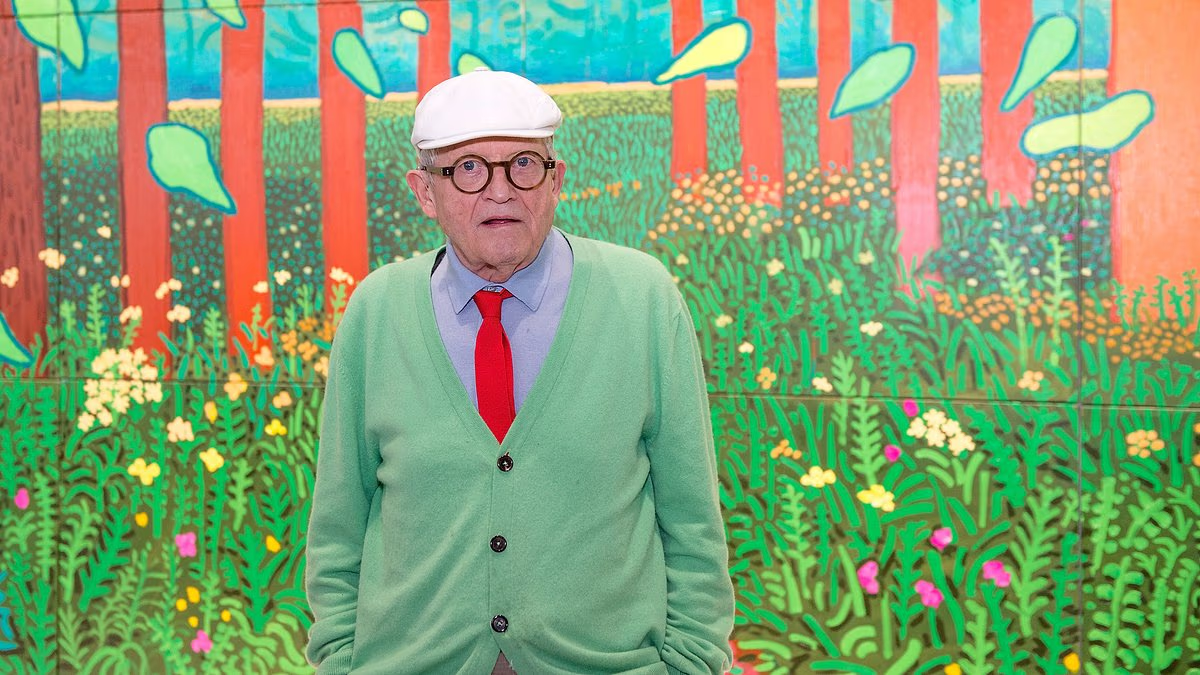

David Hockney, widely regarded as one of the most influential artists of the modern era, has long commanded intense interest from collectors — and his death last month at the age of 88 has only heightened attention around his work.
The renewed focus has also prompted fresh discussion about whether his instantly recognisable paintings and prints could offer an attractive investment opportunity.
Art dealers are increasingly promoting prints of Hockney’s best-known works to buyers, presenting them as a more accessible route into the market than original paintings, which can sell for tens of millions of pounds.
But specialists caution that anyone hoping to turn a quick profit should approach the market carefully.

Portrait of an Artist: Hockney’s 1972 work pictured on display at Christie’s in New York shortly before it sold for a record $90.3million (£67.7million)
What are Hockney prints worth?
Hockney’s 1972 painting Portrait of an Artist, which shows a clothed figure looking down at a swimmer in a pool, made history when it fetched $90.3million (£67.7million) at auction eight years ago. The sale made him the world’s most expensive living artist at the time.
For most buyers, acquiring an original Hockney is out of reach unless they have millions to spend. However, limited edition prints of his works offer a more attainable alternative for collectors looking to enter the market.
Some dealers, including Grove Gallery, have been using social media platforms such as Instagram to promote Hockney prints, with adverts suggesting buyers could “earn 5 to 10 per cent annually owning David Hockney art” and generate “passive income.”
It claims: ‘Between 2000 and 2025, prints alone made up 85 per cent of all Hockney lots sold at auction, and the £10,000 to £50,000 print band generated over £31million from nearly 1,450 lots.’
But Ellie Smith, associate director of the dealership Philip Mould & Company, says that anyone considering investing in prints needs to do their homework.
She says: ‘Limited edition prints can be a relatively affordable way of getting into the market but be aware that values can vary hugely depending on the print run, whether there were under a hundred or in the thousands.’
If Grove Gallery’s literature is to be believed, the returns could be impressive. Inside its 11-page ‘The Collector’s Guide to David Hockney’ it states: ‘Hockney’s print sales value has held up or grown, including a 72 per cent year-on-year surge in 2023 when many other blue-chip artists saw declines’.
However, Smith cautions against buying art if it is being promoted with investment returns as a key reason to buy. Despite repeated requests for a comment, Grove Gallery did not respond.
She says: ‘Your primary reason for buying should be because you love the art – not how much money it may nor may not be worth in a few years or whether it fits in with your home decorations and colour schemes.
‘Remember, just like with stocks and shares values can go down as well as up and you cannot guarantee returns.’

Iconic: The Splash is another of Hockney’s most beloved works – seen here at Sotheby’s in London. But experts warn about jumping in to art investment without doing your homework
Join the discussion
Should art be bought for love or investment, and can rising prices ruin its true value?
The Wealth Report published by estate agent Knight Frank has a Luxury Investment Index which says the investment value of art fell 0.4 per cent in value last year – though over a decade it is still up an impressive 38.6 per cent.
It says: ‘The biggest story of 2025 was the sale of David Hockney’s arrival of Spring series, a collection of iPad drawings… 17 works sold for a total of $8.3million, resetting benchmarks for Hockney prints.
‘This March, a second release of 16 works sold for $4.7million, 136 per cent above estimate.’
On Grove Gallery’s website there was an advert for 2011 digital painting by Hockney on an iPad of a view outside his window that was for sale at £40,000.
Art is not regulated as an investment by the City watchdog the Financial Conduct Authority. This means you cannot us its Financial Ombudsman Service if you have a problem with an art purchase or get any protection under the Financial Services Compensation Scheme

Small screen: Later in life, Hockney (pictured) created works on an iPad – and some of these are also now for sale
How to invest for as little as £850
Galleries such as Goldmark sell Hockney lithograph 1998 posters limited to a run of 1,000 for £850, while a 1969 grey lithograph from a run of 65 can go for £5,000.
The gallery also sells his etchings for between £950 and £18,500 – with prices ranging depending on the level of detail and style of the drawing by Hockney and subject.
The Sotheby’s Spring iPad drawings were printed on colour fabric and were sold for £50,000 to £70,000 each. It currently has a few more affordable Hockney items for sale – from a 2020 limited edition book out of 220 of his art for $3,750 to a 1991 original lithograph for $27,600.
Smith says that auction houses such as Sotheby’s are offering items on the ‘secondary market’ – meaning they are being sold by private owners, rather than directly by the artist or their estate.
She believes it is also worth going to the ‘primary market’ – galleries with an agreement to represent the artist – to ask if they have anything coming up, perhaps original art or affordable prints, etchings or lithographs.
For Hockney they include Annely Juda Fine Art and Grace Gallery.
If you like Hockney you could consider not just studying his work but also that of close contemporaries, such as Eileen Cooper who was born 15 years later, where art is still relatively affordable.
Most art collectors keep hold of their work for at least ten years – but it is important to ensure it is covered under your household insurance. It should be individually named if worth at least £2,000.
When it comes to selling you are likely to pay commission to an auction house of 15 per cent of its value. You will later be liable to capital gains tax on any gains made since purchase.
This kicks in at £3,000 at 18 per cent for a basic rate taxpayer and at 24 per cent for a higher or additional rate taxpayer.
Look for the next Hockney
There is no secret trick to discovering a great artist for the future – you can seek advice but ultimately you must rely on your eyes and how a painting makes you feel.
If you opt for a relative unknown, you will at least be able to invest from just a few hundred pounds rather than spending many thousand for an established name. And although you are unlikely to make a fortune, you at least have a work of art to hang on the wall and appreciate.
Walk around high street trading galleries, many of which have online galleries you can enjoy as well, plus look at websites such as ArtFinder, Artsy and Artgallery.
There is also the Affordable Art Fair that offers a marketplace for talent, with three fairs a year in Britain.
Jane Verity, of the trading website ArtFinder, says: ‘While it is near impossible to bank on tastes to find a future winner, you can enjoy doing research into artists and find work you love. If it rises in value this is a bonus.’
Events are also advertised in publications such as the Antiques Trade Gazette as well as by the Affordable Art Fair.
Another option is to visit an end-of-degree art college sale to find a great future artist at the start of their career.
These include Central Saint Martins College of Art and Design, in London, plus the Royal College of Art, also in the capital – and where Bradford-born Hockney studied.
SAVE MONEY, MAKE MONEY

4.51% cash Isa
4.51% cash Isa
Trading 212: 0.91% fixed 12-month bonus

Up to £200 cashback
Up to £200 cashback
5% cashback when investing at least £100
4.21% tracker account
4.21% tracker account
120 day notice account with 0.23% boost

Up to £200 bonus
Up to £200 bonus
Welcome bonus when you invest £100
Up to £750 cashback
Up to £750 cashback
Open a savings account with at least £10,000
Affiliate links: If you take out a product This is Money may earn a commission. These deals are chosen by our editorial team, as we think they are worth highlighting. This does not affect our editorial independence. Terms and conditions apply on all offers.