
A problem cannot be addressed if an institution refuses to acknowledge it exists. As the Royal Commission into Antisemitism and Social Cohesion examines the national broadcaster, the ABC’s central challenge appears to be less about any single broadcast or complaint, and more about its reluctance to concede there may be a deeper issue at all.
It has the feel of an organisation unable, or unwilling, to take the first step toward genuine self-examination.
When pressed by the inquiry, the ABC’s response resembled the kind of institutional defensiveness it often scrutinises in others. Rather than engaging with the broader cultural questions being raised, it appeared to retreat into process, policy and internal procedure.
That contrast is hard to ignore.
This is a broadcaster that regularly calls on churches, banks, corporations and political parties to confront entrenched cultural problems and accept public accountability. Yet when similar scrutiny is directed at the ABC itself, an organisation supported by more than a billion dollars a year in taxpayer funding, the response seems to suggest that formal compliance is enough.
The issue emerging from the royal commission is not simply that the ABC makes errors, or that its reporting on the Middle East draws complaints. Every media outlet makes mistakes, and coverage of Israel, Gaza and antisemitism is almost certain to provoke intense criticism from different sides of the debate.
The larger concern is whether there is an institutional unwillingness to reflect honestly on bias, culture and editorial blind spots. For critics, that refusal to confront the possibility of a problem is precisely what prevents meaningful change.

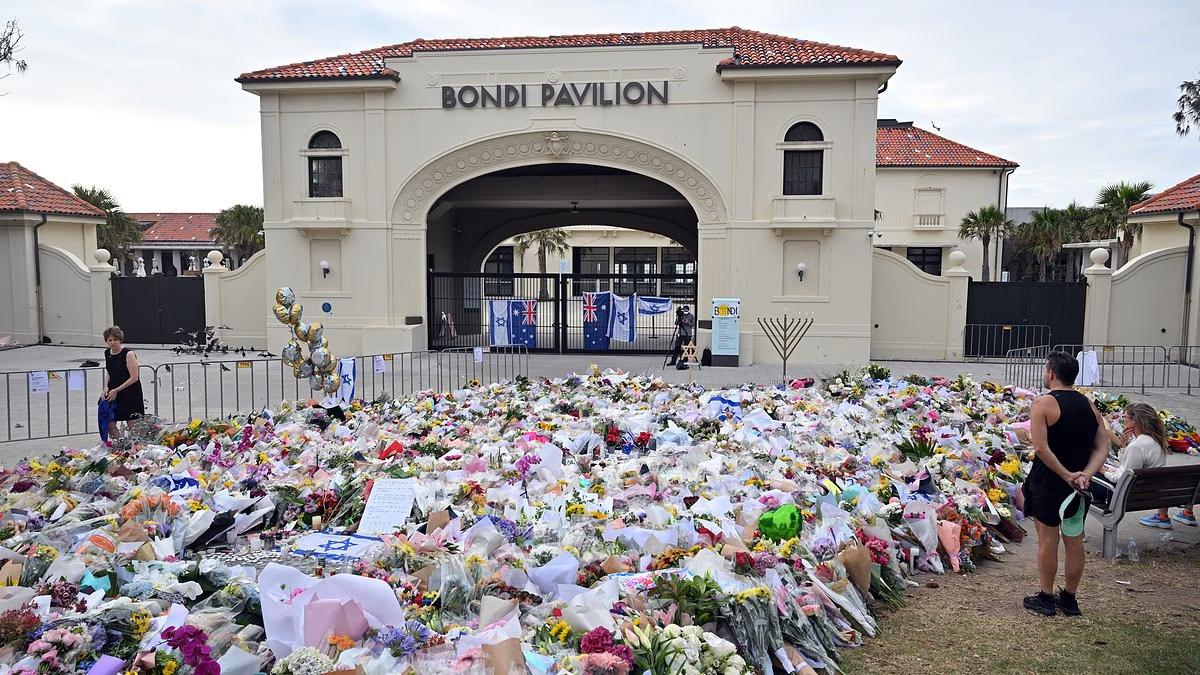
As the Royal Commission into Antisemitism and Social Cohesion turns its spotlight on the national broadcaster, critics argue the ABC’s biggest problem is that it still won’t admit it has one. (Pictured: tributes at Bondi Pavillion)
The ABC behaves as though possessing a charter, an Ombudsman and a complaints process guarantees its virtue. But rules and procedures don’t guarantee a good culture, far from it.
Antisemitism envoy Jillian Segal cut straight to the bone this week. She told the inquiry about a pervasive perception within the Jewish community that the ABC lacks balance, especially with respect to Gaza, and disproportionately amplifies anti-Israeli voices in its coverage.
Her most damning critique was institutional: the ABC marks its own homework, acting as judge and jury when assessing its performance.
Predictably, the broadcaster’s response recited its procedures, noting that no complaint of bias in its Middle East coverage has been upheld. By itself, that is, as if that settles the matter.
The ‘14,000 babies’ fiasco proves why this defensive crouch is untenable. Last May, the public broadcaster repeatedly aired a startling, emotionally explosive (and entirely false) claim that 14,000 babies in Gaza could die within 48 hours. The United Nations corrected it. The BBC, where the claim originated from, had corrected it too. The ABC just ran the story anyway.
By the Ombudsman’s own findings, the statistic was material and the network failed to ensure accuracy. But don’t worry, because the ABC hasn’t upheld any complaint about bias in its Middle East coverage, so all is well.
Making matters worse, the original error was blasted across ABC News Breakfast and the Afternoon Briefing program. The correction was a delayed whisper barely noticed. In other words, the initial egregious error got significant reach, but the correction did not.
It’s not that every ABC journalist wakes up plotting against Israel or Jewish Australians. That’s too crude, and too easy for the ABC to dismiss. A classic straw man argument.

The ABC found itself in the middle of controversies following the Bondi terror attacks. (The parents of 10-year-old victim Matilda are pictured)
The real problem is subtler and more serious: editorial instincts that too often seem to lean in one direction, followed by institutional defensiveness when challenged. We’ve long seen similar bias in the ABC’s coverage of domestic politics, with the bizarre internal self-justification that it’s the public broadcaster’s role to balance out a perception of political bias in other private media organisations.
That’s ridiculous as an unofficial cultural edict at a taxpayer-funded institution. It’s the inevitable result of an institutional echo chamber. When your newsrooms are monocultures where almost everyone shares the same worldview, ideological groupthink doesn’t feel like bias to the people writing the scripts, it just feels like common sense.
That is why they genuinely can’t see the problem.
Then came Bondi. Fifteen people were killed at a Hanukkah celebration by alleged attackers reportedly inspired by Islamic State. It was an atrocity demanding clarity, empathy and moral seriousness. Instead, the ABC once again found itself in the middle of controversies.
Its global affairs editor, Laura Tingle, was criticised for saying on a podcast that the alleged actions had ‘nothing to do with religion’. Can you think of a more callow misread of the situation?
One of the ABC’s best, Sarah Ferguson, used a 730 interview with Josh Frydenberg to suggest his comments after the massacre may have been political. It was the classic ‘how often do you hit your dog’ question. The answer doesn’t matter, the framing of the question did its subjective job.

‘The ABC doesn’t need to be a pro-Israel broadcaster. It just needs to be accurate, fair and alive to the consequences of its own framing,’ writes PVO (pictured)
How does anyone learn from their mistakes if their organisation’s cultural reflex is to dismiss criticisms?
This is not just an academic debate over journalistic standards. This kind of coverage actively shapes the moral atmosphere of the country. It mainstreams hostility and leaves Jewish Australians feeling isolated at a time of unprecedented vulnerability.
Managing Director Hugh Marks defended both of these examples, a response that tells its own story.
When Jewish leaders, the antisemitism envoy and a Royal Commission all raise the alarm, the ABC’s reflex is to defend and deny. And like every institution in denial, it seems unable to take the first step: admitting there is a problem even worthy of trying to repair.
The ABC doesn’t need to be a pro-Israel broadcaster. It just needs to be accurate, fair and alive to the consequences of its own framing. That obligation is heavier precisely because the ABC is taxpayer funded.
The ABC demands trust as a birthright and expects deference because of its legacy.
But public trust isn’t a permanent inheritance. It must be earned daily, and right now, the national broadcaster is arrogantly squandering it.
Cleary, I was wrong
On a different topic, and in sharp contrast to the ABC’s refusal to ever admit a mistake, I need to fall on my sword.
Before the rugby league State of Origin series started a few weeks back, I called for Nathan Cleary to be sacked, because of a track record of underperforming in Origin.
While I gave myself caveats galore in the event that he silenced his critics, I was wrong, it’s that simple. Of course as a NSW supporter, I’ve never been happier to be proven wrong, also because Cleary is clearly one of the nice guys in the sport.

Peter van Onselen regrets calling for Nathan Cleary (pictured) to be sacked
He won man of the match in Game 1, player of the series, and he dominated Game 3 to lock in the Blues series victory – up in the hostile climate of Brisbane, by the way.
Simply put, without Cleary playing the way that he did in the first and last games, NSW wouldn’t have won either of them. No way.
The Origin monkey is off his back, and all that awaits Cleary now is official immortal status, at lightning speed after he retires.
A final idea from me: make Cleary the first active player to be made an immortal. He deserves it.


