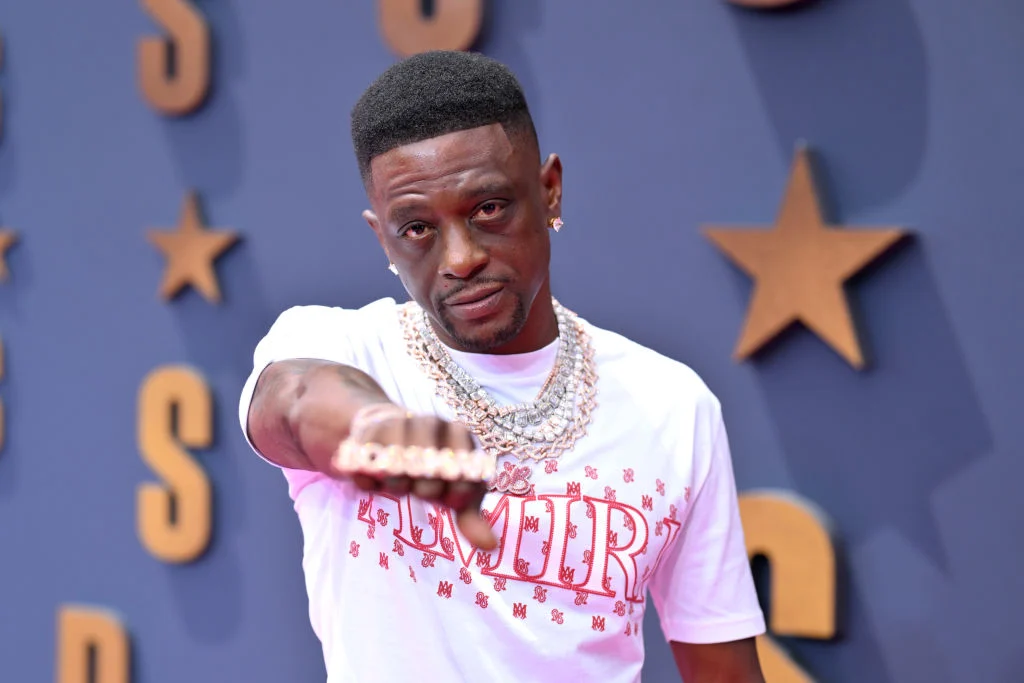

Boosie Badazz has spent much of his adult life entangled with the criminal justice system. The Baton Rouge rapper served several years in a Louisiana prison on drug-related convictions, was cleared of a murder charge in 2012 and, more recently, admitted guilt in a federal case involving illegal firearm possession as a convicted felon.
With the threat of another federal prison term looming, Boosie reportedly paid $600,000 to a Washington lobbying firm in an effort to secure a presidential pardon from Donald Trump.
A detailed report from NOTUS.org claims that two political operatives acting on Boosie’s behalf allegedly informed his lawyer that Trump had already signed the pardon and that only a formal White House announcement remained.
That announcement never materialized. Boosie’s legal team reportedly could not find proof that any pardon had been signed, while a White House official told NOTUS that the administration’s clemency team had no dealings with the operatives. Boosie is now seeking to recover $300,000 from the payment.

(Photo by Paras Griffin/Getty Images for BET)
Why Did Boosie Need a Pardon?
Boosie, born Torrence Hatch, was convicted on felony drug charges in Louisiana and spent roughly five years behind bars before his release in 2014.
Because of those felony convictions, federal law bars him from possessing a firearm.
In 2023, prosecutors accused Boosie of having a Glock pistol in San Diego. After a series of legal turns, including charges being dismissed and later refiled, he ultimately pleaded guilty to possession of a firearm by a convicted felon.
The federal offense carried a theoretical maximum sentence of 15 years in prison, although the sentence he was realistically likely to receive under federal guidelines was substantially lower.
While awaiting sentencing, Boosie began pursuing presidential clemency. A president cannot pardon state crimes, meaning Trump could not erase Boosie’s old Louisiana convictions. But he did have the authority to pardon the federal firearm offense.
A pardon would not have deleted the conviction from the public record, but it could have relieved Boosie of the federal punishment and other consequences flowing from the case.
The $600,000 Pardon Contract
According to NOTUS, Boosie hired Jacob Wohl and Jack Burkman’s firm, JM Burkman & Associates, in September 2025 after hearing that the operatives had successfully helped other clients receive pardons.
Federal lobbying disclosures reviewed by NOTUS reportedly did not substantiate claims that the firm had secured nine pardons. The outlet identified only one registered client who later received clemency, and a White House official said Wohl and Burkman had played no role in that pardon.
Boosie told NOTUS that the firm sounded extremely confident during its initial pitch.
“They were real aggressive, they were talking like they had Trump on speed dial,” he said.
A copy of the six-page agreement reviewed by CNW appears to bear the electronic signatures of both Burkman and Boosie, dated September 30, 2025.
The contract said the firm’s “primary and exclusive objective” was to secure a full pardon for Boosie’s federal gun conviction. For $600,000, the firm agreed to develop his pardon petition, submit and manage it through the Justice Department’s Office of the Pardon Attorney, lobby the White House Counsel’s Office and advocate with senior White House officials—and, where possible, the president himself.
The agreement also clearly stated that the power to grant clemency belonged exclusively to the president. The firm made “no promise, representation, or guarantee” that a pardon would actually be granted.
But the payment did come with an unusual refund provision.
The $300,000 Refund Clause
The agreement divided Boosie’s $600,000 payment into two halves.
The first $300,000 was described as non-refundable and earned upon receipt. The remaining $300,000 was labeled a “contingent refundable portion.”
According to the document, if a full pardon was not secured by the stated deadline, the consultant “shall refund” $300,000. Boosie was required to make the request in writing, after which the firm was supposed to return the money by wire transfer within three business days.
There was, however, a glaring drafting problem.
Although the contract was signed in September 2025, it repeatedly listed the deadline as January 31, 2025—a date that had already passed. Boosie’s attorney told NOTUS that everyone understood the intended deadline was January 31, 2026. The incorrect year could become an important point of dispute in the arbitration.
The agreement also directed Boosie to wire the entire $600,000 into the firm’s general bank account. It did not identify a separate trust or escrow account where the potentially refundable $300,000 would be held.
JM Burkman & Associates disputes Boosie’s interpretation of the arrangement. The firm told NOTUS that “no provision to return half the fee was ever actually agreed to.”
A lawyer for the operatives has also reportedly claimed that they did not see the retainer agreement allegedly signed by Boosie until after arbitration began. Boosie and his attorneys dispute that account.
Was Trump Really About to Sign?
Between September 2025 and January 2026, Wohl and Burkman allegedly provided Boosie’s legal team with a series of encouraging updates.
According to messages reviewed by NOTUS, the operatives reportedly claimed that Boosie’s pardon application had reached the Justice Department and was being reviewed by the White House.
They also allegedly invoked the names of prominent conservative influencers and Republican officials while discussing support for Boosie’s application.
NOTUS reported that Wohl claimed figures including Mike Cernovich, Erika Kirk and House Speaker Mike Johnson had endorsed a pardon. Representatives for several of the people named denied those claims. Kirk’s representative reportedly said she did not know who Boosie was, while Cernovich said he had never advocated for a pardon. Johnson’s office categorically denied any connection to the effort.
On New Year’s Eve, Burkman reportedly texted Boosie’s attorney that Trump had the pardon in hand and was ready to sign.
The following day, according to Boosie’s attorney, the operatives allegedly said during a phone call that Trump had signed it and that the White House only needed to announce it.
The Pardon Never Materialized
With Boosie’s sentencing hearing approaching, his criminal-defense attorney began trying to independently verify the supposed pardon.
According to NOTUS, an assistant U.S. attorney checked the federal system but found no confirmation. A White House aide reportedly said the administration had not seen Boosie’s application.
A White House official later told NOTUS that the clemency team had never heard from Wohl or Burkman and did not support their work.
Wohl and Burkman did not directly answer the outlet’s repeated questions about the allegation that they told Boosie’s attorney a pardon had been signed.
Their firm maintained that it performed extensive work on Boosie’s behalf, describing its efforts as a major advocacy campaign across Congress, the executive branch and conservative media. The firm said it continued to believe that Boosie deserved a pardon.
Boosie Received an Extremely Light Sentence
Despite failing to obtain clemency, Boosie received a remarkably favorable sentence in January 2026.
A federal judge sentenced him to 10 days in jail, all credited as time already served, followed by three years of supervised release.
In other words, Boosie reportedly spent $600,000 trying to avoid a federal prison sentence that ultimately required him to serve no additional time behind bars.
The supervised-release portion, however, soon became a serious problem.
The Houston Hookah Case
In May 2026, Boosie was charged with felony aggravated assault following an alleged altercation at a Houston nightclub.
Prosecutors allege that Boosie struck a security guard in the head with the glass base of a hookah while the guard was escorting Boosie’s niece from the club. The guard reportedly suffered injuries requiring eight staples.
Boosie has characterized the accusation as a “money grab,” and his attorney has urged the public not to reach conclusions before surveillance footage and witness evidence are reviewed. Boosie is presumed innocent.
If prosecuted as an ordinary second-degree aggravated assault under Texas law, the charge carries a potential sentence of two to 20 years in prison.
Federal prosecutors are also seeking to revoke Boosie’s supervised release. A federal judge could find that he violated the conditions of supervision even without a Texas conviction because revocation proceedings use a lower burden of proof than a criminal trial.
Boosie could potentially receive up to two years in federal prison if his supervised release is revoked.
Where Is the $300,000?
After the pardon failed to materialize, Boosie reportedly made a written demand for the return of $300,000.
According to messages reviewed by NOTUS, Burkman responded that the firm was “essentially bankrupt” and owed more than $6 million because of robocall penalties and other debts.
Wohl and Burkman previously pleaded guilty in Ohio in connection with an illegal robocall campaign that authorities said targeted Black voters. They later faced additional legal actions, settlements and multimillion-dollar penalties.
The contract requires disputes to be resolved through binding arbitration before the American Arbitration Association in Washington, D.C. It also states that the successful party may be entitled to recover reasonable legal fees and costs.
No arbitrator has ruled that Wohl, Burkman or their firm breached the agreement or committed fraud.
Meanwhile, Boosie’s criminal-defense attorney has submitted a separate pardon application directly to the White House. The administration confirmed receiving the documents but cautioned that receipt should not be interpreted as evidence that clemency will be granted.
For now, Boosie has no pardon, is fighting a new felony charge and could be returned to federal prison.
(function() {
var _fbq = window._fbq || (window._fbq = []);
if (!_fbq.loaded) {
var fbds = document.createElement(‘script’);
fbds.async = true;
fbds.src = ”
var s = document.getElementsByTagName(‘script’)[0];
s.parentNode.insertBefore(fbds, s);
_fbq.loaded = true;
}
_fbq.push([‘addPixelId’, ‘1471602713096627’]);
})();
window._fbq = window._fbq || [];
window._fbq.push([‘track’, ‘PixelInitialized’, {}]);