
A dangerous cycle of U.S. and Iranian strikes across the Middle East — coupled with fresh warnings over the Strait of Hormuz — has effectively destroyed the fragile agreement meant to halt the war.
DUBAI, United Arab Emirates — The United States expanded its attacks on Iran early Thursday, striking targets farther north while American forces also opened fire on a ship Washington said was attempting to violate its naval blockade of the Islamic Republic. Iran answered before dawn with missiles and drones aimed at U.S. allies across the region, while warning that its response could intensify.
The escalating exchange of attacks between the U.S. and Iran, along with renewed threats involving the Strait of Hormuz, has torn apart the interim deal to end the Iran war and raised fears that the region could be pulled back into full-scale conflict. Iranian officials say U.S. strikes have already killed more than 35 people and injured over 300.
For the first time in this latest surge of violence, strikes also hit areas around Iran’s capital, Tehran, underscoring the broader range of targets now being pursued by American forces.
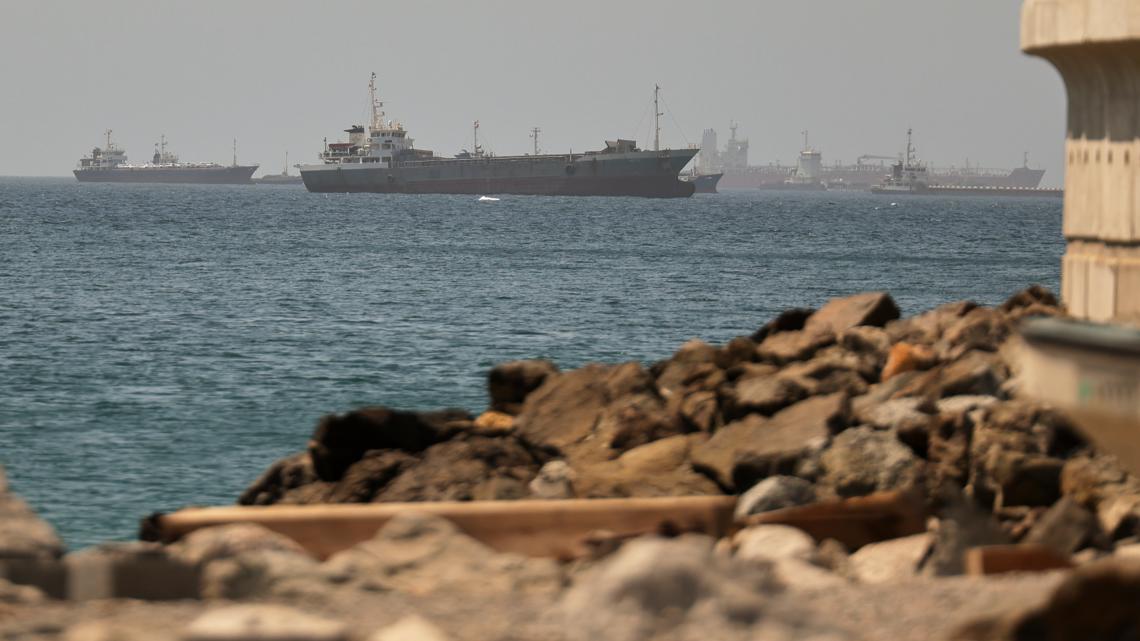
After the U.S. and Israel launched the war against Iran on Feb. 28, Tehran moved to effectively shut the Strait of Hormuz to shipping, a step that sent prices for oil, fertilizer and a range of other goods sharply higher well beyond the Middle East and gave Iran significant leverage at the negotiating table.
Col. Ebrahim Zolfaghari, a spokesperson for the Iranian military’s Khatam al-Anbiya Central Headquarters, warned that Iran could unleash widespread attacks on regional infrastructure if the U.S. follows through on President Donald Trump’s repeated threats to strike Iranian bridges and power plants.
“All the infrastructure in the region will be crushed under the steel blows of the powerful armed forces of the Islamic Republic of Iran” should Trump’s threat be carried out, Zolfaghari said.
“Under no circumstances and in no way will we allow America, as a foreign and extra-regional country, to interfere in the Strait of Hormuz,” he added. “This is Iran’s invincible red line.”
Both the US and Iran launch attacks as blockade is reimposed
The U.S. strikes early Thursday hit around Tehran, state media reported. It also reported that American attacks targeted Semnan province, home to Iran’s ballistic missile production and space program.
Iranian media also reported strikes Thursday morning around the provinces of Hamedan, Hormozgan, Khuzestan, Lorestan, Markazi, and Sistan and Baluchistan.
On Wednesday, the U.S. resumed striking Iran during daylight, further showing the increasing tempo of the attacks. An attack on Greater Tunb Island, a strategic point in the Strait of Hormuz, targeted Iranian defense and missile sites, Central Command said.
Meanwhile, the U.S. military said it opened fire on the Curacao-flagged oil tanker Belma sailing toward Kharg Island, Iran’s main oil export terminal in the Persian Gulf. After the ship “ignored multiple warnings,” a U.S. aircraft disabled the merchant vessel by firing a missile into the ship’s smokestack.
Another American strike Wednesday targeted a barracks for Iran’s 388th Mechanized Infantry Brigade, which operates tanks and armored vehicles, in Sistan and Baluchestan province, Iranian state television reported. The report said Americans fired at least 13 missiles in the attack and the seven dead included conscripts and career soldiers. A number of troops were wounded.
Iran retaliated Thursday with missile and drone attacks on Bahrain, Jordan and Kuwait, authorities in those countries home to U.S. forces said. There was no immediate acknowledgment of damage or casualties from the attacks.
Meanwhile, Iraqi Prime Minister Ali al-Zaidi condemned an overnight drone attack on the city of Irbil in Iraq’s semiautonomous northern Kurdish region. The drone, which authorities said had been intercepted, came during his trip to the U.S. in which he said Iraq would work to disarm non-state armed groups, including those backed by Iran.
Trump says a peace deal is still possible
The latest round of fighting is focused on the Strait of Hormuz, as Iran attacks ships using a U.S.-controlled route through the vital waterway.
The U.S. has threatened to reopen the strait by force, but experts say that would require a much bigger armada if not tens of thousands of ground troops.
The price for Brent crude oil, the international standard, traded above $85 a barrel on Thursday, more than 15% higher than the price before the war, but still well below the nearly $120 reached at the height of the conflict.
Rising prices pose a particular challenge to Trump and his Republican Party, which hopes to retain control of Congress in elections in November. But Washington has struggled to successfully reopen the waterway, leading to Trump reimposing the naval blockade Wednesday. Mediators have sought to calm the tensions, but so far have been unsuccessful.
Trump again insisted Iran was ready to strike a peace deal, but he did not elaborate.
“They don’t like what we’re doing, and they do want to settle. We’ll find out whether or not we settle with them, or we just finish it off,” he said Wednesday at the U.S. Army War College in Pennsylvania.
Trump separately said on social media that Tehran made a goodwill gesture by releasing an American citizen wrongly detained in Iran since 2024. He didn’t release further details. Human rights lawyer Jared Genser released a statement identifying the detainee as his client Dena Karari, a U.S.-Iranian citizen who runs a nonprofit and was charged with espionage.
Iran did not immediately acknowledge the release and her case was not publicly known, as is sometimes the case with detentions in the Islamic Republic.
Copyright 2025 Associated Press. All rights reserved. This material may not be published, broadcast, rewritten, or redistributed.