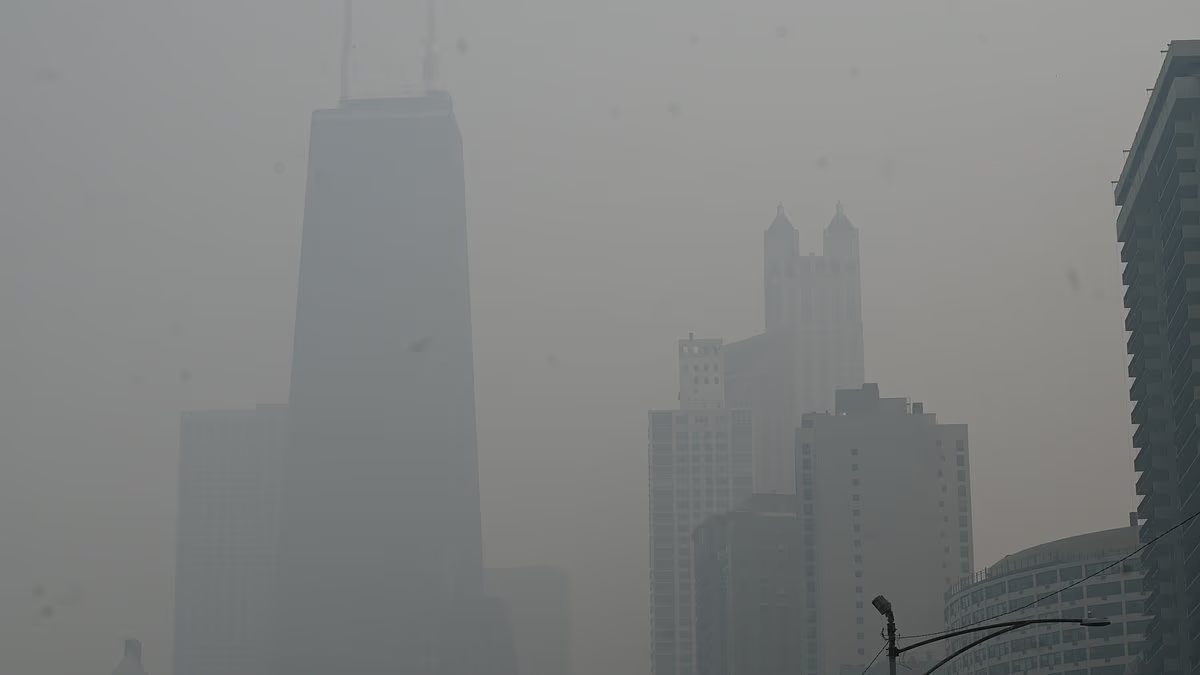


Millions of Americans are facing severe air quality warnings as smoke from Canadian wildfires drifts across the border, pushing pollution levels in some areas to the health equivalent of smoking more than a dozen cigarettes a day. Conditions worsened sharply Friday, with major cities including Chicago, Detroit, Washington and New York ranking among the most polluted in the world. The National Weather Service issued air quality alerts across 16 states, from Minnesota, Wisconsin, Michigan and Illinois in the Upper Midwest to New York, New Jersey, Maryland and Virginia on the East Coast. The Environmental Protection Agency classified the air as “hazardous” — its most serious warning level — from northern Minnesota to Columbus, Ohio. In areas where pollution has reached that threshold, NWS officials advised residents to “avoid all physical activity outdoors.” The smoke, flowing south from hundreds of wildfires in Canada, particularly in Ontario, contains fine particulate matter known as PM2.5, a microscopic pollutant that can lodge deep in the lungs.
Air pollution rivals cigarette smoking dangers

PM2.5 particles are toxic pollutants commonly produced by burning wood and industrial emissions. Because they are so small, they can enter human tissue and trigger serious respiratory problems, especially for people with heart or lung disease, and in some cases can contribute to premature death. Health experts said the PM2.5 levels recorded Friday in Detroit — 292.6 µg/m³ — were comparable to inhaling the pollution burden of more than 13 cigarettes in a single day. Chicago was also dealing with dangerous air, with live air quality monitor IQAir reporting more than 240 µg/m³ of PM2.5 pollution, roughly the same as smoking more than 10 cigarettes over 24 hours.
High AQI levels equal cigarette exposure

Berkeley Earth, a nonprofit research group that studies climate and air quality data, has estimated that breathing air containing 22 µg/m³ of PM2.5 for a full day carries a long-term health impact similar to smoking one cigarette. Dr. Jonathan Tan of the Children’s Hospital of Philadelphia told AccuWeather: “When the AQI climbs into the 150+ range for a full day outside, that’s in the ballpark of [smoking] seven to nine cigarettes.” The Air Quality Index, or AQI, generally runs from 0 to 500. Readings from 0 to 50 are considered “good,” while 51 to 100 is “moderate” and may affect unusually sensitive people. Levels from 101 to 150 are “unhealthy for sensitive groups,” and readings between 151 and 200 are “unhealthy,” meaning everyone may begin to feel the effects and should reduce outdoor exertion.
Midwest cities choke on hazardous air

Once the AQI reaches the “hazardous” range of 300 to 500, or climbs even higher, the EPA says everyone should stay away from outdoor physical activity. By 9 a.m. ET Friday, IQAir showed both Detroit and Chicago above 380. Washington, D.C., registered 247, making it the third-worst polluted major city in the world at that point, while New York ranked fourth at 165. Those readings placed the cities in unhealthy to very unhealthy territory. The expanding smoke plume has been linked to hundreds of Canadian wildfires, with criticism mounting over the country’s fire management approach as roughly 800 fires have burned more than two million acres nationwide this year.
Canada’s rural fires spark US criticism

Dan DePodwin, AccuWeather’s vice president of forecasting, told the Daily Mail that Canada’s vast rural landscape plays a major role in how many fires are handled. “Because a lot of Canada is very rural, in many parts of the country, they don’t actively fight fires, because there is very little to no population nearby,” he said. “So, the fires burn until they go out themselves, or they do minimal fire suppression. So that is part of it, that is occurring here,” he added. The worsening smoke crisis has angered some US lawmakers, who accused Canadian officials of failing to do enough to contain the wildfires and prevent dangerous smoke from spreading into northern states.
Lawmakers urge Canada to address wildfires

New York Congressman Nick Langworthy said: “Americans should not be forced to breathe hazardous air year after year because Canada refuses to properly manage its forests.” He added: “This is no longer a one-time emergency – it’s becoming an annual public health crisis. That is unacceptable.” Langworthy represents parts of Buffalo, one of the areas hit hard by the toxic air. Michigan Congressman Bill Huizenga also urged Canada to coordinate with the United States on a long-term response to the recurring wildfire smoke problem. “Michiganders must stop paying the price for bad policy,” Huizenga said.
Sensitive groups urged to stay indoors

The National Weather Service also advised people considered especially vulnerable to poor air quality to remain indoors Friday with windows closed. That includes older adults, young children, pregnant women and anyone with chronic medical conditions such as heart or lung disease. “If you don`t have an air conditioner, staying inside with the windows closed may be dangerous in extremely hot weather. If you are hot, go someplace with air conditioning or check with your local government to find out if cooling centers are available in your community,” the agency said. AccuWeather’s team also reminded residents to protect animals, adding: “Make sure to keep pets indoors to limit their exposure to poor air quality.”