
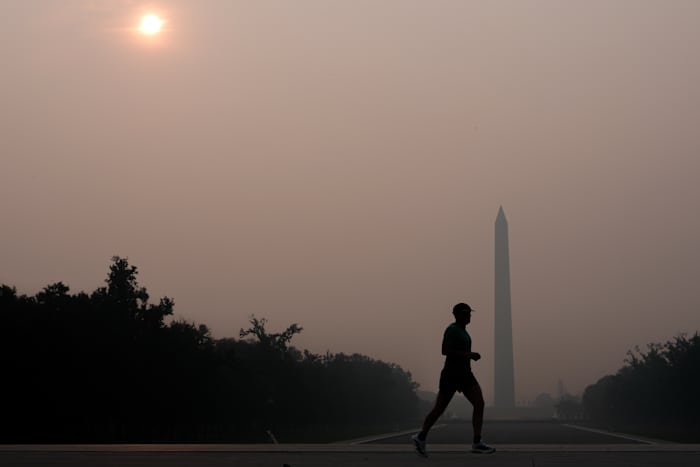
MILWAUKEE – An orange sun glowing through a curtain of wildfire smoke can look alarming, but health experts say the most serious danger is often invisible.
The fine particles carried in smoky air can trigger immediate symptoms and contribute to longer-term health problems, especially when exposure lasts for hours or days.
Wildfire smoke can linger over communities for extended periods, as seen recently when fires burning in Canada sent a thick haze across parts of the United States and created hazardous air conditions for millions of people in several states.
When smoke levels rise, public health officials recommend staying inside whenever possible and taking extra steps to keep indoor air as clean as you can.
How to use your air conditioner safely during wildfire smoke
Homes with central air conditioning may already have an important tool for filtering indoor air.
Check that your HVAC filters are changed as recommended and use the strongest filtration level your system can safely support. A filter rated MERV 13 or higher is considered ideal. Set the system to recirculate indoor air, and if possible, close any vents that draw in outside air. The University of Oregon’s Center for Wildfire Smoke Research and Practice also recommends keeping the system fan running throughout the smoke event, rather than only when the air conditioner is actively cooling.
For added protection, consider a portable air cleaner with a HEPA filter or a model specifically designed to capture small pollution particles. Avoid any unit that produces ozone, which is itself a harmful air pollutant.
If you can only afford one portable air filter, use it to create a “clean room” in your house where you can spend most of your time.
“The basic message is that something is better than nothing,” said Amy Kalkbrenner, an environmental epidemiologist at the University of Wisconsin-Milwaukee.
The science behind DIY air filters
There’s good evidence that DIY filters made by duct-taping furnace air filters to a box fan work.
They’re simple, relatively affordable and scientists at the Environmental Protection Agency have found they are just as good at removing fine particles of pollution from the air as a small commercial air purifier.
“The good news is they really work,” said Kalkbrenner.
All you need to have to make one is: four 20-by-20-inch (50.8-by-50.8-centimeters) furnace air filters rated MERV 13 or higher, a box fan, cardboard and duct tape. The EPA’s website shows how you can modify the design to only use one or two filters. The fan should blow out, and the arrows on the filters should point in. Make sure everything is taped up air-tight.
Using your window AC and cooling your air safely
Many window air conditioners, mini-split heat exchangers and portable air conditioners don’t have the filters needed to remove fine pollution particles. But heat can also be dangerous.
“When smoke and heat occur together, the impacts on your health are even greater than when they occur by themselves,” said Jess Downey, a researcher at the University of Oregon’s Center for Wildfire Smoke Research and Practice
Downey said the ideal scenario is running the AC unit and using an air purifier or a DIY box fan filter to clean the air. Make sure your AC is well-sealed in your window frame, she added.
Make sure the window units are set to recirculate air. Portable units with a single hose should be used sparingly, according to the University of Oregon wildfire smoke center.
If you don’t have AC, any reprieve from hot, smoky air is important. Head to the library, shopping mall or other space with clean, cool air.
Ways to seal up a home to keep hazardous air out
Whether it’s a towel, some tape, or something else — plug areas where air could enter from outside.
“Being from Chicago, I think you can liken it to trying to keep the cold air out,” said Dr. Khalilah Gates, a lung doctor with Northwestern Medicine. “Any areas in which air can come in, consider sealing up those areas to reduce the amount that’s coming into the home.”
When smoke levels are high, experts recommend avoiding anything that burns — candles, fireplaces, even gas stoves — so plan ahead with some meal prep.
How wildfire smoke affects the body
Exposure to wildfire smoke can lead to shortness of breath, chest tightness, headaches, and a burning sensation in the nose and eyes.
“When you ever start to feel those symptoms and they’re not severe, it’s important to acknowledge, ‘Oh, my body is responding to this. I need to move away from it. I need to move inside,’” Gates said.
If you’re wheezing, can’t catch your breath or are in distress, get to the emergency room immediately, she said.
___
The Associated Press Health and Science Department receives support from the Howard Hughes Medical Institute’s Department of Science Education and the Robert Wood Johnson Foundation. The AP is solely responsible for all content.