
There is, thankfully, an adult voice at the Federal Reserve. A few days in Washington is a useful reminder that decisions made here reach far beyond America’s borders, shaping prospects in Britain and steering financial markets across the globe. That matters all the more at a time when the US President’s approach can appear so unpredictable.
When economic policy from the White House feels erratic, investors and households need steadiness from the institution just around the corner: the Federal Reserve, America’s central bank.
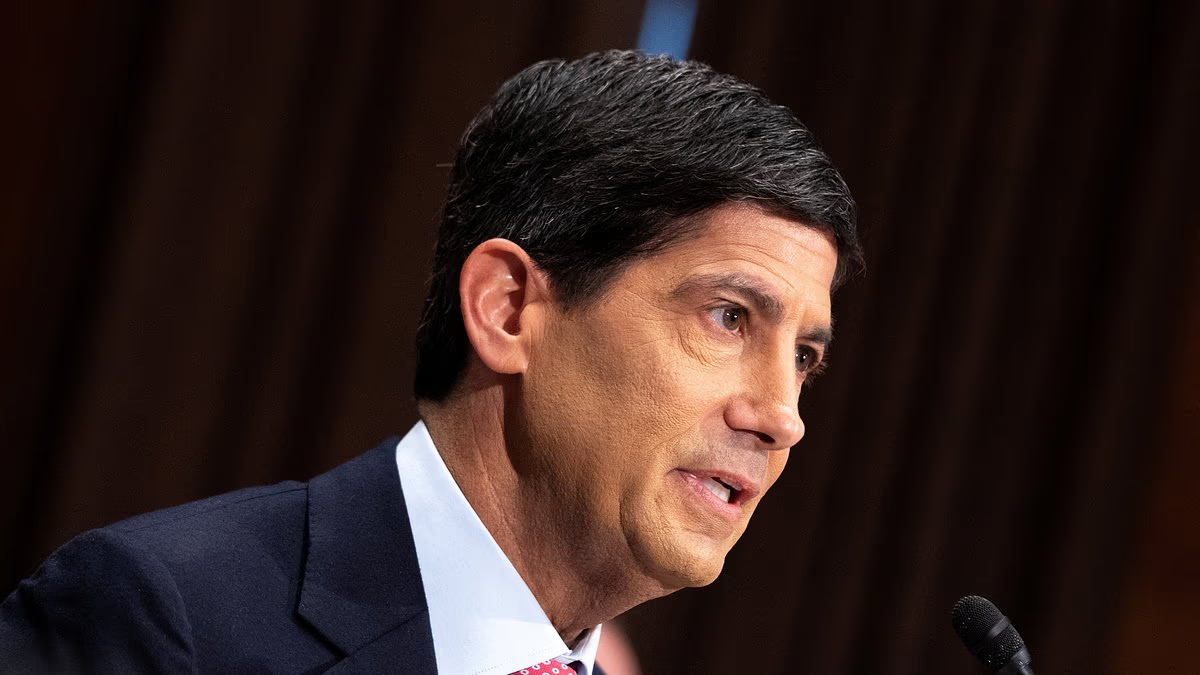
Kevin Warsh, the Fed’s new chair, was chosen by Donald Trump, as the American system allows.
Unlike Trump, however, Warsh has a term that runs until 2030. And because Fed chairs are commonly reappointed for at least one further term, he could remain in the role deep into the next decade, while retaining a seat on the board until 2040.
Last week, he made his first appearance before Congress. Watching his testimony to the House Financial Services Committee, three points stood out.

Appointment: Kevin Warsh is the new chair of the US Federal Reserve
First, he knows how to handle politicians. Faced with questions that were sometimes silly or beside the point, he remained courteous and composed, replying with a smile that the Fed “needed to stick in its lane”.
Second, he showed a clear understanding that central banks around the world, the Fed included, had fallen short of their core duty to keep inflation under control. His message was that he intended to make high inflation “a thing of the past”.
The third was that he strongly defended the independence of the central bank. He had to do that, of course, but it is good to set it on record at this first interaction with Congress.
There have been fears, I think unfounded, that he might be over-influenced by the President. So a robust defence at this stage is welcome. Get Congress on your side straight away.
All this matters to us in the UK. For a start, when the Fed raises interest rates, we risk getting left behind. The markets expect one or two such increases this year. And the European Central Bank has already jacked up its rates.
We will be in a fragile position, with inflation set to peak later this year and a new Government whose leader has already said some seriously foolish things. There could be some sort of crisis of confidence if the Bank of England is reluctant to increase rates.
In theory, it shouldn’t matter if other central banks raise their benchmark lending rate and we don’t, for our circumstances may be different. In the real world, however, it absolutely does.
It matters, too, what happens to global bond yields, for these help set the rate at which our Government borrows, and at one remove what happens to UK mortgages.
The US government is the biggest borrower in the world and US Treasury securities the biggest bond market. The Fed has a huge influence over that.
Ignore all the technical debate about the ways in which the Fed might sell off the huge holdings of government bonds it acquired as a result of quantitative easing. What matters to investors is confidence in America as an economic and financial power.
The pitch is that if you lend to the US government, you are investing in the powerhouse of the economy. Put simply, you acknowledge that the dollar will remain all mighty.
If that faith falters and lenders demand much higher rates to buy US Treasury debt, they will want still higher rates to buy UK Government bonds – gilts. We get caught in the crossfire.
That leads to a wider point. Let’s not be too alarmist, but we have to accept that in the next three or so years it is quite probable that there will be a financial crisis.
We can’t see the detail or predict the timing, but we can see signs of fragility: governments borrowing too much, inflation bubbling away, an over-valued US stock market, trade tensions – and so on.
As and when this crisis happens, the only organisation big enough to co-ordinate a rescue is the US Federal Reserve.
The record of central bankers in the past 25 years is dispiriting. They allowed the banking crash of 2008, printed industrial quantities of money and eventually created the second-worst surge in global inflation ever. They failed to learn the lessons of the 1970s.
They need to do better, and a competent head of the Fed will be a signal that maybe we can start to trust them – and the value of money – again.
DIY INVESTING PLATFORMS
AJ Bell
AJ Bell
Easy investing and ready-made portfolios
Hargreaves Lansdown
Hargreaves Lansdown
Free fund dealing and investment ideas

interactive investor
interactive investor
Flat-fee investing from £4.99 per month

Freetrade
Freetrade
Investing Isa now free on basic plan

Trading 212
Trading 212
Free share dealing and no account fee
Affiliate links: If you take out a product This is Money may earn a commission. These deals are chosen by our editorial team, as we think they are worth highlighting. This does not affect our editorial independence.
Compare the best investing account for you