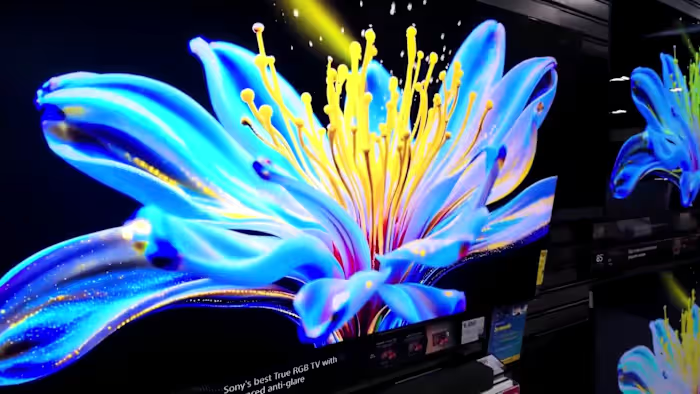


MINNEAPOLIS – A new generation of television technology has arrived in the U.S., and some industry watchers are calling it the biggest leap in picture quality since OLED sets first entered living rooms more than 10 years ago.
Known as RGB LED TVs, the new displays are designed to deliver brighter images and a much broader color range than many televisions currently on the market. Manufacturers say the screens can “produce 76% of colors the human eye can see, unlocking richer, more accurate and lifelike images customers don’t experience on current TVs.”
What makes RGB LED different from what you already own
Most TVs in homes today rely on a single white backlight that passes through color filters to build the image viewers see. RGB LED technology takes a different approach.
“The traditional LED TV that most likely you have in your home today uses a single white flashlight that shines through the screen. What gets the color on that screen is that single white light actually shines through filters that produce the color,” said Blake Hampton, senior vice president of merchandising at Best Buy.
Instead of depending on that lone white light source, RGB LED TVs use thousands of tiny red, green and blue LEDs to generate color directly. By removing the need for filters, the technology can create a wider color spectrum, stronger brightness and improved viewing angles.
How it stacks up against OLED
The last major shake-up in premium TV displays came in 2013, when OLED models began reaching consumers. Hampton and Paul Gagnon, vice president of industry analysis for the hardlines sector at Circana, a research company that monitors TV sales and market trends, both say OLED remains the benchmark for top-tier picture quality.
Still, RGB LED offers one clear advantage that OLED has struggled to match: sheer size.
While OLED TVs generally top out at 83 inches, RGB LED models can stretch to 116 inches. For shoppers chasing a massive screen without sacrificing premium picture performance, the emerging technology is quickly becoming one of the TV industry’s most closely watched developments.
“I’ve been an analyst and I’ve covered the TV industry for a couple of decades, so I’ve seen a lot of technology transitions. [RGB LED] is a pretty important one,” Gagnon said. “Some people will trade off ultimate screen size just to get that better picture quality. This is a meaningful technology for those kinds of people who are really after the best of the best.”
Do you actually need one?
Not necessarily — and experts are upfront about that.
“Any TV at all price points, if you compare what you bought in 2020 to today, is going to be really, really good. And you’re going to notice a difference,” Hampton said.
His advice? See the screens in person before deciding. Comparing picture quality alongside price is the best way to find what works for you. Best Buy has trained 15,000 staff members on the new technology to help answer questions.
Gagnon noted that premium features have historically struggled to gain traction when customers don’t fully understand what they’re buying.
“There have been times in the past when an advanced feature, a premium feature, came to market that didn’t get that level of education. And therefore, the consumer really didn’t value it properly,” he said. “Online or in unassisted sales floors, that’s difficult to do.”
What it costs
RGB LED TVs are available from Samsung, Sony, LG, TCL and Hisense, exclusively at Best Buy in the U.S. for the next year. Prices start at just over $1,000 for a 50-inch screen and climb to $30,000 for the 116-inch model. Most TVs in the 65–75-inch range run between $3,000 and $4,000, Hampton said.
Best Buy is offering free delivery, installation and mounting with purchase. The company will also haul away an old TV at no cost if the buyer does not plan to move it to another room.
What’s next for TV tech
The television industry is not slowing down. Hampton said the average screen size sold today is 65 inches, and he expects demand for even larger screens to keep growing as prices on 98-inch and 115-inch models come down.
Gagnon said one technology he has seen recently resembles the large LED displays used in arenas and concert venues.
“You see those big, bright LED billboard-type signage displays. There are smaller versions of those that are very good, but they’re mostly used in commercial applications these days and they’re very expensive,” he said. “We might see that migrate to a mainstream price point over the next five to 10 years, but it’s going to take some time.”


