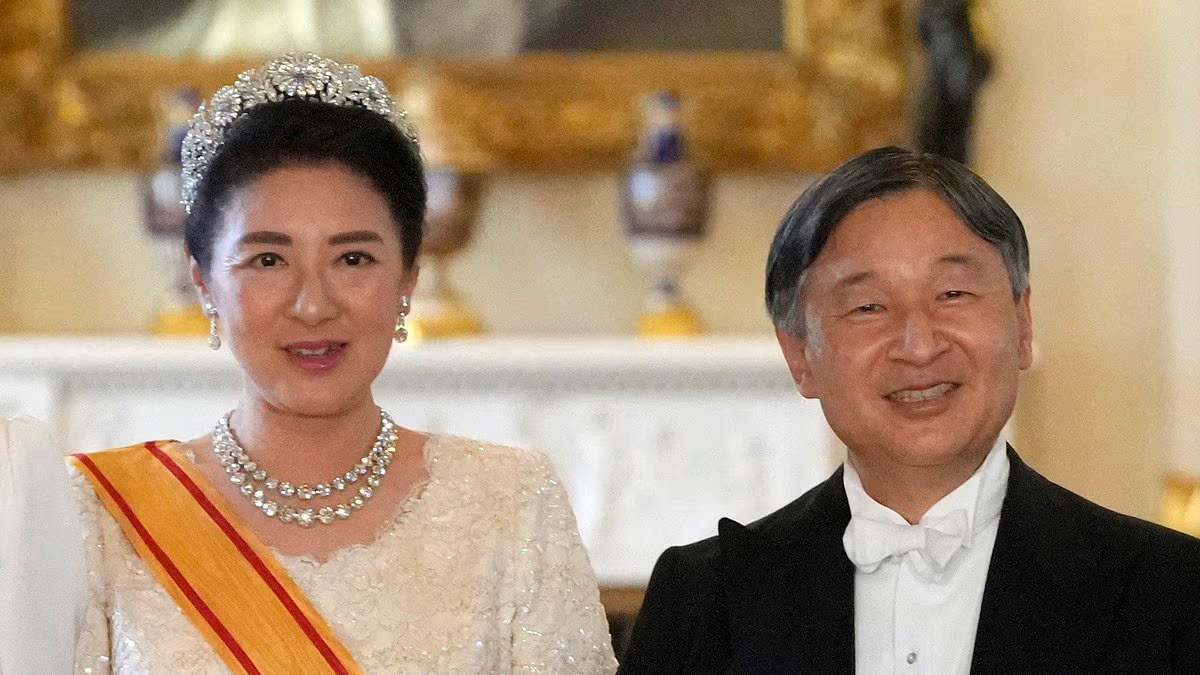

Japan’s Imperial Family has moved to ease some of its succession-related restrictions as it faces a deepening shortage of eligible heirs, though one of the monarchy’s most contentious rules remains unchanged: women still cannot inherit the Chrysanthemum Throne.
Emperor Naruhito, 66, and Empress Masako, 62, have one child, Princess Aiko, 24. She was born in 2001 after the couple underwent fertility treatment, but despite being the emperor’s only daughter, she is barred from succeeding him under current law.
The succession crisis has intensified over recent generations, with far more girls than boys born into the family. Today, the world’s oldest continuous hereditary monarchy has only three male heirs, including one who is already in his 90s.
New legislation approved last week allows the Imperial Family to adopt distant male relatives aged over 15, a measure designed to widen the pool of potential successors and ease mounting concern over the future of the royal line.
The reforms also permit female members of the family to keep their titles and continue carrying out official duties after marrying commoners. The change marks a major reversal following the case of Princess Mako, who gave up her royal status to marry her college sweetheart, Kei Komuro, in October 2021.
Mako, 34, Emperor Naruhito’s niece, was required under Japanese law to leave the Imperial Family when she married. She later relocated to New York, where Komuro works as a lawyer.
Even with the new measures, the ban on female succession remains firmly in place, leaving Princess Aiko unable to become empress despite her direct lineage.
The demographic pressures facing the Imperial Household go beyond the lack of male heirs. Seven members of the family are now over the age of 60, while only four of its members are male, underscoring the scale of the challenge confronting Japan’s monarchy.

Under new legislation, passed last week, Japan’s Imperial Family, headed by Emperor Naruhito and Empress Masako (pictured), can adopt distant male relatives over the age of 15
As it stands, Emperor Naruhito’s younger brother, Fumihito, 60, is the first in line to the throne, followed by Fumihito’s son, Prince Hisahito, 19, and thirdly, the last eligible heir is the emperor’s uncle, Prince Hitachi, who turned 90 in November.
Under the new bill, which will come into force after legal procedures, male descendants of 11 former imperial branches can be adopted into the family, despite being previously removed after the Second World War.
The new legislation marks the first amendment to the main text of the Imperial House Law since 1949, and is the biggest overhaul to the country’s imperial system in decades, the BBC reported.
Emperor Naruhito’s daughter Aiko lives a life moulded by the dynasty she’s part of – surrounded by intense security and unable to have political views or vote.
The royal lives with her parents at The Imperial Palace in Edo Castle in Tokyo and works in the Youth and Volunteer Division for the Japanese Red Cross Society, a role she combines with her royal engagements.
For now, wedded to a life of public duty, Aiko will no longer need to look to the path her first cousin, Mako Komuro, formerly Princess Mako of Akishino, took; the former royal enjoys an upper-class quiet life in New York.
In 2017, Crown Prince Fumihito’s eldest daughter sent shockwaves through the country when she announced she was giving up her royal title to marry Kei Komuro, her long-term boyfriend.
Mako and Komuro met at Tokyo’s International Christian University in 2013 and became engaged in secret before announcing their intention to marry in September 2017, sparking huge scrutiny.

Pictured: The former Princess Mako and her husband, Kei Komuro, in 2017

Japan’s royal family, the oldest continuous hereditary monarchy, is facing a succession crisis – because women still aren’t allowed to take to the throne

Emperor Naruhito’s daughter Aiko, 24, lives a life moulded by the dynasty she’s part of – surrounded by intense levels of security and unable to have political views or vote
Their wedding in October 2021 was distinctly low-key. It was met with protests and held behind closed doors without any of the pomp and pageantry of other Japanese royal weddings, which traditionally include a reception, banquet, and a parade through the streets of Tokyo.
Reading out a prepared statement, Mako defended her decision to marry, describing Kei as ‘irreplaceable’ and saying ‘our marriage is a necessary step for us to be able to protect our hearts.’
Mako also surrendered a £1million payment she was entitled to, and became the first imperial family member since World War II to not receive the money.
Now living simply as Mako Komuro, the former princess lives in a luxurious but modest – at least according to the proportions of the Imperial Palace – apartment in the Big Apple, with the pair regularly pictured on shopping trips together in the city.
The Japanese imperial family is considered to be the world’s oldest monarchy, with an unbroken line of male succession that can be traced back two millennia.
Mythology, recognised by the Imperial House, explains the legendary Emperor Jimmu, said to be a descendant of a sun goddess and a storm god, as the first of 126 Japanese emperors leading up to the current Emperor Naruhito.
European monarchies, meanwhile, have largely accepted female rulers, but a small, powerful group of traditionalists, many of whom are members of Japan’s ruling Liberal Democratic Party, say that thousands of years of tradition would be broken should women be allowed to rule.