
WASHINGTON – Four U.S. service members who died amid the latest flare-up of fighting between the United States and Iran are no longer included in the Pentagon’s official Iran war casualty total. Instead, their deaths have been shifted into a newly created, separate classification.
The change is prompting fresh scrutiny over how the military is measuring the cost to American troops as the Trump administration intensifies attacks on Iran in an effort to reopen the Strait of Hormuz. The move comes as the White House has offered limited clarity on how it plans to bring an end to a conflict that remains deeply unpopular with many Americans.
Last week, the Defense Casualty Analysis System — the database Pentagon officials have repeatedly cited as the authoritative public record for deaths and injuries tied to the conflict — removed the four fallen soldiers from its Iran war count, along with dozens of wounded personnel.
By Sunday, the system’s website displayed a new section labeled “Overseas Operations,” where the four Army deaths were listed by name alongside 207 wounded service members. It was not immediately clear whether every person included among the wounded had been hurt during the Iran conflict.
U.S. Central Command, which directs American military activity across the Middle East, directed inquiries to the Pentagon. The Defense Department did not immediately provide a response.
Pentagon previously called casualty-count changes ‘data disruptions’
Pentagon press secretary Joel Valdez said Thursday that the reduced casualty numbers appearing in the online system should not be interpreted as an attempt to obscure the war’s rising human cost. He attributed the changes to “anomalies” and “temporary data disruptions,” saying the issues were expected to be fixed “imminently.”
As recently as Tuesday, the site listed the official toll from the war at 18 dead and 482 wounded.
It appeared to reflect that four soldiers had been killed since fighting resumed despite the signing of an interim ceasefire deal last month — three on a base in Jordan that was struck July 17 by Iranian ballistic missiles and drones, and one in Iraq a day later during a controlled detonation of an Iranian drone.
Adding further confusion, when the Pentagon announced two of the deaths in Jordan, it said the troops were supporting the U.S. mission to counter the Islamic State group. The other two were announced in press releases simply as supporting overseas operations.
President Donald Trump has confirmed the total, writing in a Truth Social post on Tuesday that the “Iran Military Conflict” had claimed 18 lives.
By Wednesday, the Iran war figures in the Pentagon’s system fell back to 14 dead and 420 wounded. However, a U.S. official told The Associated Press at the time that the actual number of wounded personnel in the war had actually grown to well over 500 troops.
The Pentagon’s top spokesman, Sean Parnell, took to social media that day to assert that the reported drop was a “temporary data disruption.”
New category lists casualties following date of renewed fighting
The U.S. and Israel launched the war in Iran on Feb. 28, and 14 troops were killed in the initial waves of fighting. Washington and Tehran agreed to a ceasefire in April and then signed an interim deal to end the war in mid-June.
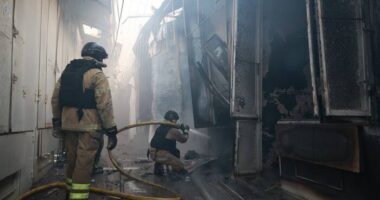
It was short-lived. Iran struck three merchant vessels in the Strait of Hormuz on July 7 that were transiting along a route near the coast of Oman overseen by the U.S. military. American forces launched strikes in response to the attacks on vessels in the key energy shipping corridor. Trump soon declared that the ceasefire was over.
The Pentagon system’s new “Overseas Operations” category says it tallies casualties starting July 7.
Since then, the U.S. and Iran have exchanged regular fire in a bid to control the crucial waterway, with the U.S. hitting Iranian targets nightly for nearly two weeks and Tehran responding with attacks on neighboring countries hosting American forces. There have been no strikes for two nights as mediators push for diplomacy.
Since the renewed hostilities began, the Pentagon has provided even less information about military strategy and casualties than it did during the first phase of the conflict. The Pentagon has not held a press briefing about the war since early May, and officials at U.S. Central Command have stopped providing casualty updates to reporters.
Pentagon officials such as Valdez and Parnell have insisted that the DCAS website is proof of the commitment to transparency about the number of dead and injured in the war.