
BANTARGEBANG – Hours before sunrise reaches Indonesia’s biggest landfill, Nur Wencih is already among the crowds of waste pickers scaling heaps of trash, scanning the piles for items that can be resold.
The 35-year-old widow has spent 20 years working at the vast Bantargebang landfill on the eastern outskirts of Jakarta, continuing a livelihood her parents still depend on. The site has helped her cover food and rent and support her two teenage daughters, who live with a relative in a rural village. What she wants most is for them to avoid the same life.
From a small rented room near the landfill, Wencih heads out to collect discarded toys, cardboard and plastic bottles before bulldozers push new loads of waste over them. On a strong day, she can make around 200,000 rupiah, or about $12. Every now and then, the search turns up something more valuable: a piece of gold jewelry.
“It feels like hitting a jackpot,” Wencih said during a pause from the oppressive July heat.
Those rare discoveries — and possibly the income she relies on — may soon be harder to come by.
Starting Aug. 1, Indonesia is set to begin shifting Bantargebang away from open dumping and toward a more regulated waste management system. The move is part of a broader national plan announced last month, under which the government will close open-dumping operations at 343 of the country’s 550 disposal sites. Those facilities will be required to move to controlled or sanitary landfill systems and, over time, take in only waste that cannot be recycled or composted, including diapers, soiled paper towels and stickers.
At the same time, households are being urged to separate organic waste and recyclable materials for different forms of processing — a routine that many Indonesian residents have never been taught to practice on a wide scale.
Dudi Gardesi Asikin, who heads Jakarta’s Environment Agency, said the new policy is intended to protect environmental health, cut pollution and reduce methane emissions produced as waste decomposes.
Methane is responsible for roughly one-third of global warming and traps more heat than carbon dioxide, making it a key focus of worldwide climate efforts. U.N. Secretary-General António Guterres, for example, is urging governments to sharply reduce methane emissions, calling it one of the fastest ways to slow global warming.
A landfill at the center of the methane debate
Researchers say Bantargebang emits more methane than nearly any other landfill in the world, placing it at the center of Indonesia’s waste management reforms.
Asikin said Bantargebang opened in 1989 as a sanitary landfill equipped to collect methane. Unlike open dumps, sanitary landfills also cover waste with soil.
But after a private-sector contract ended in 2016, the facility gradually drifted toward open dumping.
“What was never intended to be open dumping became full open dumping,” Asikin said.
Only two of the landfill’s original 12 methane extraction wells remain operational, Asikin said.
Under the new plan, parts of Bantargebang are already being covered with tarps, and officials hope to cover much more. Asikin estimated that covering the rest of the disposal area could cost as much as 200 billion rupiah ($12 million).
Uncertain future for waste pickers
Indonesia faces a dilemma as it attempts one of its biggest waste-management reforms in decades while also protecting the livelihoods of an estimated 600,000 waste pickers.
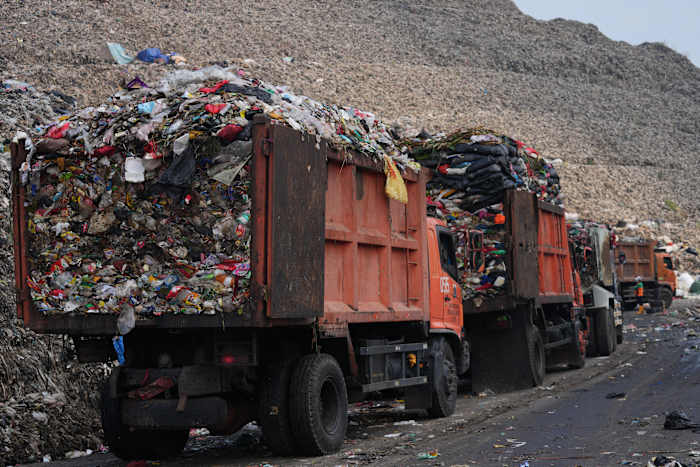
At Bantargebang alone, officials estimate more than 4,000 registered waste pickers work among trucks, excavators and mountains of garbage each day. The materials they recover are sorted and sold to a network of traders and recycling businesses that have grown around the landfill.
“What worries me most is how I will feed my family,” Wencih said of the new plan, while excavators behind her pushed fresh waste onto exposed slopes.
Asikin said the government wants to improve conditions for waste pickers, who already receive some workplace protections and healthcare through a national social security program.
He believes the new policy will eventually create safer formal jobs in recycling and composting.
“Today they are practically racing against our excavators to grab recyclable materials. It is extremely dangerous,” he said.
Bunin, a 53-year-old neighborhood chief who lives nearby, said while the landfill causes pollution, it also creates business opportunities including rental housing and food stalls catering to waste pickers.
“The landfill not only brings negative impacts, there are also economic benefits,” said Bunin, who like many Indonesians uses a single name.
A landfill at its limits
Covering roughly 110 hectares (272 acres), Bantargebang has grown into a human-made mountain reaching as high as 60 meters (196 feet), roughly the height of a 20-story building. About 7,500 tons of waste arrive daily from the capital city.
“The waste people produce does not disappear. It is gathered in one place and has become a mountain,” said Agung Pujo Winarko, who heads the facility.
A collapse triggered by heavy rain in Bantargebang in March killed seven people, underscoring the risks posed by the landfill’s sheer scale.
“This situation is extremely urgent,” Winarko said. “Its carrying capacity is reaching, or even exceeding, its limits.”
Satellite data analyzed by UCLA’s STOP Methane initiative ranked Bantargebang in 2025 as the world’s second-largest landfill methane emitter after a site in Argentina.
Evan George from UCLA’s Emmett Institute on Climate Change and the Environment said reducing organic waste entering landfills could lower emissions, but that existing landfills will still require decades of monitoring and gas collection.
Changing Jakarta’s throwaway culture
Under the new approach, Jakarta residents are expected to separate food scraps and other organic waste from recyclables and residual trash before collection. New refuse-derived fuel plants are also part of the plan.
“What we are doing is somewhat revolutionary,” Asikin said. “For decades, people were never asked to separate their waste.”
But many households are only beginning to learn the system, raising questions about whether enough public education has taken place.
“All we know is to throw the trash in the bin, not to sort it,” said Rukasih Wanti, a Central Jakarta resident. “The new rule is confusing us. It’s inconvenient, creates extra work and wastes our time.”
Asikin said multiple government institutions, including education and health ministries, are supporting the efforts.
Environmental advocates say new recycling and composting infrastructure is also needed. The transition is daunting because government data shows only about one-quarter of Indonesia’s daily waste is currently handled by formal systems, with the remainder dumped, burned or otherwise unmanaged.
David Sutasurya, executive director of the environmental organization YPBB, said about half of Jakarta’s waste is compostable and another 30% recyclable, meaning up to 80% could be kept out of landfills.
“We delayed transforming our waste-management system for too long, and only realized the problem when landfills were already close to full,” Sutasurya said.
In a West Jakarta neighborhood, Monica T. Anggriani has spent more than a decade persuading neighbors to separate household waste, building a community waste bank that now processes about one ton of organic waste daily through composting, maggot cultivation and urban farming.
“Our generation was never taught to separate waste,” Anggriani said. “If we don’t start now, nothing will change in the future.”
___
Associated Press writer Jennifer McDermott in Providence, Rhode Island, contributed to this report.
___
The Associated Press’ climate and environmental coverage receives financial support from multiple private foundations. AP is solely responsible for all content. Find AP’s standards for working with philanthropies, a list of supporters and funded coverage areas at AP.org.