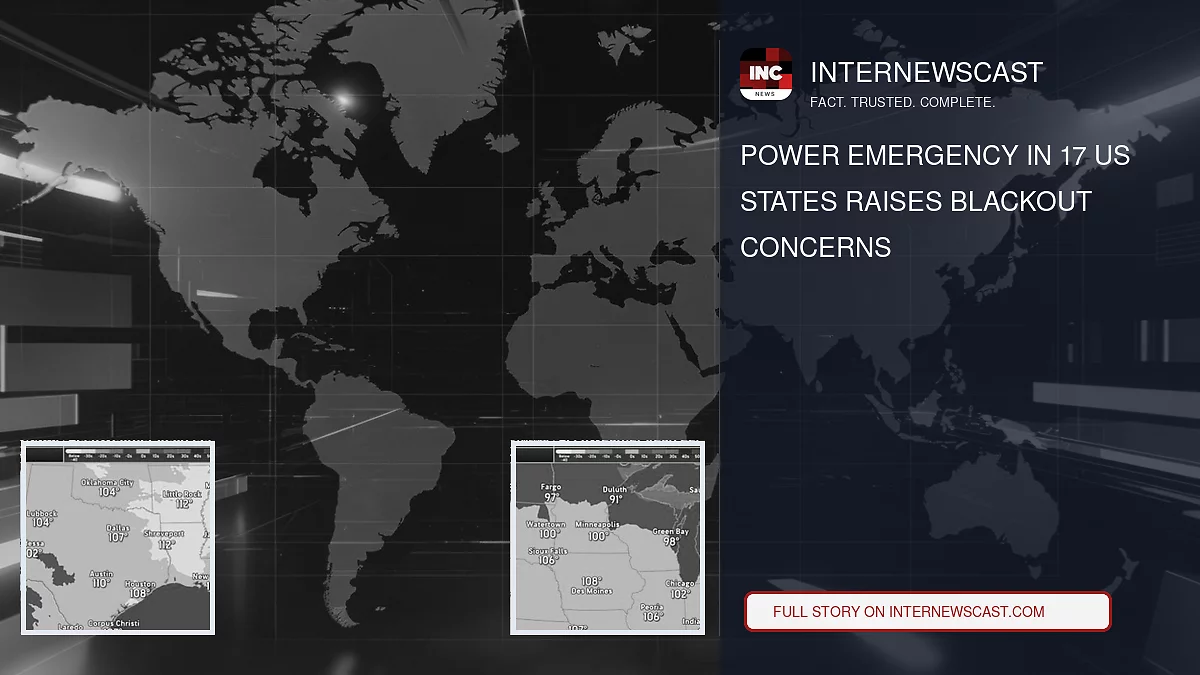

Concerns over potential power outages are mounting for roughly 20 million Americans as a dangerous heat wave drives electricity demand close to the grid’s breaking point.
On Sunday, the US Department of Energy granted emergency approval to a regional grid operator serving parts of 17 states, allowing it to bring standby power resources online to help prevent disruptions.
The authorization means power plants that typically sit idle can be used to produce additional electricity if heavy usage begins to strain available supplies.
The emergency directive applies to Arizona, Arkansas, Colorado, Iowa, Kansas, Louisiana, Minnesota, Missouri and Montana, as well as Nebraska, New Mexico, North Dakota, Oklahoma, South Dakota, Texas, Utah and Wyoming.
Under the order, Southwest Power Pool, the organization responsible for managing much of the central US electric grid, can call on backup generators if the system faces a shortage of power.
Officials described the action as the last safeguard before a Level 3 Energy Emergency Alert, a stage that could lead to rolling blackouts designed to avoid a broader grid failure.
The Department of Energy said the order will stay in place through August 3 as part of an effort to “mitigate the risk of blackouts.”
The warning comes as about 40 million people across the US remain under extreme heat alerts, with high temperatures and stifling humidity sending air-conditioning use—and electricity consumption—soaring.

The US Department of Energy (DOE) on Sunday authorized the grid operator serving parts of 17 states to deploy idle power sources to help prevent blackouts
Former DOE official Kerry Duggan said extreme heat is increasingly becoming an energy challenge rather than a simple weather event.
‘As we experience more frequent and longer-lasting heat waves, our ability to keep homes, businesses and critical facilities cool depends on having a reliable and resilient electric grid,’ Duggan said.
National Weather Service’s Monday alerts across much of that region forecast temperatures or heat indexes above 100F, with readings reaching 113F to 115F in parts of Louisiana.
Texas, Arkansas, Oklahoma, Kansas, Colorado and Nebraska were also facing dangerous conditions approaching 110F.
Meteorologists have blamed the brutal conditions on another heat dome, which traps hot air over a region and causes temperatures to climb for days.
US Secretary of Energy Chris Wright said: ‘The Trump Administration is tapping into an abundant supply of unused backup generation to maintain affordable, reliable, and secure power for hardworking American families and businesses.
‘The previous administration’s energy subtraction policies weakened the grid, leaving Americans more vulnerable during emergency events.
ALSO READ: Alexa Plus AI Upgrade Enables More Complex Voice Commands
‘Thanks to President Trump’s leadership, we are reversing those failures and using every available tool to ensure Americans have continued access to affordable, reliable, and secure energy to power and cool their homes.’

The order was issued Sunday and will remain in effect through August 3 to ‘mitigate the risk of blackouts,’ according to DOE

Meteorologists have blamed the brutal conditions on another heat dome, which traps hot air over a region and causes temperatures to climb for days
Join the discussion
What should be done to secure our power grid as extreme weather becomes more common?
DOE estimates that more than 35 gigawatts (GW) of unused backup generation remain available nationwide.
The risk of rotating blackouts escalated in SPP in the past week.
On Friday, a sudden loss of electricity imported from neighboring grids left the utility company with razor-thin reserves for possible power plant outages and falling renewable generation in its territory spanning parts of Arizona, Colorado, Montana, Nebraska, South Dakota, Wyoming and Utah.
SPP avoided outages that day by appealing for voluntary conservation of electricity to maintain reserves.
But the company expected the western territory’s highest demand of the week on Sunday evening as temperatures rose above 90F.