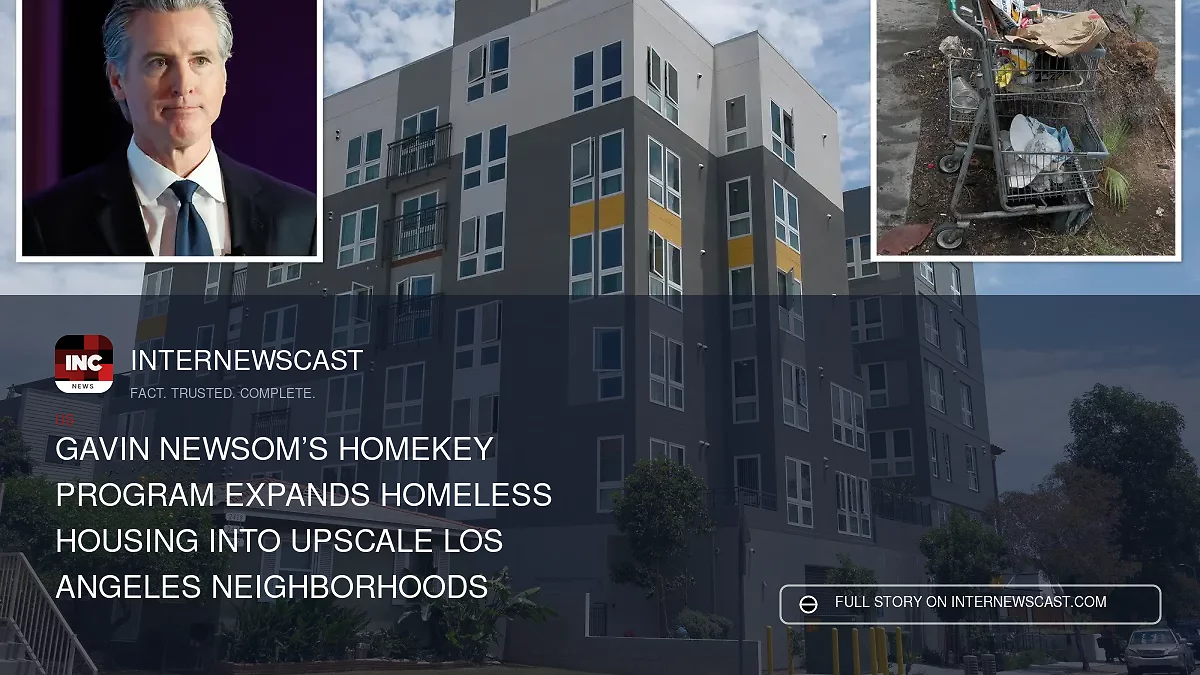

Some of Los Angeles’ most desirable neighborhoods are now home to taxpayer-funded homeless housing sites that have drawn repeated police attention.
The properties — ranging from individual supportive housing complexes to full apartment buildings — have been the subject of hundreds of LAPD calls, with at least one location generating more than 1,200, The California Post can reveal.
Records reviewed by The Post show that officers were repeatedly dispatched to nearly 50 publicly funded homeless housing developments across Los Angeles during a two-year span.
Many of those projects were backed by Gov. Gavin Newsom’s Homekey initiative, the city’s Proposition HHH bond program, or a combination of the two — funding streams that together represent more than $2 billion in taxpayer spending.
The police calls included reports of assaults, domestic violence, batteries, attempted suicides, mental health emergencies, drug activity, robberies, criminal threats and shots fired, according to the records.
Among the most notable cases is 5050 Pico Boulevard, a contemporary apartment building located only minutes from Beverly Hills and The Grove.
The property had once been promoted as a luxury rental building featuring quartz countertops, gated parking and high-end finishes. Instead, it was acquired through Newsom’s Homekey program for about $35 million — roughly $1.2 million per unit — and converted into permanent supportive housing.
LAPD records show officers were sent to the Pico Boulevard property more than 1,200 times over approximately two years for incidents including assaults, batteries, domestic violence, mental health crises, welfare checks, trespassing, suspicious-person reports and ambulance calls.
When The Post visited the property, a memorial with candles sat outside the entrance.
Neighbors said a woman died after falling from the roof while allegedly under the influence of drugs. Authorities have not publicly confirmed the circumstances surrounding her death.
Homeowner Raphael Swann said he purchased his townhouse in 2019 just a few doors down after reviewing plans for what he believed would be a luxury apartment development.
Instead, during the pandemic, the project was converted into homeless housing before it ever opened.
“I was expecting all this new construction with the Metro opening was going to be a positive thing,” Swann said. “Not this.”
“It’s incredibly demoralizing,” Swann said. “The city does absolutely nothing.” He said neighbors were never consulted before the conversion and have never been invited to meetings to address ongoing concerns.
Since 2020, Newsom’s Homekey program has committed roughly $1.3 billion to help local governments purchase hotels, motels and apartment buildings for conversion into homeless housing.
Los Angeles city and county agencies have committed roughly another $1.3 billion to renovate, complete and operate many of those same projects, bringing the regional public investment tied to Homekey developments to about $2.6 billion.
Many Homekey developments also received HHH funding, meaning some projects were financed with both state and local taxpayer dollars.
“What exactly are we getting from our taxes?” said Scott Meyers a Republican running for election to the U.S. House to represent California’s 30th Congressional District, which includes large parts of Los Angeles County.
“We defer to future generations the cost of any road maintenance, and we squeeze funding away from basic city services, yet we grant hundreds of $600,000 apartment units to vagrants which become crime scenes that can’t be addressed by our police and fire departments because they’ve suffered cutbacks of funding that was shell-gamed away to build those same apartment units.
And it’s not just “no oversight”, it all goes completely unmentioned by the Democrats in City Hall, all the way up to our United States Congressional representatives,” said Meyers.
Another high-profile example is The Iris on Barry Avenue in West Los Angeles near Sawtelle.
Originally planned as a luxury apartment building, the project later received nearly $7 million in Proposition HHH funding to convert part of the property into permanent supportive housing.
The development includes 61 apartments, including 34 supportive housing units for formerly homeless residents. Police records reviewed by The Post document repeated responses for assaults, batteries, domestic violence, attempted suicides, burglaries and mental health emergencies.
The property also became the focus of one of the neighborhood’s most disturbing crimes.
Prosecutors alleged Ishmail Bangura, whom police identified as living at The Iris, ran naked from the building on Feb. 27, 2025, before allegedly breaking into a nearby apartment, attacking a 3-year-old child and attempting to sexually assault a 63-year-old woman.
Bangura had been arrested twice in the days before the attack.
He later pleaded no contest to assault with intent to rape, first-degree burglary and felony child abuse, while admitting he committed the crimes while released on another pending case.
Units in unfavorable neighbors are also a hotspot for police calls, taking up significant police resources.
601 San Pedro Street generated roughly 750 police calls, while nearby 566 San Pedro Street logged about 840 responses involving fights, cutting injuries, reports of people armed with guns and knives, shots fired and narcotics activity.
Other developments also generated significant police activity. Officers responded about 390 times to 517 San Julian Street for trespassing, attempted suicide and criminal threats.
Neighboring properties at 527 and 543 Crocker Street generated more than 420 combined calls involving domestic violence, batteries, trespassing and reports of armed groups.
The California Post requested comment from Gov. Gavin Newsom and Mayor Karen Bass.