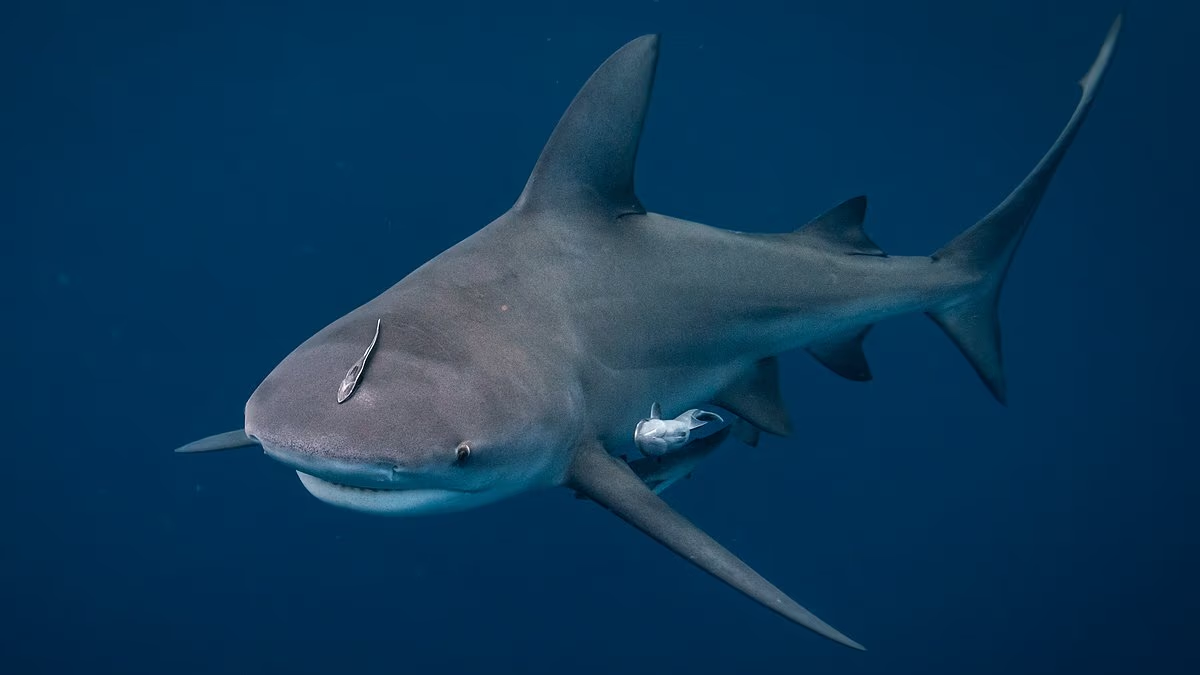

A shark attack survivor who lost a hand and a leg in a near-deadly encounter in Australia says researchers have identified the “dinner bell” conditions that can drive aggressive bull sharks toward humans.
Paul De Gelder, an Australian military veteran, was severely injured in 2009 when he was attacked during a counterterrorism training exercise in Sydney Harbor.
De Gelder has since become a conservationist and a familiar face on Discovery’s annual Shark Week. In his latest special, Bull Shark Dinner Bell, airing Monday at 8pm ET, he explores three key factors that can combine to heighten the risk of bull shark attacks in waters around the world.
In experiments conducted off the Florida coast, apex predator specialist Rosie Moore found that rainstorms, vibrations caused by diving or fishing, and waters rich with fatty fish can lure bull sharks into dense activity near people — and potentially trigger bites.
Although most of the roughly 500 shark species generally avoid humans, bull sharks are different in important ways. They thrive in temperate waters and are often described as ambush predators.
They are widely considered the leading suspect in many shark attacks worldwide, with 10 biting incidents already attributed to bull sharks in 2026, according to the Global Shark Attack File, a public database that records cases dating back to the 1940s.
Speaking during the Shark Week special, De Gelder said: “If you go through the Global Shark Attack Files since 2025, bull sharks are responsible for twice as many attacks as tiger sharks, and even 25 percent more than great whites.
“If they chose to, they could kill you, but they more often than not don’t.”

Wildlife experts have warned that bull sharks are not afraid to swim near people

Paul De Gelder lost his right hand and leg in a shark attack during a military exercise in Australia in 2009
De Gelder traveled to Florida, the bull shark capital of the US, to team with Moore to figure out why bull shark attacks have been on the rise and what humans are doing to set off the ‘dinner bell.’
Moore said on the Discovery Channel: ‘With bull sharks, there’s usually a number of factors that lead up to that bite.’
They traveled to Jupiter Ledge, a bull shark hotspot near Palm Beach, where the predators immediately gathered around their boat.
One constant factor tied to bull shark attacks has been rain, with researchers believing that storms potentially agitate the creatures by making countless vibrations on the surface of the ocean.
Moore dove into the Atlantic near a pack of five to six bull sharks, while De Gelder activated a water pump that simulated rainfall. It instantly attracted more sharks to the area, which were moving faster as the rain came down.
‘I think the bull sharks might associate the raindrops on the surface with other fish. They detect the tiniest vibrations. They can literally see with their eyes closed,’ Moore explained.
She added that these extraordinary sensors allow sharks to hunt even in the darkest waters.
‘The rain has definitely triggered a more aggressive response. They’re faster, bolder, more willing to bite,’ Moore said. ‘Rain is definitely a factor we need to ring this dinner bell.’

The predators swarm a crate of food researchers lowered into the Atlantic to discover which type of fish meat attracts bull sharks

Apex predator specialist Rosie Moore discovered three key factors that cause bull sharks to attack humans in a Shark Week special airing on Discovery on Monday
Since the sharks clearly showed a desire to swarm near the ocean surface and attack live fish during rainstorms, the team also tested different types of bait, including lean fish meat like grouper and oily and fatty fish like bonito.
De Gelder and Moore brought a crate of each meat type down into the open water of the Atlantic, and watched as a group of bull sharks bumped and headbutted the boxes – a behavior they engage in before attacking potential prey.
Oddly, when the team dropped in a third crate full of pork to simulate human flesh and blood, the bull sharks ignored the meat.
Instead, the predators chose to attack the crate full of oily and fatty fish when hunting, which Moore and De Gelder said was a critical clue as to what sets off the dinner bell for the deadly sharks.
Moore explained: ‘By knowing what seasonal fish migration patterns overlap with the bull shark populations, that can help us advise people on when they should stay out of the water because the sharks might be hunting.’

Multiple bull sharks swarm in Jupiter Ledge, a hotspot for the species near Florida’s Palm Beach

De Gelder returned to bull shark-infested waters near Florida to research what causes them to attack people for Discovery’s Shark Week
The researchers then looked at how human behavior could trigger a bull shark attack, since these creatures, like other shark species, are highly sensitive to vibrations.
One activity that has been frequently tied to bull shark attacks is spearfishing.
While De Gelder caught a fish with a speargun from the boat, Moore watched in scuba gear as a bull shark charged in to attack the struggling fish. Nearly a dozen more bull sharks moved into the area to bump Moore and her cameraman.
‘Bull sharks are interesting because it’s almost like they get a sense of FOMO. It triggers an uptick in aggression from the other sharks around it because if you’re a shark in the ocean, there’s not necessarily a grocery store for you to go to; you have to compete for that available prey,’ Moore said.
In one final experiment, De Gelder tested the sharks’ reactions by jumping into the ocean, triggering a massive splash and vibration.
‘As soon as I hit the water, they came to investigate,’ De Gelder said.
The sharks were seen putting both pectoral fins down, a sign they were extremely agitated, with one actually biting De Gelder’s scuba fin.

A bull shark and another, smaller shark were spotted in early July off the New York coast, triggering bans on swimming for beachgoers
When the team put all of these factors together – rainfall, the presence of oily and fatty fish meat and a human diving directly into an area with sharks – the bulls immediately moved to attack De Gelder.
‘As soon as I hit the surface with the rain, the bait in the water, it was like the perfect storm,’ he said.
Not only were the bull sharks agitated, but more were attracted to the area and the predators began to attack one another.
‘I have never seen bull sharks behave like this,’ Moore declared. ‘You can literally see how if all these elements lined up and you had somebody in the water that was not prepared, they would not stand a chance. The dinner bell has rung.’
Moore noted that there were ways to peacefully coexist with sharks, but certain conditions, including rainfall, fatty fish in the area and too much human activity disrupting the water, create a deadly recipe for a shark attack.
‘Truly assess the conditions before you enter the water, it could save your life,’ De Gelder said.